
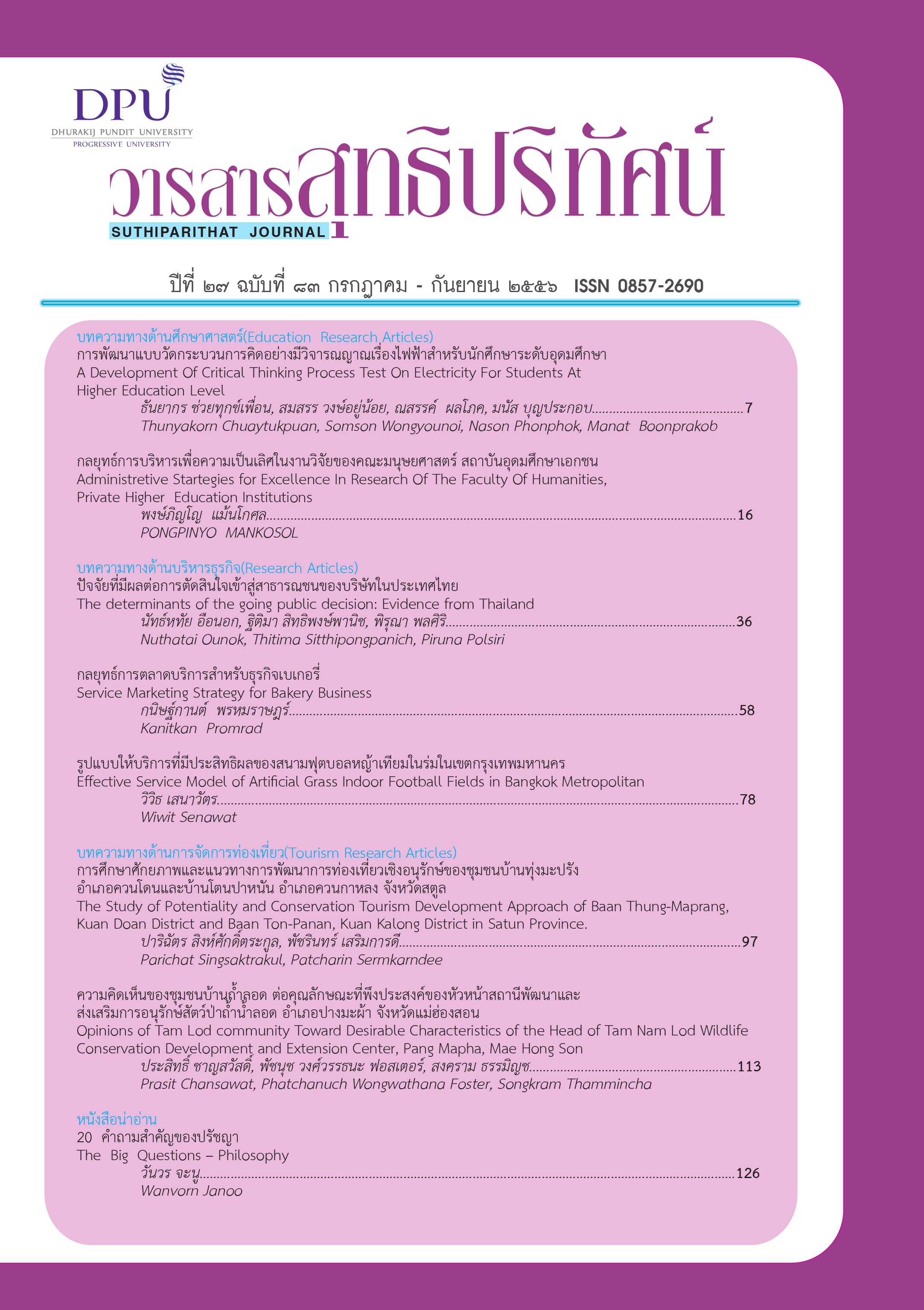
THE DETERMINANTS OF THE GOING PUBLIC DECISION: EVIDENCE FROM THAILAND
Keywords:
Going Public, Initial Public Offerings (IPO), Business Groups, ThailandAbstract
The objective of this research is to investigate the determinants of the going public decision of companies in Thailand, using 1,210 companies operating during the period 2000 - 2005. Our probit model includes a business group variable. To mitigate asymmetric information problems and imperfect capital markets, business groups are important in emerging economies. They are considered as an internal capital market for member firms, which have difficulty in accessing to external finance. However, business groups may cause an inefficient resource allocation among member firms, unproductive investments, and agency problems between major shareholders and minority shareholders of listed companies in the group. Our results show that group firms are more likely to go public than non-group firms so that they could allocate external funds obtained from other shareholders to member firms. In addition, larger companies are more likely to go public because they have lower asymmetric information problems, compared to smaller firms. Nevertheless, firm age and profitability are negatively related to the probability of an IPO. Younger firms tend to have adverse selection problems, resulting in a limited access to other external finance. Consistent with the pecking order theory, firms with higher profitability are less likely to go public because they have sufficient internal fund from retained earnings. Our findings provide several implications. First, although the high probability to go public of group firms is beneficial for the capital market development, relevant authorities should strengthen mechanisms in prohibiting potential expropriation of minority shareholders. Second, the capital market should promote long-established firms to list in the stock market because these firms have better reputation and creditability, thus attracting more investors. Last, in order to support the growth of young companies, financial institutions should provide them an easier access to external sources of funds. This, in turn, helps improve the country’s economic development.
References
สุมาลี อุณหะนันทน์. (2550). การบริหารการเงิน. พิมพ์ครั้งที่ 6. กรุงเทพมหานคร: สำนักพิมพ์จุฬาลงกรณ์มหาวิทยาลัย
Albornoz, B. G. and Pope, P. F. (2004). The determinants of the going public decision: evidence from the U.K. Working paper.
Aslan, Hadiye, and Praveen Kumar. (2007). Going Public and Going Private: What Determines the Choice of Ownership Structure?, Working paper.
Bancel, F., and U. R. Mittoo. (2008). Why European firms go public?. Working paper.
Belenzon, S., and Berkovitz, T. (2008). Business Group Affiliation, Financial Development and Market Structure: Evidence from Europe. Working paper.
Bhattacharyam, S., and Ritter, J.R. (1983). Innovation and Communication: Signaling with Partial Disclosure. Review of Economic Studies, 50, 331-346.
Brau, James, Bill Francis, and Ninon Kohers. (2003). The Choice of IPO versus Takeover: Empirical Evidence. Journal of Business, 76, 583-612.
Brau, J., Lambson, V.E., and McQueen, G. (2005). Lockups Revisited. Journal of financial and quantitative analysis, 2005, 40 (3), 519-530.
Brau, J. C., and Fawcett, S.E. (2006). Initial Public Offerings: An Analysis of Theory and Practice. Journal of Finance, LXI (1), 399-436.
Campbell, Tim. (1979). Optimal Investment Financing Decisions and the Value of Confidentiality. Journal of Financial and Qualitative Analysis, 14, 913-924.
Chemmanur, Thomas, and Paolo Fulghieri. (1999). A Theory of the Going-Public Decision. Review of Financial Studies, 12 (2), 249-279.
Chemmanur, T. J., S. He and D. Nandy. (2005). The going-public decision and the product market, Working paper, Boston College.
Claessens, S., Fan, J. P. H., and Lang, L. H.P. (2002). The Benefits and Costs of Group Affiliation: Evidence from East Asia. Working paper.
Ferris, S. P., Kim, K. A., and Kitsabunnarat, P. (2003). The costs (and benefits?) of diversified business groups: The case of Korean chaebols. Journal of Banking & Finance, 27, 251-273.
Fischer, C. (2000). Why Do Companies Go Public? Empirical Evidence from Germany’s Neuer Markt. Working paper.
George, R., and Kabir, R. (2008). Business groups and profit redistribution: A boon or bane for firms?. Journal of Business Research, 61, 1004-1014.
Gleason, K., Payne B., and Wiggenhorn J. (2007). An Empirical investigation of going private decisions of U.S. Firms. Journal of Economics and Finance, 31, 207-218.
Gopalan, R., Nanda, V., and Seru, A. (2007). Affiliated firms and financial support: Evidence from Indian business groups. Journal of Financial Economics, 86, 759-795.
Huyghebaert, N. and C.V. Hulle. (2005). Structuring the IPO: Empirical evidence on the portions of primary and secondary shares. Journal of Corporate Finance, 12 (2), 296-320.
Khanna, T. and Palepu, K. (2000). Is Group Affiliation Profitable in Emerging Markets? An Analysis of Diversified Indian Business Groups. Journal of Finance, LV (2), 867-891
Khanna, Tarun, and Yishay Yafeh. (2005). Business Groups and Risk Sharing Around the World. Journal of Business, 78, no. 1, 301-340.
Kim, W., and M. S. Weisbach. (2005). Do firms go public to raise capital?. NBER Working paper, February.
Kim, Jeong-Bon., and Yi, Cheong H. (2005). Ownership Structure, Business Group Affiliation, Listing Status, and Earnings Management: Evidence from Korea. Working paper.
Maksimovic, V. and P. Pichler. (2001). Technological innovation and initial public offerings. Review of Financial Studies, 14, 459-494.
Mayur, M., and Kumar, M. (2006). An Empirical Investigation of Going Public Decision of Indian Companies. Working paper.
Myers, S. C. (1984). The capital structure puzzle. Journal of Finance, 39, 575-592.
Myers, S. C., and N. S. Majluf. (1984). Corporate financing and investment decisions when firms have information
that investors do not have. Journal of Financial Economics, 13, 187-221.
Pagano, M., F. Panetta, and L. Zingales. (1998). Why Do Companies Go Public? An Empirical Analysis. Journal of Finance, 53 (1), 27-64.
Pannemans, S. (2002).Going Public: Opportunism or Necessity? Empirical Evidence from Belgian IPOs. Working paper.
Polsiri, P., and Wiwattanakantang, Y., (2004). Business Groups in Thailand: Before and after the East Asian Financial Crisis. Center for Economic Institutions. Working paper series, vol. 13, 1-43.
Rajan, R., and L. Zingales. (1998). Financial Dependence and Growth. American Economic Review, 88, 559-586.
Ritter, J. R. (1987). The Costs of Going Public. Journal of Financial Economics, 19 (2), 269-281.
Ritter, J. R. (1991). The Long-Run Performance of Initial Public Offerings. Journal of Finance, 46, 3-27.
Ritter, J. R., and I. Welch. (2002). A Review of IPO Activity, Pricing, and Allocations. Journal of Finance, 57 (4), 1795-1828. Rosen, R.J., Smart, S. B., and Zutter, C.J. (2005). Why Do Firms Go
Public? Evidence from the Banking Industry. Working paper. Welch, Ivo. (1989). Seasoned offerings, imitation costs, and the underpricing of initial public offerings. Journal of Finance, 44, 421-449.
Shen, Yang-Pin, and Wei. P. (2007). Why do companies choose to go IPOs? New results using data from Taiwan. Journal of Economics and Finance, 31 (3), 359-367.
Yosha, Oved. (1995). Information disclosure costs and the choice of financing source. Journal of Financial Intermediation, 4, 3-20.
ตลาดหลักทรัพย์แห่งประเทศไทย. (2552). แผนพัฒนาตลาดทุนไทย. ค้นเมื่อ 15 ธันวาคม 2552, จาก http://www.sec.or.th/sec/ppt_CMP_Master.pdf
ตลาดหลักทรัพย์แห่งประเทศไทย. (2551). ข้อมูลการเข้าจดทะเบียน. ค้นเมื่อ 21 พฤศจิกายน 2551, จาก http://www.set.or.th/
th/products/listing/info_p1.htmlhttp://www.set.or.th/th/products/listing/info_p1.html
สำนักงานคณะกรรมการกำกับหลักทรัพย์และตลาดหลักทรัพย์. (2551). การออกและเสนอขายหลักทรัพย์. ค้นเมื่อ 15 กุมภาพันธ์ 2551, จากhttp://www.sec.or.th/securities_issuance/Content_0000000007.jsp?categoryID=CAT0000066&lang=th
Word Federation of Exchanges. (2011). WFE Annual report and statistics. Retrieved May 8, 2012, from http://www.world-exchanges.org/files/statistics/excel/WFE11%20final.pdf
Downloads
Published
How to Cite
Issue
Section
License
Content and information of the article published at Suthiparithat Journal are based on the sole opinions and responsibility of author(s) only. Neither the editorial board involve in......





