
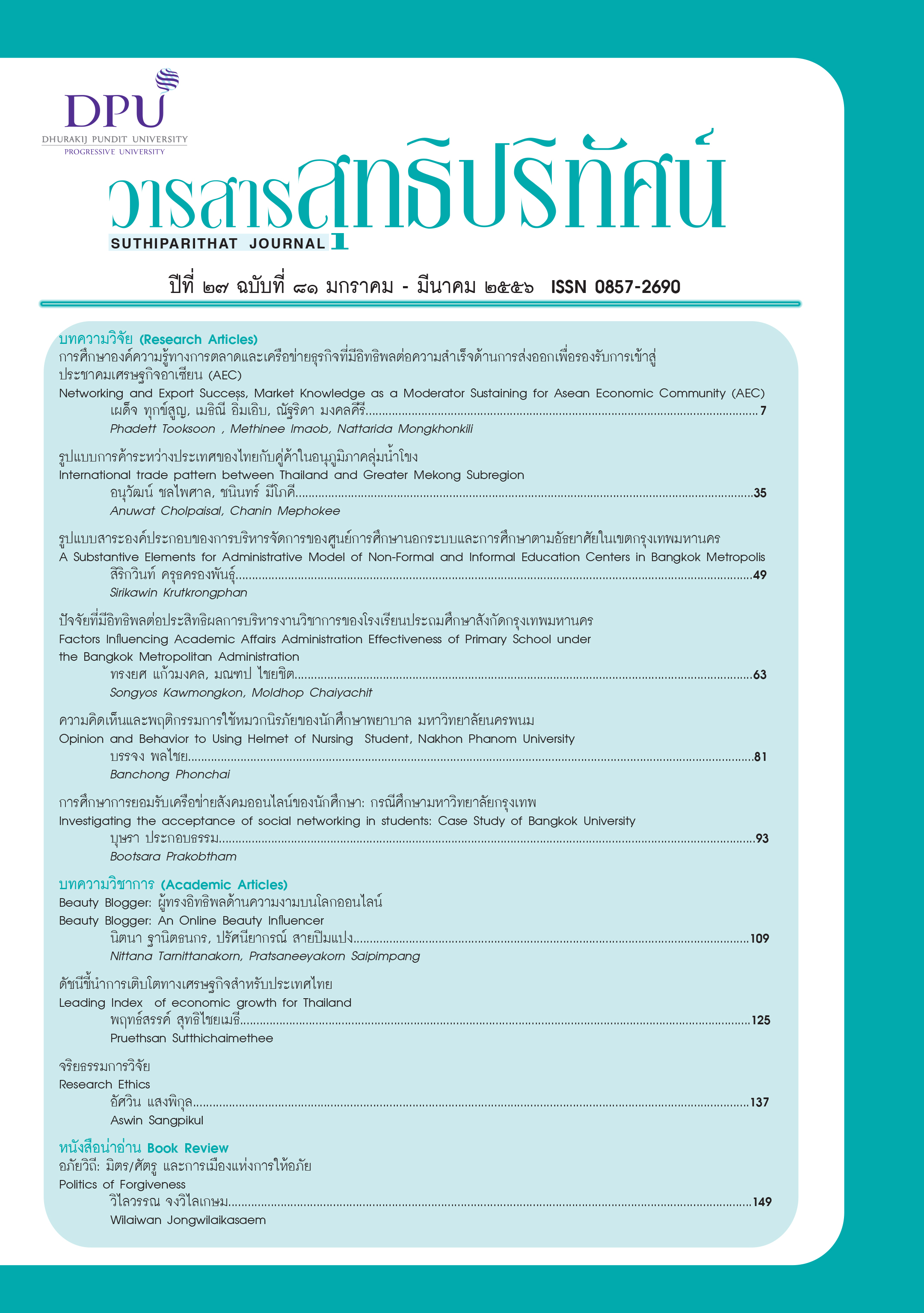
INVESTIGATING THE ACCEPTANCE OF SOCIAL NETWORKING IN STUDENTS: CASE STUDY OF BANGKOK UNIVERSITY
Keywords:
Social Networking, Technology Acceptance Model (TAM), Bangkok UniversityAbstract
Objectives of this research were to study the effect of factors to the students’ to acceptance of social networks and the influence of them by using Technology Acceptance Model (TAM). The research was the survey research and used the questionnaire to collect the data. The samples of the research were 400 undergraduate students in Bangkok University, randomly selected using the stratified sampling according to the proportion of the students across faculties. The results showed that perceived ease of use, perceived usefulness and influencing of social significantly influenced to the students’ attitude to use social networks of the students which significantly affected to their intention to use at 0.01 level. This finding, educational institute could utilize the results to distribute information quickly and easily through social networks. In additional, teachers could use them as a channel to easy communicate with their students more effectively.
Downloads
References
Agarwal, P., & Prasad, J. (1997). The Role of innovation characteristic and perceived voluntariness in the acceptance of information technologies. Decision Sciences, 28, 557-582.
Ajjan, H., & Fishbein, M. (1980). Understanding attitudes and predicting behavior. Englewood Cliffs, NJ: Prentice Hall.
Ajjan, H., & Hartshorne, R. (2008). Investigating faculty decisions to adopt Web 2.0 technologies: Theory and empirical tests. The Internet and Higher Education, 11(2), 179-211.
Davis, F. D. (1989). Perceived usefulness, perceived ease of use, and user acceptance of information technology. MIS Quarterly, 13(3), 319-339.
Davis, F. D., Bagozzi, R., & Warshaw, P. (1989). User acceptance of computer technology: A Comparision of two theoretical models. Management Science, 35, 982-1003.
Erickson, T. (2002). Some problems with the notion of context-aware computing. Communications of the ACM, 45, 102–104.
Fishbein, M., & Ajzen, I. (1975). Belief, attitude, intention, and behavior: An Introduction to theory and research. MA: Addison-Wesley, Reading.
Internet Usage Statistics. (2011). Retrieved June 25, 2012, from http://www.internetworldstats.com/stats.htm
Jackson, C., Chow, S., & Leitch, R. (1997). Toward an understanding of the behavioral intention to use an information system. Decision Sciences, 28, 357-389.
Kwon, O. (2004). Modeling and generating context-aware agent-based applications with amended colored petri nets. Expert Systems with Applications, 27, 609–621.
Mason, R. (2006). Learning technologies for adult continuing education. Studies in Continuing Education, 28(2), 121-133.
Venkatesh, V. (1999). Creation of favorable uses perceptions: Exploring the role of intrinsic motivation. MIS Quarterly, 23, 239-260.
Venkatesh, V., Morris, M., Davis, G., & Davis, F. (2003). User acceptance of information technology: Toward a unified view. MIS Quarterly, 27, 425–478.
Yamane, Taro. (1973). Statistics: An Introductory Analysis (3rd ed.). New York: Harper and Row Publication.
Downloads
Published
How to Cite
Issue
Section
License
Content and information of the article published at Suthiparithat Journal are based on the sole opinions and responsibility of author(s) only. Neither the editorial board involve in......



