
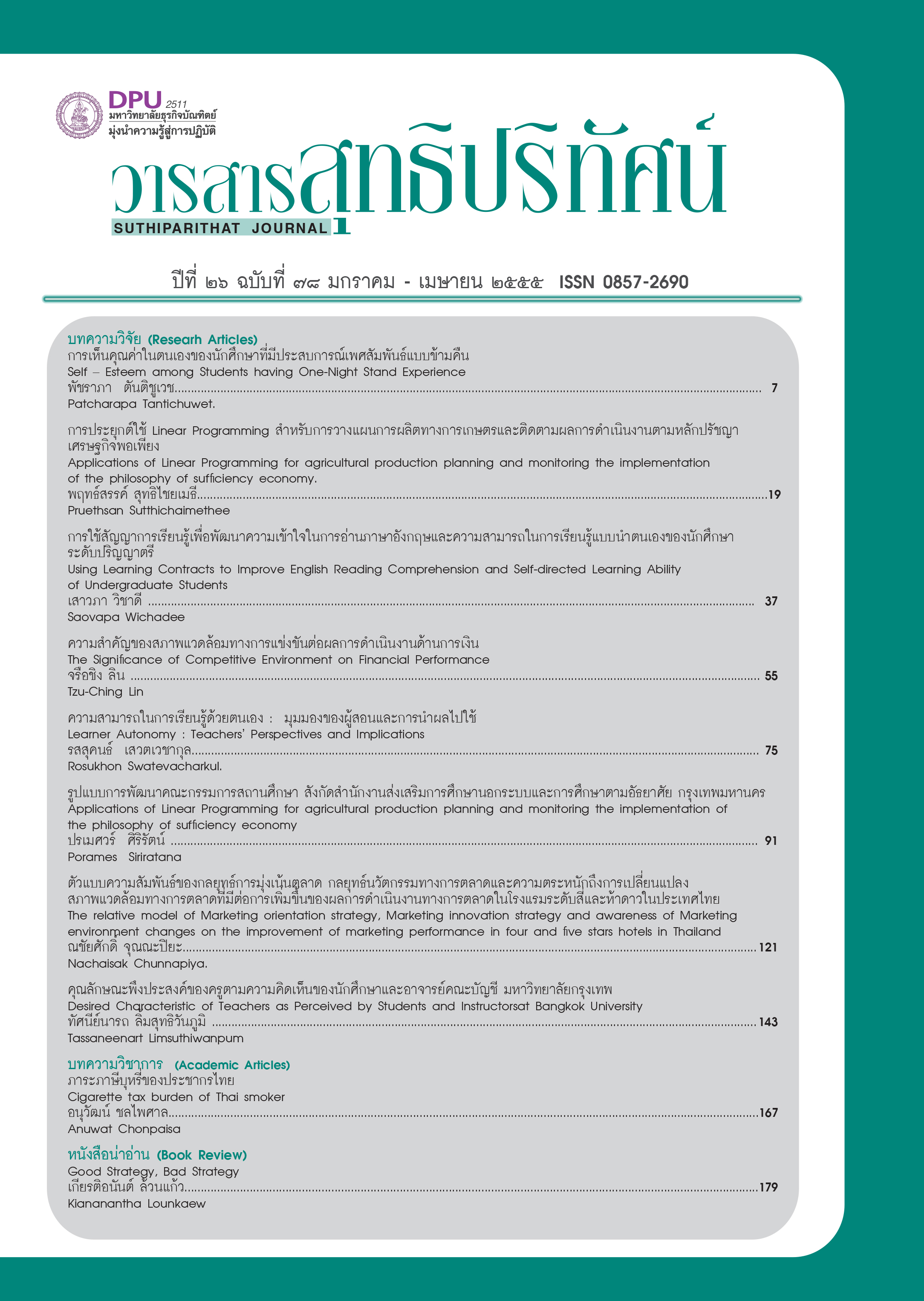
LEARNER AUTONOMY : TEACHERS’ PERSPECTIVES AND IMPLICATIONS
Keywords:
teachers’ perspectives, learner autonomy, English learning, teacher roleAbstract
In the area of learner autonomy, the emphasis has been put on learners and teaching them how to learn; therefore, teachers have a vital role to play in developing learner autonomy. The objective of this study was to investigate the teachers’ perspectives of learner autonomy. Their perspectives could shed light on their readiness for learner autonomy development. This study took the form of survey research using a questionnaire and interviews to collect data from 155 teachers teaching English in five private universities in the Bangkok Metropolis. The questionnaire consisted of 4 domains which are of importance to learner autonomy, teacher’s responsibilities, self-confidence of Thai students, and capacity of Thai students. Scores of the 5-point Likert Scale questionnaires were computed to find mean score and standard deviation (SD). The findings revealed that on average, teachers highly hold positive perspectives of learner autonomy (M = 3.53, SD = 0.33). Further analysis of each domain showed that the mean of the importance of learner autonomy was very high (M = 4.46, SD = 0.45). The mean of the teacher’s responsibilities domain was high (M = 3.78, SD = 0.45). The mean of the self-confidence of Thai students domain was moderate (M = 2.83, SD = 0.81) and the capacity domain was moderate (M = 3.14, SD = 0.56). Discussions were done along with implications of both theoretical and pedagogical dimensions.
References
Benson, P. (2001). Teaching and researching autonomy in language learning. London: Longman.
Breen, M. and Mann, S. (1997). Shooting arrows at the sum: perspectives on a pedagogy for autonomy. In P. Benson & P. Voller (Eds.), Autonomy & Independence in Language Learning. London: Longman, 132-149.
Chan, V. (2003). Autonomous language learning: teachers’ perspectives. Teaching in Higher Education. 8: 33-54.
Cotterall, S. (1995). Readiness for autonomy: investigating learner beliefs. System. 23 (2): 195-205.
Dam, L. (2003). Developing learner autonomy: the teacher’s responsibility. In D. Little, J. Ridley, and E. Ushioda (Eds.), Learner Autonomy in the Foreign Language Classroom. Authentik, 135-146.
Dornyei, Z. (2001). Motivational strategies in the language classroom. Cambridge: Cambridge University Press.
Hofstede, G. (1986). Cultural differences in teaching and learning. International Journal of Intercultural Relations. 10: 301-320.
Johnson. J., Pardesi, H. and Paine, C. (1990). Autonomy in our primary school. In I. Gathercole (Ed.), Autonomy in Language Learning. London: CILT, 46-54.
Little, D. (1990). Autonomy in language learning. In I. Gathercole (Ed.), Autonomy in Language Learning. London, CILT: 7-15.
Little, D. (1995). Learning as dialogue: the dependence of learner autonomy on teacher. System. 23 (2): 175-181.
Shaw, J. (2008). Teachers working together: What do we talk about when we talk about autonomy? In T. Lamb & H. Reinders (Eds.), Learner and Teacher Autonomy. Amsterdam/Philadelphia: John Benjamins Publishing Company, 187-204.
Swatevacharkul, R. (2010). Are Tertiary Students Ready for Learner Autonomy? Suthiparithat. 74: 39-60.
Ushioda, E. (1996). Learner autonomy 5: The role of motivation. Dublin: Authentik. Waterhouse, P. (1990). Supported self-study across the curriculum. In I. Gathercole (Ed.), Autonomy in Language Learning. London: CILT, 4-6.
Wenden, A. (1987). Conceptual background and utility. In A. Wenden & J. Rubin (Eds.), Learner Strategies in Language Learning. Hertfordhire: Prentice Hall International, 3-13.
Downloads
Published
How to Cite
Issue
Section
License
Content and information of the article published at Suthiparithat Journal are based on the sole opinions and responsibility of author(s) only. Neither the editorial board involve in......





