
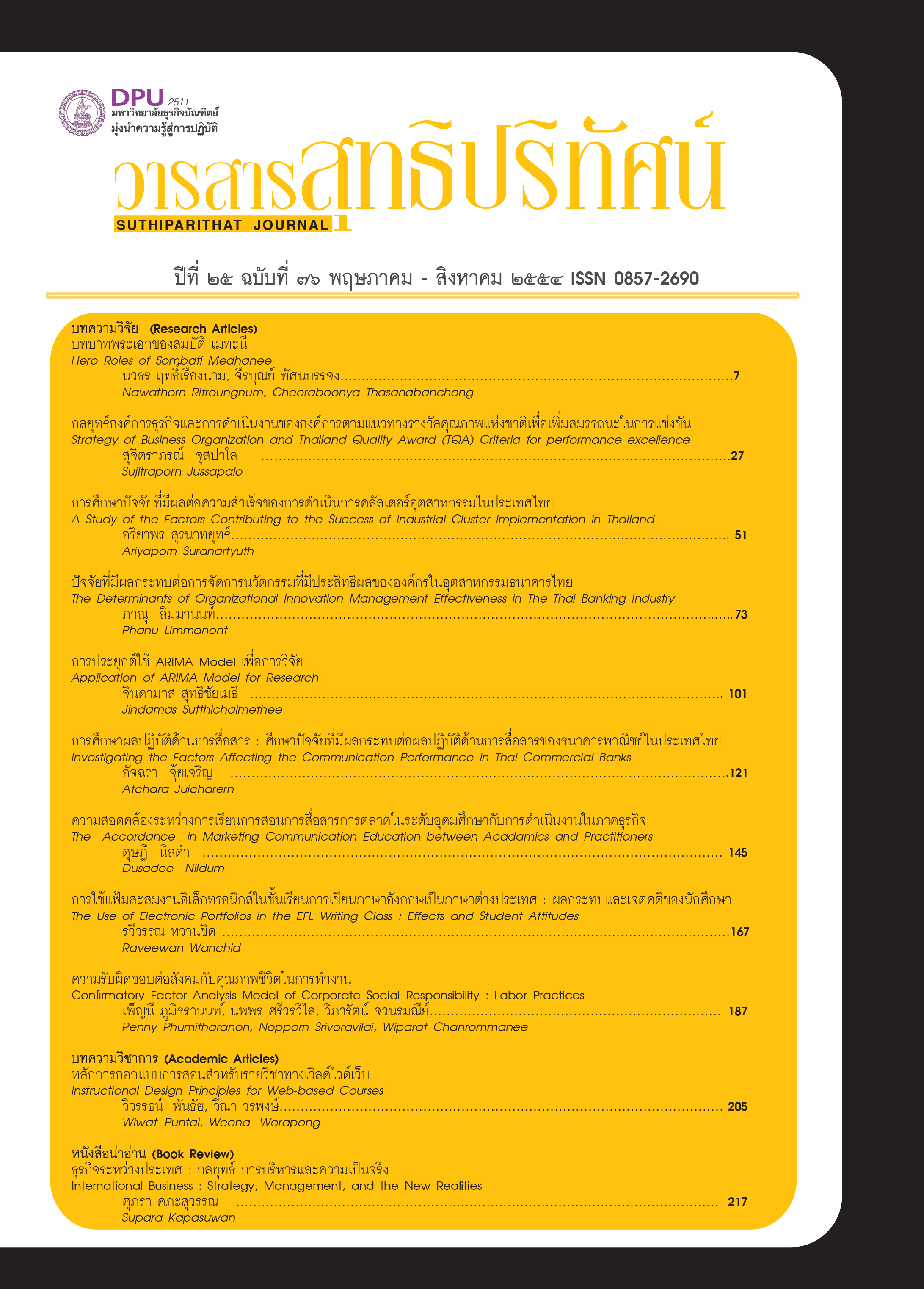
INVESTIGATING THE FACTORS AFFECTING THE COMMUNICATION PERFORMANCE IN THAI COMMERCIAL BANKS
Keywords:
Communication, Effective Communication, Organizational Communication, Goal Clarity, Intercultural Communication Competence, Organizational Culture, DecentralizationAbstract
Despite the acknowledgement that communication is a key to organizational effectiveness, study of the factors affecting the communication performance in organizations is scarce. This research focuses on investigating the relationships of goal clarity, organizational culture, decentralization, and intercultural communication competence with communication performance in the context of Thai commercial banks.
A survey was conducted at the bank branches of seven Thai commercial banks. Due to the nature of the exploratory model of communication performance, some of the relationships among the variables have not been prominently established in the past; therefore the correlation method was used to analyze the relationships of the constructs.
The findings are (a) Goal clarity has received strong statistical support as a key factor in communication performance, followed by organizational culture, decentralization, and intercultural communication competence. (b) However, when analyzing the relationships of these key factors with each communication performance domain (i.e. interpersonal, external, and internal communication performance), it can be seen that all of the factors are positively related to internal and external communication, but not to interpersonal communication.
Downloads
References
Arasaratnam, L. A. 2009. The Development of a New Instrument of Intercultural Communication. Journal of Intercultural Communication. Retrieved 20 May, 2009. from http/www.immi.se/intercultural/.
Bank of Thailand. 2008. Financial Data of Commercial Banks. Retrieved April 18, 2008 from http://www.bot.or.th/English/Statistics/ FinancialInstitutions/CommercialBank/Pages/StatNumberofBranches.aspx
Berger, C. R and Calabrese, J. J. 1975. Some Explorations in Initial Interaction and Beyond: Toward a developmental theory of Interpersonal Communication. Human Communication Research. 1 (1): 99-112.
Burns, T and Stalkers, G. M. 1961. The Management of Innovation. London: Tavistock.
Byrne, Z. S and LeMay, E. 2006. Different media for organizational communication : perceptions of quality and satisfaction. Journal of Business and Psychology. 2 (2): 149-173.
Cheney, G and Christensen, T. 2000. Linkages between internal and external communication. In the New Handbook of Organizational Communication: Advance in Theory, Research, and Methods. edited by Jablin, F.M. and Putnam, L.L.Thousand Oaks. CA:Sage.
Chintana Monthienvichienchai, Chintawee Kasemsuk, Sirintorn Bhibulbhanuwat, and Speece,M. 2002. Cultural Awareness, Communication Apprehension, and Communication Competence: a Case Study of Saint John’s International School. The International Journal of Education Management. 16 (6): 288-296.
Chun, Y.H. and Rainey, H. G. 2006. Consequences of Goal Ambiguity in Public Organizations. in Public Service Performance. edited by G. Boyne, G., Meier, K., L.O’Toole Jr., and Walker, R.New York: Cambridge University Press. Pp. 92–112.
Conrad, C and Poole, M. S. 2002. Strategic Organizational Communication in a Global Economy. Orlando: Harcourt College.
Deal, T. E and Kennedy, A. A. 1982. Corporate Cultures: The Rites and Rituals of Corporate Life. Reading, MA: Addison-Wesley Publishing Co.
Drucker, P. 1974. Management: Tasks, Responsibilities, Practices. New York: Harper and Row
Fantini. A. E. 2006. Exploring and Assessing Intercultural Competence. Retrieved May 10, 2007 from http;//www.sit.edu/publications/docs /feil_research_report.pdf
Frey, L. R; Botan, C. H and Kreps, G. L. 2000. Investigating Communication an Introduction to Research Methods. Needham Heights: Allyn & Bacon.
Garnett, J. L. 1992. Communication for Results in Government: A Strategic Approach for Public Management. San Francisco: Jossey-Bass.
Garnett. 1997. Aministrative Communication: Domain, Threats, and Legitimacy. In The Handbook of Administrative Communication. James L. Garnett and Alexander Kouzmin, eds. New York: Marcel Dekker. Pp. 3-20.
Gianakis, G and Xiao, H.W. 2000. Decentralization of the Purchasing in Municipal Government: A National Survey. Journal of Public Budgeting, Accounting and Financial Management. 12(3): 421-40.
Gold, K. A.1982. Managing for Success: A Comparison of the Public and Private Sectors. Public Administration Review. 42 (6): 568-75.
Hilgermann, R.H. 1998. Communication Satisfaction, Goal Setting, Job Satisfaction, Conceptive Control, and Effectiveness in Self-managing Teams. Dissertation Abstracts International. 59 (5-A): 1661.
Katz, D and Kahn R.L. 1966. The Social Psychology of Organization. New York: Wiley.
Kotter, J. P. 1999. What Leaders Really Do. Boston: Harvard Business School Press.
Maini, B.S and Morrel-Samuels, P. 2006. Cascading improvements in communication: adopting a new approach to organizational communication, Physician Executive. 32 (5): 38-43.
McCullough, J; Heng, L. S and Khem, G. S. 1986. Measuring the Marketing Orientation of Retail Operations of International Banks. Journal of International Bank Marketing. 4 (3): 9-18.
Miller, K. I. 1999. Organizational Communication. Belmont: Wadsworth. Mintberz, H., Raisinghani, d. and Theoret, A. 1976. The Structure of ‘Unstructured’ Decision Processes. Administrative Science Quarterly. 21 (2): 246-275
Ouchi, W. 1981. Theory Z: How American Business Can Meet The Japanese Challenge. Reading. MA: Addison-Wesley.
Pandey, S. K and Garnett, J. L. 2006. Exploring Public Sector Communication Performance: Testing a Model and Drawing Implications. Organization Performance. Public Administration Review 66 (1): 37-51.
Quinn, R.E. and Kimberly, J.R. 1984. Paradox, Planning, and Perseverance: Guidelines for Managerial Practice. In Managing Organizational Translations, Kimberly, J.R. and Quinn, R.E. ed. Homewood, IL: Down Jones/Irwin. Pp. 295-313.
Rainey, H .J. 1983. Public Agencies and Private Firms: Incentives Structures, Goals, and Individual Roles. Administration & Society.
Raney, H. L. 2003 Understanding and Managing Public Organizations. San Francisco: Jossey-Bass.
Richardson, H. A; Vandenberg, R. J; Bulm, T. C and Roman, P.M. 2002. Does Decentralization Make a Difference for the Organization? An Examination of the Boundary Conditions Circumbscribing Decentralized Decision-
Making and Organizational Financial Performance. Journal of Management. 28 (2): 217-244.
Rodsutti, M. C and Swierczek, F. W. 2002. Leadership and Organizational Effectiveness in Multinational Enterprises in Southeast Asia. Leadership & Organization Development Journal. 23 (5): 250-259.
Schein, E.H.1992. Organizational Culture and Leadership. San Francisco: Jossey-Bass.
Shannon, C. E and Weaver, W. 1949. The Mathematical Theory of Communication. Urbana, IL: University of Illinois Press.
Vos, M. 2009. Communication Quality and Added Value: a Measurement Instrument for Municipalities. Journal of Communication Management. 13 (4): 362 – 377.
Woodward, J. 1965. Industrial Organization: Theory and Practice. London: Oxford University
Zammuto, R.F., and Krakower, J.Y. 1991. Quantitative and Qualitative Studies of Organizational Culture. In Woodman, R.W. and Passmore, W.A. eds. Research in Organizational Change and Development. Greenwich, CT: JAI. Pp. 83-114.
Downloads
Published
How to Cite
Issue
Section
License
Content and information of the article published at Suthiparithat Journal are based on the sole opinions and responsibility of author(s) only. Neither the editorial board involve in......



