
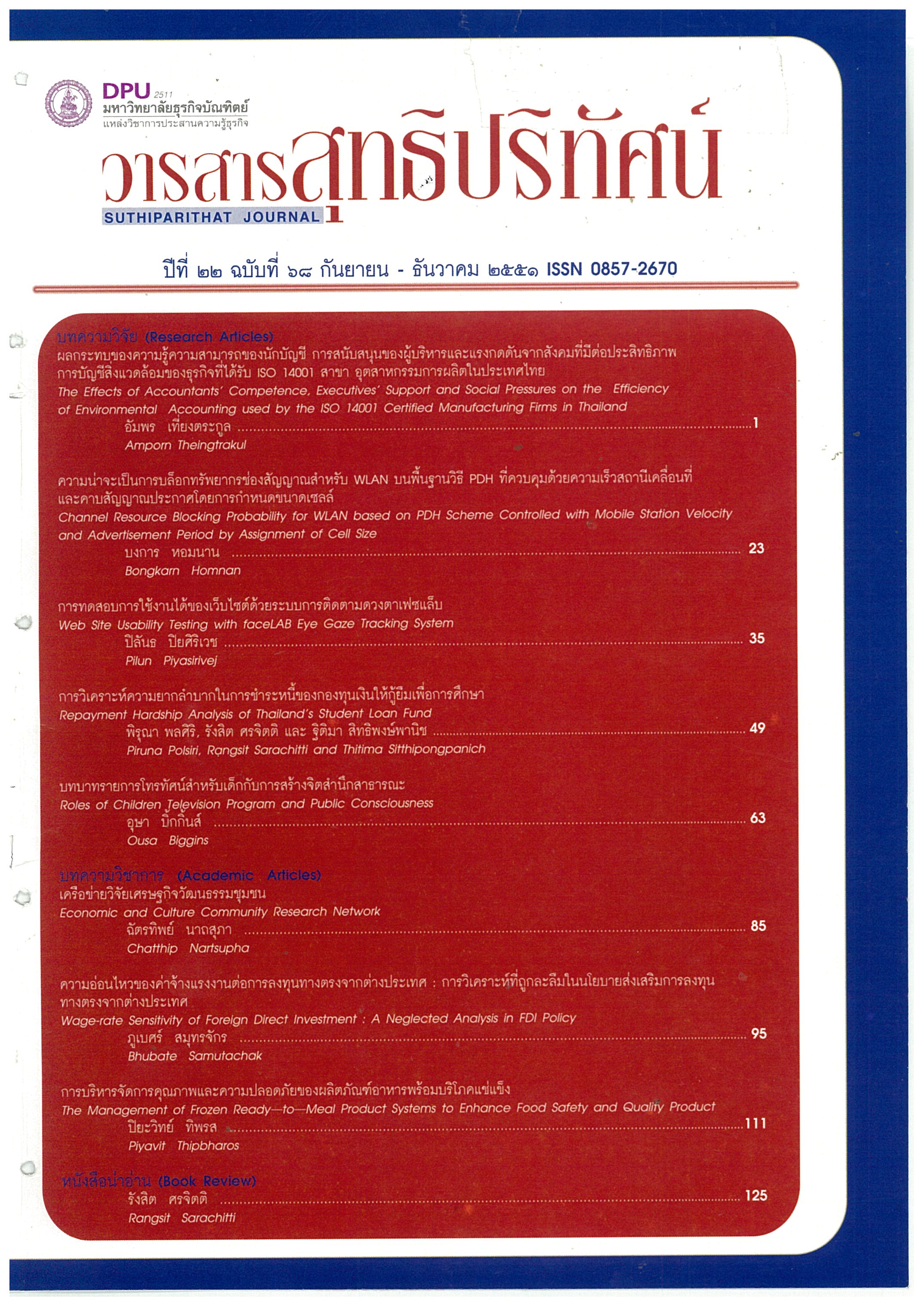
REPAYMENT HARDSHIP ANALYSIS OF THAILAND'S STUDENT LOAN FUND
Keywords:
Student Loan Fund, Repayment Hardship, ThailandAbstract
Using the age-earnings profiles of the Student Loans Fund (SLF) borrowers, we analyze the repayment hardship for the undergraduate level. The current SLF is compared with our three proposed SLF schemes. We assume different grace periods of interest charge and loan repayment, and a 7% nominal interest rate, instead of 1%, for all schemes. Under the current SLF, average repayment hardship (as measured by the ratio of total re- payment to total income) of average graduates is roughly 4% of total income, while that of unlucky graduates (i.e. graduates whose income is in the bottom 10%) is three times as much. In case of the radically modified SLF scheme, of which all government subsidies are eliminated, the average repayment hardship of average graduates increases almost three times. As for unlucky graduates, their average repayment hardship raises more than two times.
References
Chapman, B. and Lounkaew, K. (2008). “Income Contingent Student Loans for Thailand: Alternatives Comparative Conference Proceedings, DPU/ANU Conference, Financing, Nigher Education and Economic Development in East Asia, Bangkok, July 15-16, 2008.
Chapman, B. (2006). Government Managing Risk: Income Contingent Loans for Social and Economic Progress. Routledge. London.
Chapman, B. and Ryan, C. (2002). “Income-contingent financing of student charges for higher education: Assessing the Australian Innovation.” The Welsh Journal of Education, 11(1), 64-81.
Johnstone, D. B. (1986). Sharing the Costs of Higher Education: Student Financial Assistance in the United Kingdom, the Federal Republic of Germany, France, Sweden, and the United States. NewYork: The College Board.
Johnstone, D.B. (2004). “Higher educational finance and accessibility and student loan in Sub-Saharan Africa." Journal of Higher Education in Africa, 2(2), 11-36.
Johnstone, D.B. and Aemero, A. (2001). “The applicability for developing countries of income-contingent loans or graduate taxes, with special consideration of an Australian HECS-Type income-contingent loan program for Ethiopia.” Working Paper, University at Buffalo Center for Comparative and Global Studies in Education. Office of Student Loans Fund (2007). SLF's Handbook (in Thai). Bangkok.
Polsiri, P., Sarachitti, R. and Sitthipongpanich, T. (2008). “Thailand's Student Loan Fund: An Analysis of Inter est Rate Subsidies and Repayment Hardships.” Conference Proceedings, DPU/ANU Conference, Financing Higher Education and Economic Development in East Asia, Bangkok, July 15-16, 2008.
Shen, H. and Ziderman, A. (2007). “Student Loans Repayment and Recovery:International Comparisons.” Working Paper, Department of Economics, Bar Ilan University.
Tangkitvanich, S. and Manasboonphempool, A. (2006). “Policy evaluation of Student Loans Fund.” Working Paper, Thailand Development Research Institute.
Weesakul, Boonserm. (2006). Student Loans in Thailand: Past, Present and Future. Mimeo, Dhurakij Pundit University.
Ziderman. Adrian. (2003). Student Loans in Thailand: Are They Effective, Equitable, Sustainable?. United Nations Educational. Scientific and Cultural Organization (UNESCO). Bangkok.
Ziderman. Adrian. (2004). Policy Options for Student Loan Schemes: Lessons from Five Asian Case Studies. International Institute for Educational Planning. Paris: UNESCO.
Downloads
Published
How to Cite
Issue
Section
License
Content and information of the article published at Suthiparithat Journal are based on the sole opinions and responsibility of author(s) only. Neither the editorial board involve in......





