
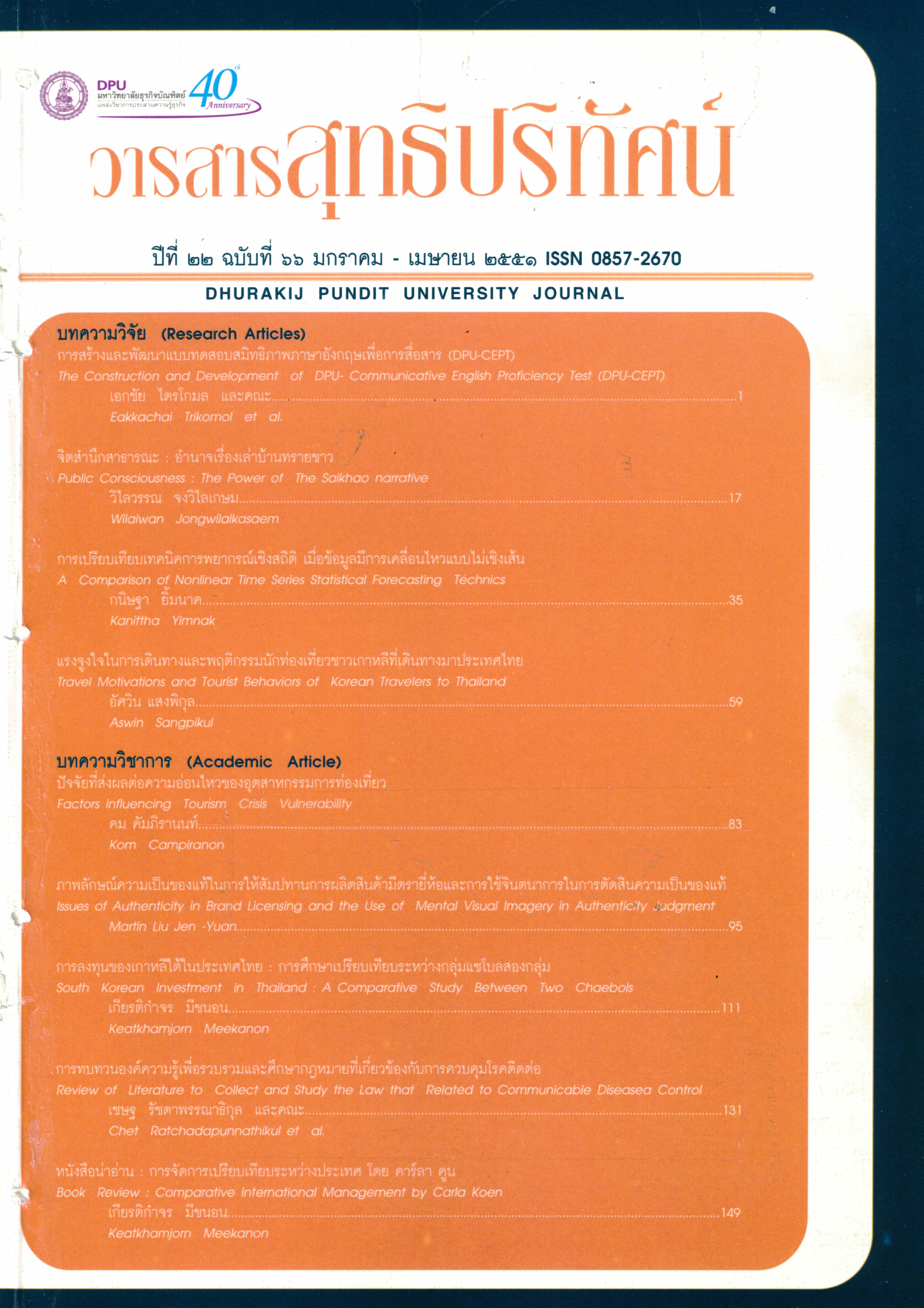
PUBLIC CONSCIOUSNESS : THE POWER OF THE SAIKHAO NARRATIVE
Keywords:
Dynamic, Narrative, Identity, Public ConsciousnessAbstract
The research has 2 objectives. The first is to study dynamic in Saikhao community, where there is a mix of population differenting in ethnicity, religious and culture, through the phenomenon of peace harmonious living amidst violence in The Deep Southern. The second is to study how the power of narrative creates public conscious in Saikhao community. The researcher selects 2 target-groups as subjects. One is the ideology leader from religious communities and local administrative officers from Saikhao. The other is 3 generations of villagers in Saikhao. The reason is to observe different dynamics in each generation. Furthermore the researcher participated and observed in traditional rituals in Saikhao, i.e. the marriage of Buddhist-Thais and Moalid of the Muslim- Thais.
The research finds that The Saikhao narrative told from generations to generations since the ancient time has influenced beliefs and be of Buddhist-Thai and Muslim-Thai in Saikhao. Furthermore, it integrates 2 cultures to create the unique identity of Saikhao people that is different from other Muslim-Thai communities in The Deep South, especially the "language". Usually, Muslim-Thais in the Deep South speak Malayu language, but Muslim- Thais in Saikhao speak local Saikhao language, a key factor in preventing the creation of segregation and creating trusts, the basis that form public consciousness of 'Saikhao people'. Thus Saikhao villagers feel that both Muslim activities and Buddha activities are Saikhao activities . That is the presentation of "public consciousness" which leads to a strong civil society that experiences no violence in Saikhao. Both Buddhist-Thais and Muslim - Thais who define themselves as "Saikhao-people" conclude that there are 6 factors contributing to no violence incidents in Saikhao community despite the Deep South crisis. They are 1, no suspicions between different religious groups in the community 2.understanding between Buddhist-Thais and Muslim- Thais 3. Feeling of belonging to the same group 4. common language 5. strong leadership and 6, industrious and entrepreneurial nature of Saikhao.
References
กาญจนา แก้วเทพ กรวิเคราะห์สื่อ : แนวคิดและเทคนิค. กรุงเทพมหานคร: คณะนิเทศศาสตร์ จุฬาลงกรณ์มหาวิทยาลัย, 2543.
กาญจนา แก้วเทพ. สื่อสารมวลชน : ทฤษฎีและแนวทางการศึกษา. กรุงเทพฯ : โรงพิมพ์ภาพพิมพ์, 2541.
ชัยวัฒน์ สถาอานันท์. "เทววิทยาแห่งวาทกรรม : ทำความเข้าใจอำนาจแห่งวาทกรรมด้วยนารายณ์สิบปาง" สมุดสังคมศาสตร์ 12 : 3-4 (กุมภาพันธ์ - กรกฎาคม 2533) : 175-191.
ไชยรัตน์ เจริญสินโอฬาร. วาทกรรมการพัฒนา: อำนาจ ความรู้ ความจริง เอกลักษณ์และความเป็นอื่น. กรุงเทพมหานคร: ศูนย์วิจัยและผลิตตำรา มหาวิทยาลัยเกริก, พ.ศ.2542
ไชยรัตน์ เจริญสินโอฬาร. สัญวิทยา โครงสร้างนิยม หลังโครงสร้างนิยมกับการศึกษารัฐศาสตร์. กรุงเทพมหานคร : สำนักพิมพ์วิภาษา, 2545
ธงชัย วินิจจะกูล. "วิธีการศึกษา ประวัติศาสตร์แบบวงศาวิทยา (Genealogy)" รายงานโครงการวิจัยเสริมหลักสูตร มหาวิทยาลัยธรรมศาสตร์, 2534.
ธเนศ วงศ์ยานนาวา. การวิเคราะห์ซับเจค (Subject : ทฤษฎีที่ไร้ทฤษฎีว่าด้วยอำพาจของมิเชล ฟูโก) กรุงเทพฯ : ศูนย์วิจัยคณะรัฐศาสตร์ มหาวิทยาลัยธรรมศาสตร์, 2532.
ธีระ นุชเปี่ยม. "ความรู้ อำนาจ อุดมการณ์ในวาทกรรมทางประวัติศาสตร์" วารสารร่มพฤกษ์ 15 : 2 (ตุลาคม 2539-มกราคม 2540) : 6-21.
Foucault, M. The Archaeology of Knowledge. Trans. Alan Sheridan. Vintage,1972.
Foucault, M. Discipline and Punish : Birth of the Prison. Trans. Alan Sheridan. London Pelican, 1977
Foucault. M. History of Sexuality, vol. I : An Introduction. Trans. R. Harley. New York, 1978.
Foucault. M Madness and Civilization : A History of Insanity in the Age of Reason. trans. Richard Howard. London: Tavistock, 3 rd Impression, 1965.
Downloads
Published
How to Cite
Issue
Section
License
Content and information of the article published at Suthiparithat Journal are based on the sole opinions and responsibility of author(s) only. Neither the editorial board involve in......





