
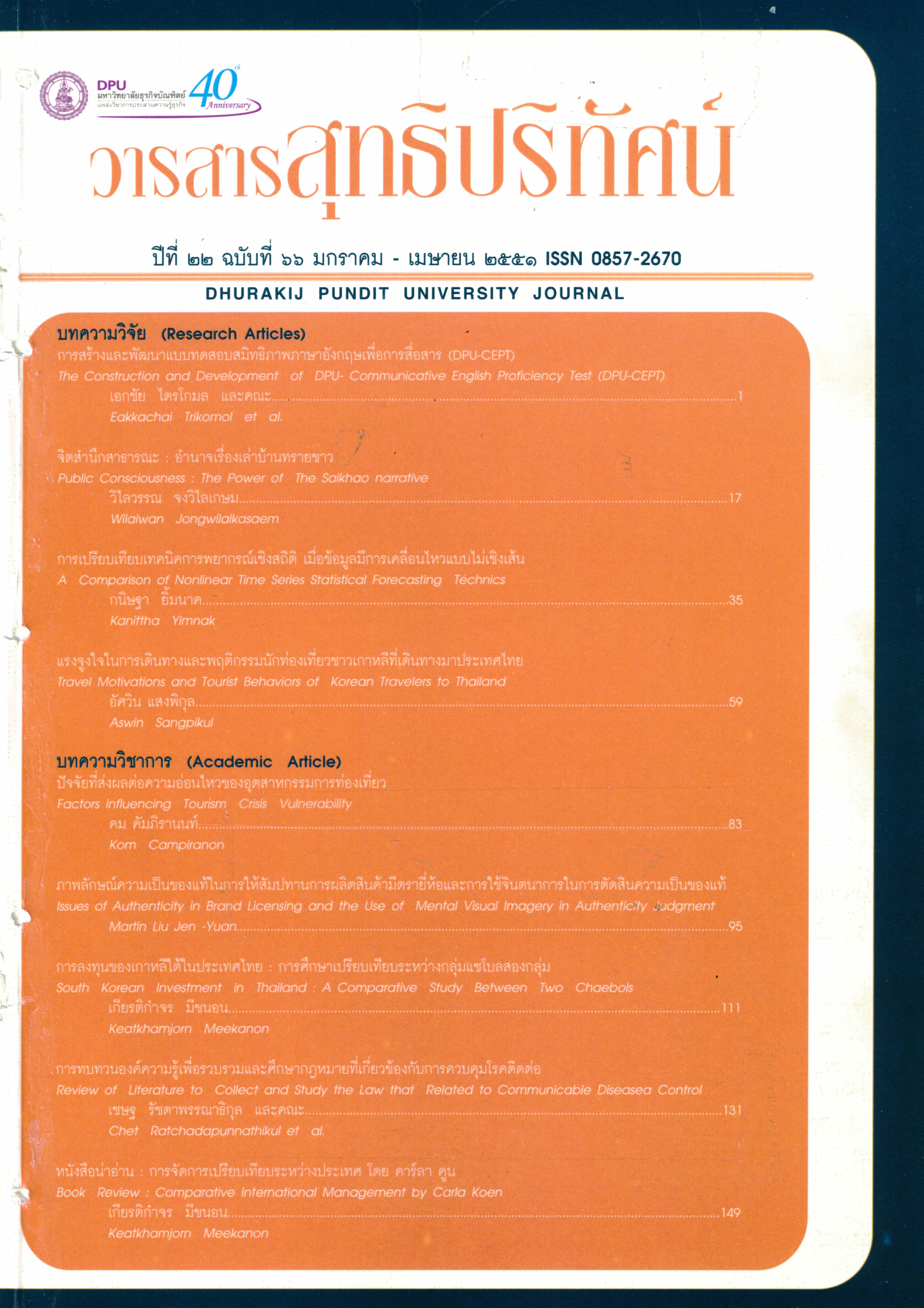
TRAVEL MOTIVATIONS AND TOURIST BEHAVIORS OF KOREAN TRAVELERS TO THAILAND
Keywords:
Travel motivations, Tourist behaviors, Korean travelers, ThailandAbstract
The Korean travel market is one of the important international markets for many Southeast Asian destinations. With the established economy and emergence of affluent middle class, millions of Koreans travel abroad each year for their leisure and holiday purposes. However, Thai researchers are yet to pay at to investigate this important segment. In order to increase the number of Korean travelers to Thailand, it is important for tourism marketers to learn and understand their travel related behaviors for developing appropriate marketing strategies for the target market. This study, therefore, aims to examine travel motivations and tourist behaviors of Korean travelers by using the theory of push and pull motivations as a conceptual framework.
A self-administered questionnaire survey was used to collect data from 400 Korean travelers who were visiting Thailand. The results of factor analysis identified three push and two pull factor dimensions. The three push factors (travel motives) were 'fun & relaxation', 'novel experience', and 'socialization', while the two ull factors (destination attractions) included 'attraction va costs' and 'safety & cleanliness'. Among them, 'fun & relaxation' and 'attraction variety & costs' were regarded the most important push and pull factors, respectively. The study also reveals interesting findings of Koreans' travel behaviors and provides practical implications that can be useful for both policy makers and industry practitioners to develop appropriate marketing strategies and tourism products for the target market.
References
Cavana, R, Delahaye, B., and Sekaran, U. (2001). Applied Business Research: Qualitative and Quantitative Methods. Australia, Milton: John Wiley & Sons.
Chen, J and Hsu, C.(2000). "Measurement of Korean Tourists' Perceived Images of Overseas Destinations". Journal of Travel Research. 3S, 411-416.
Crompton, J.L. (1979). "Motivations for Pleasure Vacation". Annals of Tourism Research. 6(4), 408-424.
Cummings, J.(2000). Lonely Planet World Food Thailand. Melbourne: Lonely Planet Publications.
Danaher, P and Arweiler, N. (1996). "Customer Satisfaction in the Tourist Industry: A Case Study of Visitors to New Zealand". Journal of Travel Research. 35, 69-93.
Dann, G. (1977). " Anomie, Ego- Enhancement and Tourism". Annals of Tourism 4(4),184-194.
Hanqin, Z. O. and Lam, T. (1999). "An Analysis of Mainland Chinese visitors' Motivation Visit Hong Kong". Tourism Management. 20(4), 58
Heung, V. and Cheng, E. (2000). " Assessing Touris ts' Satisfaction with Shopping in the Hong Kong Special Administrative Region of China". Journal of Travel Research. 38, 396-404.
Huh, J, and Uysal, M. (2003). " Satisfaction with Cultural/Heritage Sites: Virginia Historic Triangle". Journal of Quality Assurance in Hospitality & Tourism. 4(3/4), 177-194.
Jang, S. and Wu, C. (2006). "Seniors Travel Motivation and the Influential Factors: An Examination of Taiwanese Senior". Tourism Management, 27(2), 306-316.
Jang, S. and Cai, L. (2001). "Travel Motivations and Destination Choice: A Study of British Outbound market'. Journal of Travel & Tourism Marketing, 13( 3), 111-133
Kim, E. Y. J. (1997). "Korean Outbound Tourism: Pre-visit expectation of Journal of Travel & Tourism Marketing. 6(1), 11-19.
Kim, S. M. and Prideaux, B. (1998). "Korean Inbound Tourism to Australia of Supply-side Deficiencies". Journal of Vacation Marketing. 5(1), 66-81.
Klenosky, D. 2002, "The Pull of Tourism Destinations: A Means-End Investigation", Journal of Travel Research. 40(4), 385-395.
Kozak, M. (2002). "Comparative Analysis of Tourist Motivations by Nationality and Destinations", Tourism Management, 23(2), 221-232.
Master, H. and Prideaux, B. (2000). "Culture and Vacation Satisfaction: A Study of Taiwanese Tourist in South East Queensland". Tourism Management. 21, 445-449.
Ministry of Tourism and Sports. (2008). "The Meeting of ASEAN NTOs + 3 (China, Japan and Korea)". [Online]. Retrieved. www.mots.go.th/ tourism/becon trol/files/tourism/document/9otbinlhih.doc (August 11, 2008)
Lam, T. and Hsu, C. (2004). "Theory of Planned Behavior Potential Travelers from China". Journal of Hospitality & Tourism Research. 28(4), 463-482.
Laksanakan, N.(2003). Travel Characteristics of International Visitors to Phuket. Unpublished Master thesis. National Institute of Development Administration, Bangkok.
Lee, C.K. (2000). "A Comparative Study of Caucasian and Asian Visitors to a Cultural Expo in an Asian Setting", Tourism Management. 21(3), 169-176.
Patterson, C. (2002). The Business of Ecotourism. Rhinelander, Wisconsin: Explorers' Guide Publishing.
Pearce, P. and Caltabiano, M. (1983). 'Inferring Travel Motivation from Travelers Experience".Journal of Travel Research. 12(2),16-20.
Sangpikul, A. (2007). Princples of Tourism Marketing. Bangkok: Dhurakij Punit University Press.
Sansartji, R. (2005). Atitudes and Behaviors of Traveling in Thailand of Foreign tourists after the Tsunami Disaster. Unpublished Master thesis. Thammasart University, Bangkok.
Sirakaya, E. and McLellan, R. (1997). " Factors Affecting Vacation Destinational of College Students". Anatolia: An International Journal of Tourism and Hospitality Research. 8(3), 31-44.
Taworn, R. (2007). Tourist Behaviors in Selecting Accommodation in Chiang Mai. Unpublished Master thesis. Chiang Mai University, Chiang Mai.
Travel Counsellors. (2007). "Thailand Touted as Best Value for Money". [Online]. Retrieved: http://news.travelcounsellors.co.uk/Thailand_touted_ as_best_value_for_money_18156923.html (September 2, 2008)
Tourism Authority of Thailand or TAT. (2003). Operational Plans for Determining Tourism Products. Final Report by Core and Planning Development Co.,Ltd. Bangkok.
Tourism Authority of Thailand or TAT. (2008). "International Tourist Arrivals by Country of Residence". [Online]. Retrieved http:// www2.tat.or.th/stat/web/static _download.php? Rpt-cre (August 1l, 2008)
You, X. and O'Leary J. (1999). "'Destination Behavior of Older UK Travelers", Tourism Recreation Research, 24(1), 23-34.
You, X., O'Leary, J., Morrison, A, and Hong, G. (2000). "A Cross-Cultural Comparison of Travel Push and Pull Factors: UK vs. Japan", International Journal of Hospitality & Tourism Administration. 5(1), 1-26.
You, X, O'Leary, J, and Lee, G. (2001). "Mature International Travelers: An Examination of Gender and Benefits". Journal of Hospitality & Leisure Marketing, 9(1/2). 53-72.
Yoon, Y. and Uysal, M. (2005). "'An Examination of the Effects of Motivational and Satisfaction on Destination Loyalty: A Structural Model". Tourism Management 26, 45-56.
Yenkuntauch, K and Lougepanitpitak, P. (2004). A Study of Tourist Behaviors in Chiang Mai. Unpublished Research Report. Rajamangala University of Technology Lanna Chiang Mai, Chiang Mai.
Yuan, S. amd McDonald, C. (1990). "Motivational Determinants of International Pleasure Time". Journal of Travel Research. 24(2), 42-44.
Downloads
Published
How to Cite
Issue
Section
License
Content and information of the article published at Suthiparithat Journal are based on the sole opinions and responsibility of author(s) only. Neither the editorial board involve in......





