
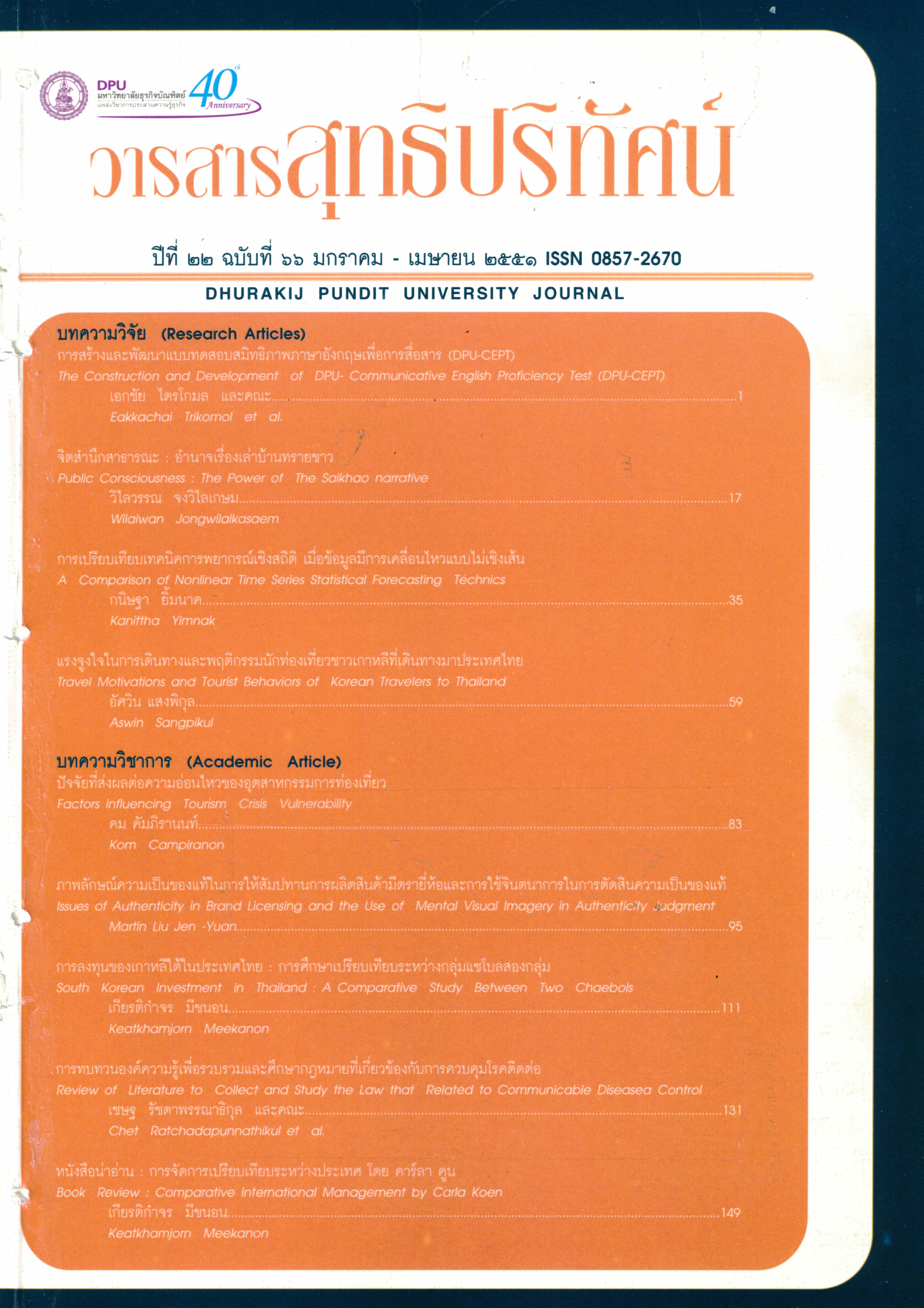
การลงทุนของเกาหลีใต้ในประเทศไทย : การศึกษาเปรียบเทียบระหว่างกลุ่มแชโบลสองกลุ่ม
Keywords:
Chaebol, EDI, MNCs, ThailandAbstract
This pilot study compares Thai subsidiaries of two well-known South Korean Chaebols from economic, behavioural and strategic management perspectives. Each perspective has its theoretical flaws, but each of them is complementary to each other. The eclectic paradigm and the Uppsala model have existed for almost two decades, but both theories have failed to explain the strategic direction of investment behaviour. Strategic directions can reflect the companies' expansion, stabilisation and retrenchment. Analogously, strategic direction can mirror investment, commitment and divestment. This study employs a host-country perspective. The study employs a qualitative comparative analysis as a research strategy. As an initial phase of the study, this study uses secondary data of both Chaebols for the analysis. Nonetheless, two cases of Samsung and LG alone cannot generalise the investment behaviour of South Korean Chaebols as a whole. More South Korean cases in Thailand and other host countries need to be investigated, before a follow-up large-scale quantitative survey in the future research.
References
Andersen, O (1997). Internationalisation and market entry mode; A review of theories and conceptual frameworks. Management International Review, 37 (2). 21-42
Andersson, U, Johanson, M & Silver, L (1996). What's up in distribution and marketing channels: An analysis of three concepts frequently applied in marketing research. Working paper, Uppsala University Sweden, Department of Business Studies.
Barkema, H, Bell, J &e Pennnings, J (1996), Foreign entry, cultural barriers and learning Strategic Management Journal, 17 (2). 151-166
Bell, J (1999). Entry mode and location decisions. In R van Hoesel & R Narula (Eds). Multinational enterprises from the Netherlands (Ch 6, Pp 172-190). London, UK: Routledge
Blomstrom, M & Kokko, A (2002). Good governance at the macro level: Foreign direct investment incentives. Comparative Regional Integration: ASEAN and the EU: Monograph Series (2). 82-98: Chulalongkorn University Press
Bradley, F (1995). International marketing strategy. London, UK: Prentice-Hall
Cantwell, J (2003). International business and the eclectic paradigm. London, UK: Routledge
Cantwell, J & Iammarino, S (1998). MNCs, technological innovation and regional systems in the EU: Some evidence in the Italian case. International Journal of the Economics of Business 5 (3). 383-408
Cantwell, J& Iammarino, S (2000). Multinational corporations and the location of technological innovation in the UK regions. Regional Studies 34 (4). 317-332
Chang, S-J & Delios, A (2006). Competitive interactions between global competitors: The entry behaviour of Korean and Japanese Multinational Firms. Paper presented at the Conference, Japan Centre for Economic Research, Tokyo, 1st June 2006, JCER discussion paper No, 97
Choe, S K & Roehl, T W (2007). What to shed and what to keep: Corporate transformation in Korean business groups. Long Range Planning, 40, 465-487
Chung, K H, Lee, H Ch & Jung, K H (1997). Korean management: Global strategy and cultural transformation. Berlin: de Gruyter
Clarke, C J & Gall, F (1987). Planned divestment - A five-step approach. Long Range Planning 20 (1). 17-24
Dunning, J H (1993). Multinational enterprises and the global economy. Workingham, UK: Addison-Wesley
Dunning, J H (1998). Location and the multinational enterprise: A neglected factor. Journal of International Business Studies, 29 (1). 45-66
Eisenhardt, K M (1989). Building theories from case study research. Academy of Management Review, 14 (4). 532-550
Eriksson, K, Johanson, J, Majkgard A & Sharma, D D (1997). Experiential knowledge and cost in the internationalisation process. Journal of International Business Studies, 28 (2). 337-360
Euh, Y-D & Rhee J H (2007). Lesson from the Korean crisis: Policy and managerial implication. Long Range Planning, 40. 431-445
Fina, E & Rugman, A M (1996). A test of internalisation theory and internationalisation theory: The Upjohn Company. Management International Review, 36 (3). 199-213
Forsgren, M (1989). Foreign acquisitions: Internalisation or network interdependency. In L Hall?n & J Johanson (Eds). Networks of relationships in international industrial marketing. Green wich, NJ: JAI Press
Fox-Wolfgramm, S J (1997). Towards developing a methodology for doing qualitative research: The dynamic-comparative case study method. Scandinavian Journal of Management, 13 (4). 439-455
Hollensen, S (2001). Global marketing: A market-responsive approach(2nd Ed). Harlow, UK: Prentice Hall
Johansson, J & Vahlne, J-E (1977). The internationalisation process of the firm: A model of knowledge development and increasing foreign market commitments. Journal of International Business Studies, 8 (1). 23-32
Johansson, J & Vahlne, J-E (1990). The mechanism of internationalisation. International Marketing Review, 7 (4). 1-24
Johanson, J & Vahlne, J-E (2006). Commitment and opportunity development in the internationalization process: A note on the Uppsala internationalisation process model. Management International Review 46 (2). 165-178
Karakaya, F (2000). Market exit and barriers to exit: Theory and practice. Psychology and Marketing, 17 (8). 651-668
Kim, L-S & Yi, G-H (1999), Reinventing Korea's national management system. International Studies of Management and Organization, 28 (4). 73-83
Kim, H-C, Hoskisson, R E, Tihanyi, L & Hong, J-B (2004), The evolution and restructuring of diversified business groups in emerging markets: The lessons from Chaebols in Korea. Asia-Pacific Journal of Management 21. 25-48
Kwon, Y-Ch (2002). Korean multinationals' foreign direct investment projects; Variability in the micro- and macro-level determinants, The International Trade Journal, 16 (2). 203-229
Larsson, R (1993). Case survey methodology: Quantitative analysis of patterns across case studies. Academy of Management Journal, 2 (6), 1515-1546
Lasserre, P(1995). Corporate strategies for the Asia Pacific region, Long range planing, 28 (1). 13-30
Lasserre, P & Sch?tte, H (1995). Strategies for Asia Pacific. London, UK Macmillan
Lee, W H & Lee, N S (2007). Understanding Samsung's diversification strategy. The case of Samsung Motors Inc. Long Range Planning, 40. 488-504
Lavie, D & Fiegenbaum, A (2003). The dominant strategic positioning of foreign MNCs: A typological approach and the experience of Israeli industries. Journal of Business Research, 56. 805-814
Leepiyachart, N & Chunsiripong, Ch (2005). The study of the need of staff with the knowledge of Korean language in Korean workplaces (Pp 117-141). Paper presented at the Conference "Korea, Past, Present and Future" held at Burapha University, Thailand, 18th -19th January 2005
Lindblad, J T (1999). European versus Asian style of foreign investment in Southeast Asia: A preliminary exploration. In F Knipping, P Bunnag && V Phathatowom (Eds). Europe and Southeast Asia in the contemporary world: Mutual influences and comparison (Pp 67-90). Asia-Europe Studies Series Vol 2 Nomos Verlagsgesellschaft: Baden-Baden.
Linstrand, A (2003). The usefulness of network experiential knowledge in the internationalization process. Unpublished doctoral dissertation, Department of business studies, Uppsala University, Sweden
McKern, B (1993). An evolutionary approach to strategic management in the international firm. In P Lorange, B Chakravarthy, J Roos & A van de Ven (Eds). Implementing strategic processes: Change, learning and co-operation (Ch 16, Pp 349-372). Oxford, UK: Blackwell
Miles, M B & Huberman, A M (1994). Qualitative data analysis: An expanded sourcebook (2nd ed.). Thousand Oaks, CA: Sage
Park, Y-R, Pak, Y' S & Lee, J Y (2006). What they learned from the crash; A comparison of Korean firms' FDI before and after the 1997 financial crisis. Management International Review, 46 (1). 109-130
Park, C S (2007). Radical environment changes and corporate transformation: Korean firms: Special issue introduction by the guest editor. Long Range Planning, 40. 419-430
Pettigrew, A M (1997). What is a processual analysis? Scandinavian Journal of Management, 13 (4). 337-348
Ragin, C C (1987). The comparative method: Moving beyond qualitative and quantitative strategies. Berkley, CA: UC Press
Ramiah, V (1998). European views on Asia and Europe-Asia relations. IPS working paper no.4. Singapore: Institute of Policies Studies
Robock, S H & Simmonds (1989). International business and multinational enterprises (4th Ed). Tokyo, Japan: Toppan
Rugman, A M & Verbeke, A (2004). A perspective on regional and global strategies of multinational enterprises. Journal of International Business Studies, 35 (1). 3-18
Stake, R E (1995). The art of case study research. Thousand Oaks, CA: Sage
Stibora, J & De Vaal, A (1999). Service FDI and the Dutch economy. In R van Hoesel & R Narula (Eds). Multinational enterprises from the Netherlands (Ch 5, pp 138-171). London, UK: Routledge
Suh, Ch-S & Kwon, S-H (2005). Globalization strategy of South Korean corporations after the 1997 financial crisis - A case study on three large Korean electronics companies (Pp 5-30). Paper presented at the Conference "Korea, Past, Present and Future" held at Burapha University, Thailand, 18th -19th January 2005
Trevino, L J & Mixon, F G (2004). Strategic factors affecting foreign direct investment decisions by multi-national enterprises in Latin America. Journal of World Business, 39.233-243
Yin, R K (2003). Case study research: Design and methods (3rd ed.). Thousand Oaks, CA: Sage
Young, S, Hamill, J, Wheeler, C & Davies, J R (1989). International market entry and development: Strategies and management. Hertfordshire, UK: Harvester-Wheatsheaf
Yu, SJ (1998). The growth pattern of Samsung Electronics. International Studies of Management and Organisation, 28 (4). 57-72
Downloads
Published
How to Cite
Issue
Section
License
Content and information of the article published at Suthiparithat Journal are based on the sole opinions and responsibility of author(s) only. Neither the editorial board involve in......





