
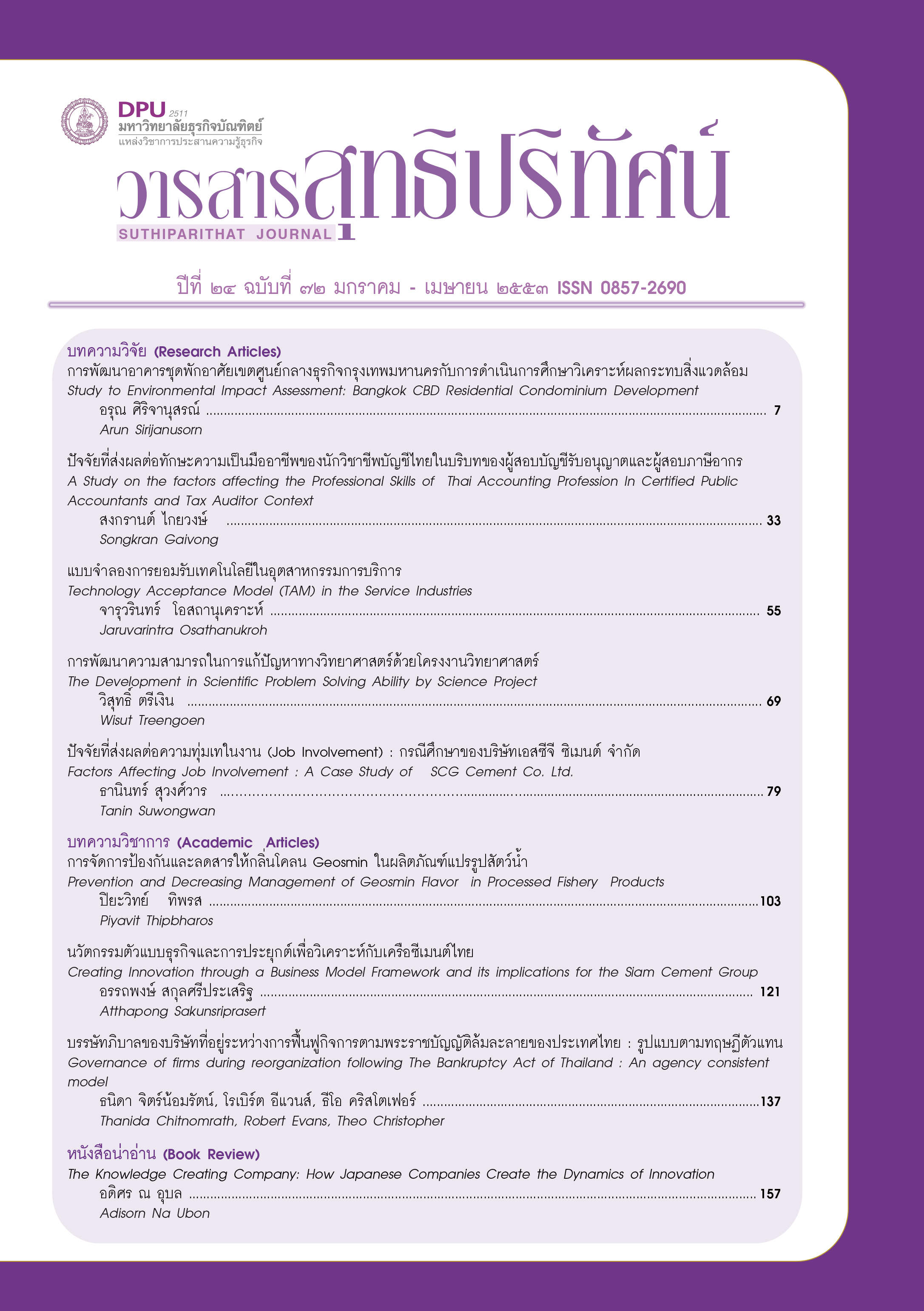
CREATING INNOVATION THROUGH A BUSINESS MODEL FRAMEWORK AND ITS IMPLICATIONS FOR THE SIAM CEMENT GROUP
Keywords:
Business model innovation, differentiation strategy, innovationAbstract
The adjustment of the organization to be in line with the business environment is crucial and should be emphasized by every organization, especially in rapidly changing business environments. However, firms are capable of coping with the critically changing environment through the strategy of innovation through employing a business model. The main objective of this article is to propose a Business Model Framework as a tool for the business practitioner for application to new business model creation. The author has divided this article into three main parts: the review of literature on the business model, the proposal of the Business Model Framework, and the implications of the framework based on a case study of HYPERLINK “http://www.siamcement.com/” the Siam Cement Group Company (SCG).
The Business Model Framework is a framework showing the process of creating business model innovation consisting of three main stages: 1) Defining the existing business model, 2) Reconfiguring the business model, and 3) Defining the types of Business Model Innovation. Within the stage of reconfiguration, five main components to create business model innovation are introduced, namely customer value proposition, profit formula, key resources, value chain/networks, and competitive strategy.
References
Donald Mitchell and Carol Coles (2003) “The ultimate competitive advantage of continuing business model innovation” Journal of Business Strategy, Vol.24 (5). pp. 15-21.
Donald Mitchell and Carol Coles (2004) “Establishing a continuing business model innovation process” Journal of Business Strategy, Vol.25 (3). pp 39-49.
Edward Giesen, Saul J. Berman, Ragna Bell, and Amy Blitz. (2007) “Paths to success: Three ways to innovate your business model” IBM Global Business Service
Henry Chesbrough (2006) OPEN INNOVATION: The New Imperative for Creating and Profiting from Technology. Harvard Business School Press.
Henry Chesbrough (2007) “Business model innovation: it’s not just about technology anymore” Strategy and Leadership, Vol.35(6). pp. 12-17.
Mark W. Johnson, Clayton M. Christensen, and Henning Kagermann (2008) “Reinventing Your Business Model” Harvard Business Review, pp. 51-59.
Tony Davila, Marc J.Epstein, and Robert Shelton (2006) Making Innovation Work: How to Manage It, Measure It, and Profit from It Wharton School Publishing.
กองบรรณาธิการ (2550) พิมพ์เขียว 3 เพชรยอดมงกุฏบรรษัทไทย. กรุงเทพ: Brandage Essential หน้า 133-176.
บริษัทปูนซีเมนต์ไทย(มหาชน) จำกัด (2549) รายงานประจำปีบริษัท. หน้า 1-25.
บริษัทปูนซีเมนต์ไทย(มหาชน) จำกัด (2550) รายงานประจำปีบริษัท. หน้า 1-21.
พสุ เดชะรินทร์ (2551) “นวัตกรรมตัวแบบธุรกิจ” ผู้จัดการรายสัปดาห์ หน้า D5.
Downloads
Published
How to Cite
Issue
Section
License
Content and information of the article published at Suthiparithat Journal are based on the sole opinions and responsibility of author(s) only. Neither the editorial board involve in......





