
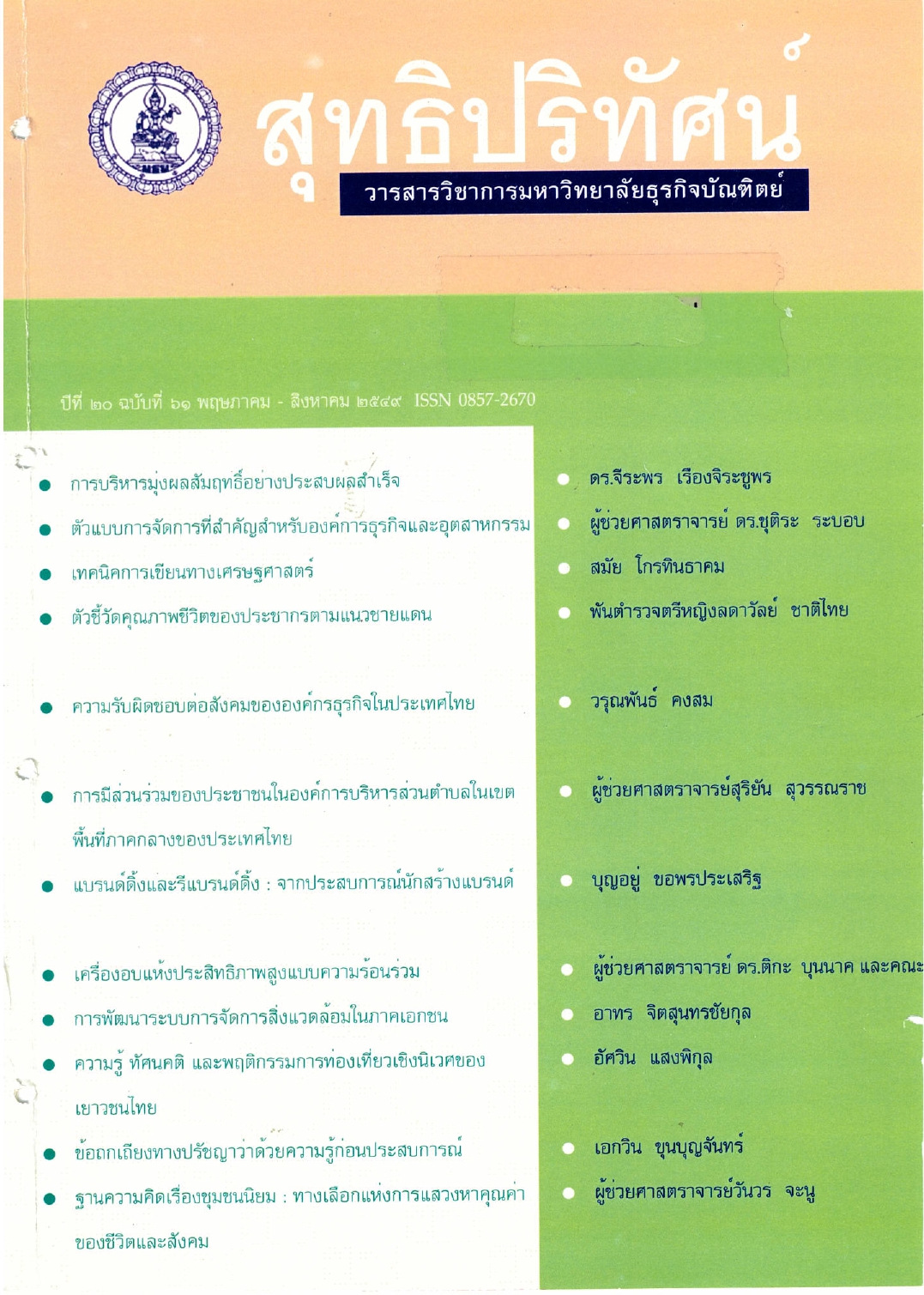
KEY MANAGEMENT MODELS FOR INDUSTRIAL AND BUSINESS FIRMS.
Keywords:
ตัวแบบการจัดการAbstract
Abstract unavailable. Please see print journal.
Downloads
References
Hammer, Michael and Champy, James. (1993). Reengineering the corporation : a monifesto for business revolution. New York: Harper Business.
Handy, Charles. (1978, 1991). Gods of management : the changing work of organizations. London : Business Books.
Hardjono, T.W., Have, Steven Ten and Have, W.D. Ten. (1996). The European Way to Excellence : How 35 European manufacturing, public and service organizations make use of quality managment. Brussels : EFQM.
Have, Steven Ten et al. (2003). Key management models: the management tools and practices that will improve your business. New York : Financial Times Prentice Hall.
Henderson, Bruce D. (1979). Henderson on corporate strategy. Cambridge, Mass. : Abt Books.
Imai, Masaaki. (1986). Kaizen: the key to Japan's competitive success. New York : McGraw-Haill.
Kaplan, Robert S. and Cooper, Robin. (1998). Cost & effect : using integrated cost systems to drive profitability and performance. Boston, Mass.: Harvard Business School Press.
Kets de Vries, Manfred F.R. and Miller, Danny. (1984). The neurotic organication. San Francisco : Jossey-Bass.
Monden, Yasuhiro. (1998). Toyota producation system : an integrated approach to just-in time. (3rd ed.). Norcross, Ga. : Engineering & Management Press.
Normann, Yasuhiro. (1994). Designing interactive strategy : from value chain to value constellation. Chichester : John Wiley.
Senge, Peter M. et al. (1994). The Fifth discipline fieldbook : strategies and tools for building a learning organization. New York : Doubleday ; Nicholas Brealey.
Walton, Mary. (1986). The deming management method. London : Mercury Books.
Watson, Gregory H. (1993). Strategic benchmarking : how to rate your company's performance against the world's best. New York: John Wiley.
Downloads
Published
How to Cite
Issue
Section
License
Content and information of the article published at Suthiparithat Journal are based on the sole opinions and responsibility of author(s) only. Neither the editorial board involve in......



