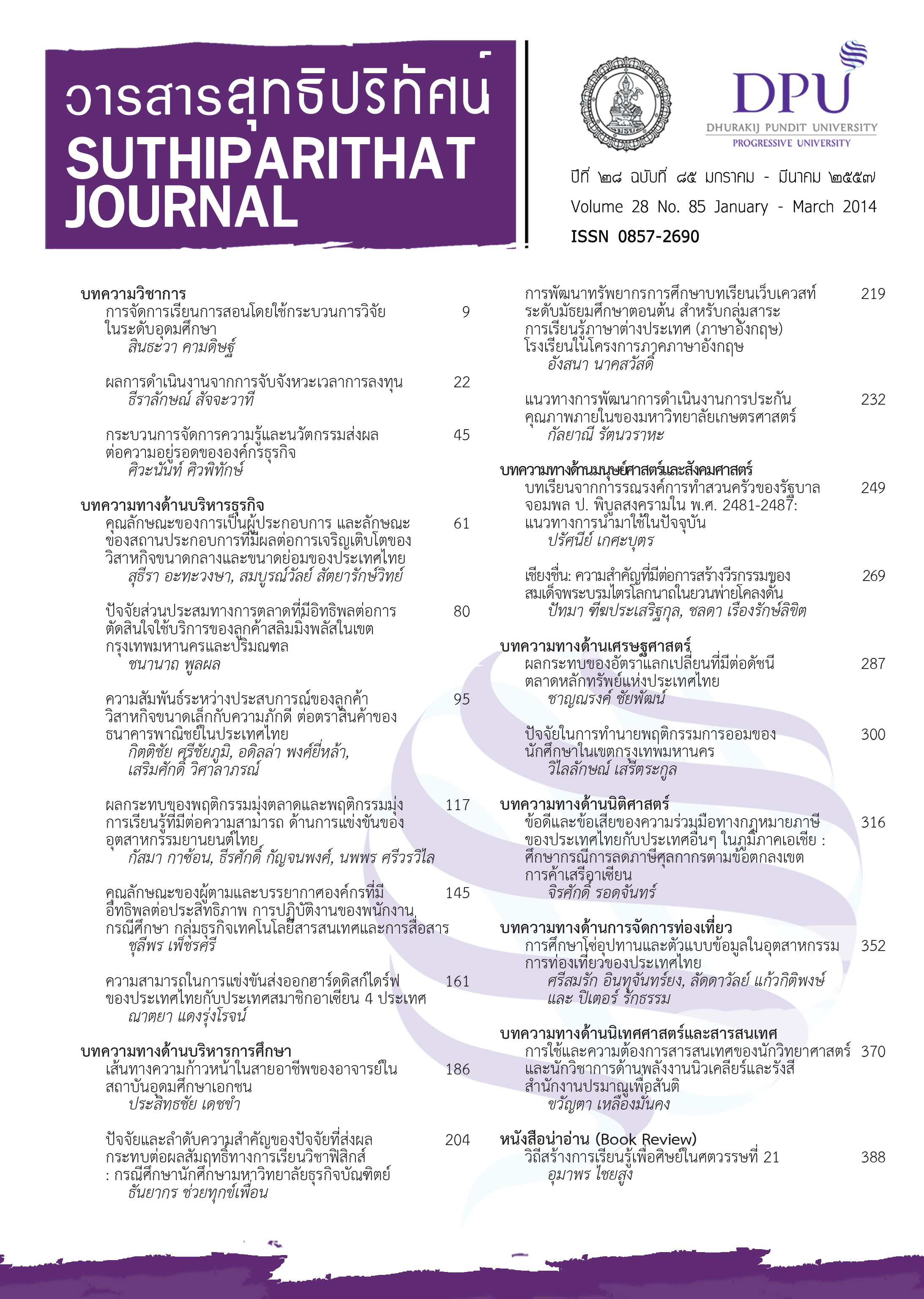
ผลกระทบของอัตราแลกเปลี่ยนที่มีต่อดัชนีตลาดหลักทรัพย์แห่งประเทศไทย
คำสำคัญ:
อัตราแลกเปลี่ยนเงินตราต่างประเทศ, ดัชนีตลาดหลักทรัพย์แห่งประเทศไทย, โคอินทิเกรชั่นบทคัดย่อ
ดัชนีตลาดหลักทรัพย์แห่งประเทศไทย มักจะเคลื่อนไหวเปลี่ยนแปลงไปตามการลงทุนของนักลงทุนต่างชาติ โดยปัจจัยหนึ่งที่มีผลต่อกำไรของนักลงทุนต่างชาติคืออัตราแลกเปลี่ยน งานวิจัยนี้จึงมุ่งศึกษาความสัมพันธ์ระหว่างอัตราแลกเปลี่ยนและดัชนีตลาดหลักทรัพย์แห่งประเทศไทย เพื่อเป็นข้อมูลประกอบการตัดสินใจลงทุนในตลาดหลักทรัพย์แห่งประเทศไทย การศึกษาจะใช้ข้อมูลทุติยภูมิ ตั้งแต่เดือนมกราคม พ.ศ.2546 ถึง เดือนมิถุนายน พ.ศ.2556 รวม 126 เดือน ประกอบด้วยตัวแปรดัชนีตลาดหลักทรัพย์แห่งประเทศไทย อัตราแลกเปลี่ยนของเงินดอลลาร์สหรัฐเทียบกับบาท อัตราแลกเปลี่ยนของเงินดอลลาร์ สหรัฐเทียบกับเยนและอัตราแลกเปลี่ยนของเงินยูโรเทียบกับดอลลาร์สหรัฐ โดยใช้สถิติ cointegration ในการวิเคราะห์ ผลการวิเคราะห์พบว่าอัตราแลกเปลี่ยนของเงินดอลลาร์สหรัฐเทียบกับเงินบาท และอัตราแลกเปลี่ยนของเงินยูโรเทียบกับดอลลาร์สหรัฐ มีผลต่อดัชนีตลาดหลักทรัพย์แห่งประเทศไทยในทิศทางตรงกันข้าม กล่าวคือในภาวะที่เศรษฐกิจของประเทศสหรัฐอเมริกาหรือสหภาพยุโรปชะลอตัว จะทำให้เงินดอลลาร์สหรัฐหรือเงินยูโรอ่อนค่า และเกิดการเคลื่อนย้ายเงินทุนเข้ามาในเอเชีย จึงทำให้เงินบาทแข็งค่าและดัชนีตลาดหลักทรัพย์แห่งประเทศไทยเพิ่มขึ้นด้วย ในกรณีกลับกันเมื่อเงินดอลลาร์สหรัฐหรือเงินยูโรแข็งค่าเงินลงทุนจะไหลออกจากประเทศไทย ทำให้ดัชนีตลาดหลักทรัพย์แห่งประเทศไทยลดลง ส่วนอัตราแลกเปลี่ยนของเงินดอลลาร์สหรัฐเทียบกับเงินเยนไม่มีความสัมพันธ์กับดัชนีตลาดหลักทรัพย์แห่งประเทศไทย ดังนั้นงานวิจัยนี้ชี้ให้เห็นว่านักลงทุนสามารถใช้ข้อมูลเกี่ยวกับอัตราแลกเปลี่ยนประกอบการตัดสินใจลงทุนในตลาดหลักทรัพย์แห่งประเทศไทย
เอกสารอ้างอิง
ชาญณรงค์ ชัยพัฒน์. (2554). ระดับการเคลื่อนย้ายเงินทุนระหว่างประเทศจากแบบจำลองการกำหนดอัตราดอกเบี้ย. วิทยสารเกษตรศาสตร์, 32(3), 382-392.
ตลาดหลักทรัพย์แห่งประเทศไทย. (2556). ราคาดัชนีตลาดหลักทรัพย์. สืบค้นเมื่อ 9 สิงหาคม 2556, จาก http://marketdata.set.or.th/mkt/sectorialindices.do?language=th&country=TH
ธนาคารแห่งประเทศไทย. (2556). สถิติเศรษฐกิจและการเงิน. สืบค้นเมื่อ 9 สิงหาคม 2556, จาก http://www.bot.or.thThai/Statistics/ContactPerson/Pages/Contact.aspx
Chkili, W., Aloui, C., & Nguyen, D. K. (2012). Asymmetric effects and long memory in dynamic volatility relationships between stock returns and exchange rates. Journal of International Financial Markets, Institutions & Money, 22, pp738-757.
Dickey, D. A., & Fuller, W. A. (1981). Likelihood ratio tests for autoregressive time series with a unit root. Econometrica, 49(4), pp.1057-1072.
Engle, R. F., & Granger, C. W. J. (1987). Cointegration and error correction: Representation, estimation, and testing. Econometrica, 55(2), pp.251-276.
Liu, L., & Wan, J. (2012). The relationship between Shanghai stock market and CNY/USD exchange rate: New evidence based on cross-correlation analysis, structural cointegration and nonlinear causality test. Physica A, 391, pp. 6051-6059.
Tsai, I-C. (2012). The relationship between stock price index and exchange rate in Asian markets: Aquantile regression approach. Journal of International Financial Markets, Institutions & Money, 22, pp. 609-621.
Wu, K. J., Lu, C. C., Jono, H., & Perez, I. (2012). Interrelationship between Philippine stock exchange index and USD exchange rate. Social and Behavioral Sciences, 40, pp.768-782.
ดาวน์โหลด
เผยแพร่แล้ว
รูปแบบการอ้างอิง
ฉบับ
ประเภทบทความ
สัญญาอนุญาต
เนื้อหาและข้อมูลในบทความที่ลงตีพิมพ์ในวารสารสุทธิปริทัศน์ ถือเป็นข้อคิดเห็นและความรับผิดชอบของผู้เขียนบทความโดยตรงซึ่งกองบรรณาธิการวารสาร ไม่จำเป็นต้องเห็นด้วย หรือร่วมรับผิดชอบใด ๆ
บทความ ข้อมูล เนื้อหา รูปภาพ ฯลฯ ที่ได้รับการตีพิมพ์ในวารสารสุทธิปริทัศน์ ถือเป็นลิขสิทธิ์ของวารสารสุทธิปริทัศน์หากบุคคลหรือหน่วยงานใดต้องการนำทั้งหมดหรือส่วนหนึ่งส่วนใดไปเผยแพร่ต่อหรือเพื่อกระทำการใด ๆ จะต้องได้รับอนุญาตเป็นลายลักษณ์อักษรจากวารสารสุทธิปริทัศน์ก่อนเท่านั้น