Cross-level Influencing Factors of Employees' Innovative Behavior in Chinese Enterprises: The Mediating Role of Psychological Capital
คำสำคัญ:
Cross-level Influencing, Factors of Employees' Innovative Behavior, Chinese Enterprises the Mediating Role, Psychological Capitalบทคัดย่อ
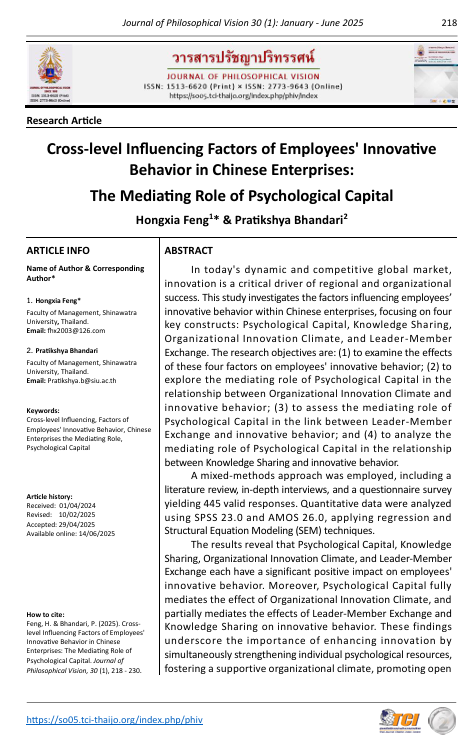
In today's dynamic and competitive global market, innovation is a critical driver of regional and organizational success. This study investigates the factors influencing employees’ innovative behavior within Chinese enterprises, focusing on four key constructs: Psychological Capital, Knowledge Sharing, Organizational Innovation Climate, and Leader-Member Exchange. The research objectives are: (1) to examine the effects of these four factors on employees' innovative behavior; (2) to explore the mediating role of Psychological Capital in the relationship between Organizational Innovation Climate and innovative behavior; (3) to assess the mediating role of Psychological Capital in the link between Leader-Member Exchange and innovative behavior; and (4) to analyze the mediating role of Psychological Capital in the relationship between Knowledge Sharing and innovative behavior.
A mixed-methods approach was employed, including a literature review, in-depth interviews, and a questionnaire survey yielding 445 valid responses. Quantitative data were analyzed using SPSS 23.0 and AMOS 26.0, applying regression and Structural Equation Modeling (SEM) techniques.
The results reveal that Psychological Capital, Knowledge Sharing, Organizational Innovation Climate, and Leader-Member Exchange each have a significant positive impact on employees' innovative behavior. Moreover, Psychological Capital fully mediates the effect of Organizational Innovation Climate, and partially mediates the effects of Leader-Member Exchange and Knowledge Sharing on innovative behavior. These findings underscore the importance of enhancing innovation by simultaneously strengthening individual psychological resources, fostering a supportive organizational climate, promoting open communication between leaders and employees, and encouraging knowledge sharing.
Downloads
เอกสารอ้างอิง
Amabile, T. M., Conti, R., Coon, H., Lazenby, J., & Herron, M. (1996). Assessing the work environment for creativity. Academy of Management Journal, 39(5), 1154–1184. https://doi.org/10.5465/256995
Avey, J. B., Wernsing, T. S., & Luthans, F. (2008). Can positive employees help positive organizational change? Impact of psychological capital and emotions on relevant attitudes and behaviors. The Journal of Applied Behavioral Science, 44(1), 48–70. https://doi.org/10.1177/0021886307311470
Baron, R. A., Franklin, R. J., & Hmieleski, K. M. (2016). Why entrepreneurs often experience low, not high, levels of stress: The joint effects of selection and psychological capital. Journal of Management, 42(3), 742–768. https://doi.org/10.1177/0149206313495411
Cao, K., & Dou, Z. (2015). Cross-level research on organizational innovation climate, knowledge sharing and employees' innovative behavior. Scientific Research Management, 36(12), 83–91.
Chen, S. (2006). Cross-level analysis of innovation behavior and innovation performance: The viewpoint of resource-based theory [Master’s thesis, Taipei University].
Davenport, T. H., & Prusak, L. (1998). Working knowledge: How organizations manage what they know. Harvard Business Press.
Digan, S. P., Sahi, G. K., Mantok, S., & Kumar, V. (2019). Women's perceived empowerment in entrepreneurial efforts: The role of bricolage and psychological capital. Journal of Small Business Management, 57(1), 206–229. https://doi.org/10.1111/jsbm.12401
Enkel, E., & Heil, S. (2014). Preparing for distant collaboration: Antecedents to potential absorptive capacity in cross-industry innovation. Technovation, 34(4), 242–260. https://doi.org/10.1016/j.technovation.2014.01.010
Gao, W., Cao, Q., & Xu, Z. (2017). The influence of ethical leadership on employee safety performance: Cross-layer mediation of safety atmosphere and psychological capital. Management Review, 29(11), 116–128.
Girard, J. (2015). Defining knowledge management: Toward an applied compendium. Online Journal of Applied Knowledge Management, 3(1), 1–20.
Gu, J., & Wu, J. (2020). Research on the mechanism of high-quality relationship among employees in new ventures affecting learning failure. Scientific Research Management, 41(5), 164–171.
Lewin, A., Long, C., & Caroll, T. (1999). The coevolution of new organizational forms. Organization Science, 10(5), 535–550. https://doi.org/10.1287/orsc.10.5.535
Li, X. (2002). A study on the relationship between individual creativity, organizational innovation climate and innovation performance [Master’s thesis, National Central University].
Li, Y. (2018). The influence of transformational leadership on employees' innovative behavior: The role of psychological empowerment and emotional commitment. Scientific Research Management, 39, 123–130.
Liang, F., & Li, S. (2016). The influence mechanism of transformational leadership on employees' innovative behavior: Research on a cross-level model. Scientific and Technological Progress and Countermeasures, 33(24), 147–153.
Liu, Y., & Shi, J. (2009). A study on the interaction effect of organizational innovation climate and incentive preference on employees' innovative behavior. Management World, 193(10), 88–101.
Luthans, F., & Youssef, C. M. (2004). Human, social, and now positive psychological capital management: Investing in people for competitive advantage. Organizational Dynamics, 33(2), 143–160. https://doi.org/10.1016/j.orgdyn.2004.01.003
Luthans, F., Norman, S. M., Avolio, B. J., & Avey, J. B. (2008). The mediating role of psychological capital in the supportive organizational climate–employee performance relationship. Journal of Organizational Behavior, 29(2), 219–238. https://doi.org/10.1002/job.507
O'Dell, C., & Grayson, C. J. (1998). If only we knew what we know: Identification and transfer of internal best practices. California Management Review, 40(3), 154–174. https://doi.org/10.2307/41165948
Peng, Z., & Zhao, H. (2011). R&D team leader exchange, psychological perception and employee innovation. Science of Science Research, 29(2), 283–290+229.
Scott, S. G., & Bruce, R. A. (1994). Determinants of innovative behavior: A path model of individual innovation in the workplace. Academy of Management Journal, 37(3), 580–607. https://doi.org/10.5465/256701
Su, Y., Zhou, W., Cui, M., & Zhao, J. (2018). The influence of shared empowerment leadership on employees' innovative behavior: The mediating role of insider identity perception. Journal of Industrial Engineering and Engineering Management, (2), 17–26.
Tang, Y. (2022). Research on the influence mechanism of psychological capital, job involvement and knowledge sharing on employees' innovative behavior [Master’s thesis, University of Electronic Science and Technology of China].
Wang, Y., & Zhu, Y. (2006). Research progress and prospect of organizational innovation atmosphere. Advances in Psychological Science, 14(3), 443–449.
Wiig, K. M. (1997). Knowledge management: Where did it come from and where will it go? Expert Systems with Applications, 13(1), 1–14. https://doi.org/10.1016/S0957-4174(97)00018-3
Xiangyang, & Cao, Y. (2012). Knowledge governance, knowledge sharing and employees' innovative behavior: A study based on cognitive perspective. China Management Science, (S2), 600–607.
Xie, X., & Wu, Y. (2013). Collaborative innovation culture and innovation performance of enterprises: A moderating effect model based on team cohesion. Scientific Research Management, 34(12), 66–74.
Zhang, H. (2017). Study on the cross-level effects of dynamic ability, innovation atmosphere and knowledge sharing on innovation behavior [Master’s thesis, University of Electronic Science and Technology of China].
Zhen, M., Peng, J., & Yang, J. (2012). The influence of organizational innovation climate on employees' innovative behavior: An analysis based on individual goal orientation and psychological capital. Science and Technology and Economy, 2(1), 86–90.
ดาวน์โหลด
เผยแพร่แล้ว
รูปแบบการอ้างอิง
ฉบับ
ประเภทบทความ
สัญญาอนุญาต
ลิขสิทธิ์ (c) 2025 Journal of Philosophical Vision

อนุญาตภายใต้เงื่อนไข Creative Commons Attribution-NonCommercial-NoDerivatives 4.0 International License.
บทความวิชาการและบทความวิจัย ในวารสารฉบับนี้ ถือเป็นความรับผิดชอบของผู้เขียนเท่านั้น
สงวนลิขสิทธิ์ตามพระราชบัญญัติลิขสิทธิ์



