
Impact Of Operation Strategies on User Perception and Travel Behavior in Shared Bicycle Enterprises In Thejiangsu-Zhejiang Region of China
บทคัดย่อ
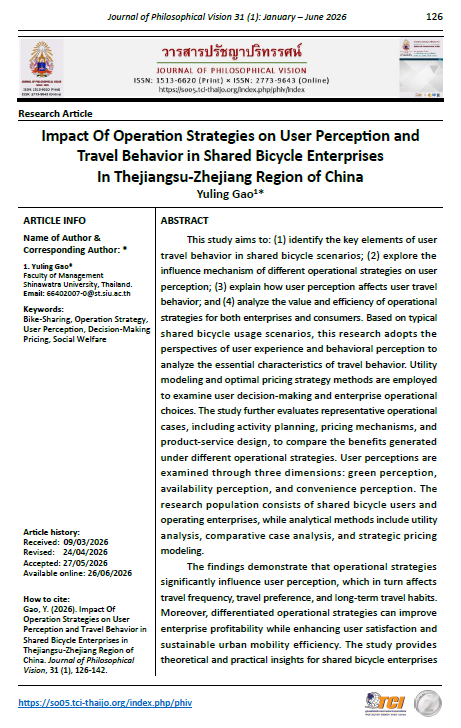
This study aims to: (1) identify the key elements of user travel behavior in shared bicycle scenarios; (2) explore the influence mechanism of different operational strategies on user perception; (3) explain how user perception affects user travel behavior; and (4) analyze the value and efficiency of operational strategies for both enterprises and consumers. Based on typical shared bicycle usage scenarios, this research adopts the perspectives of user experience and behavioral perception to analyze the essential characteristics of travel behavior. Utility modeling and optimal pricing strategy methods are employed to examine user decision-making and enterprise operational choices. The study further evaluates representative operational cases, including activity planning, pricing mechanisms, and product-service design, to compare the benefits generated under different operational strategies. User perceptions are examined through three dimensions: green perception, availability perception, and convenience perception. The research population consists of shared bicycle users and operating enterprises, while analytical methods include utility analysis, comparative case analysis, and strategic pricing modeling.
The findings demonstrate that operational strategies significantly influence user perception, which in turn affects travel frequency, travel preference, and long-term travel habits. Moreover, differentiated operational strategies can improve enterprise profitability while enhancing user satisfaction and sustainable urban mobility efficiency. The study provides theoretical and practical insights for shared bicycle enterprises and policymakers seeking to optimize sustainable transportation systems.
Downloads
เอกสารอ้างอิง
Ajzen, I. (1991). The theory of planned behavior. Organizational Behavior and Human Decision Processes, 50(2), 179–211. https://doi.org/10.1016/0749-5978(91)90020-T
Bao, J., He, T., Ruan, S., ... (2017). Planning bike lanes based on sharing-bikes' trajectories. In Proceedings of the 23rd ACM SIGKDD International Conference on Knowledge Discovery and Data Mining (1377-1386).
Beers, C., & Zand, F. (2014). R&D cooperation, partner diversity, and innovation performance. Journal of Product Innovation Management, 31(3), 477–490. https://doi. org/10.1111/jpim.12103
Bigne-Alcaniz, E., Sanchez-Garcia, I., & Sanz-Blas, S. (2011). The impact of brand credibility on consumer loyalty in online services. Journal of Service Marketing, 25(5), 326–334.
Channuwong, S., Siripap, P., Ladnongkun, V., Makingrilas., J. (2022). The model of
marketing strategies influencing customer satisfaction of supermarkets in Bangkok
areas. The Journal of MCU Peace Studies, 10(2), 472-487.
https://doi.org/10.2478/ejes-2018-0047
Chen, J. (2018). Pricing strategy and government subsidy in internet-based bike-sharing systems: A bi-level programming approach. Transportation Research Part C: Emerging Technologies, 92, 1–18.
Ding, H. (2017). The development and current status of bike-sharing systems in Japan: Implications for urban transport planning. Journal of Transport Geography, 62, 1–10.
El-Assi, W., Mahmoud, M. S., & Nurul Habib, K. (2017). Effects of built environment and weather on bike sharing demand: A station level analysis of commercial bike sharing in Toronto. Transportation, 44, 589–613.
Farla, J., Markard, J., Raven, R., & Coenen, L. (2010). Sustainability transitions in the making: A closer look at actors, strategies and resources. Research Policy, 41(6), 991–1001.
Fishman, E., Washington, S., & Haworth, N. (2013). Bike share: A synthesis of the literature. Transport Reviews, 33(2), 148–165.
Ji, Y., et al. (2014). Simulation analysis of electric bike-sharing systems: User demand and service availability. Simulation Modelling Practice and Theory, 42, 1–15.
Kaspi, M., Raviv, T., & Tzur, M. (2017). Service quality in bike-sharing systems: The effect of unavailable bicycles. Transportation Research Part B: Methodological, 99, 63–84.
Liu, T. X. (2018). Research on the legal issues and risks of shared bicycle deposits (Master’s thesis, Capital University of Economics and Business). (Translated from Chinese)
Li, Y., Zhang, T., & Zhao, J. (2018). Financial incentives and adoption of green transportation services. Journal of Cleaner Production, 172, 234–243.
Liu, C., & Liu, Y. (2017). Externalities and public acceptance of bike-sharing systems in urban transport. Journal of Transport Geography, 58, 34–42.
Liu, J. L., & Liu, Z. L. (2017). Research on the externality analysis and development strategy of shared bicycles. Transport Research, 4(3), 1–7. (Translated from Chinese)
Liu, Y. (2018). Trust, risk, and legal issues in shared mobility platforms. Information & Management, 55(4), 467–477.
Mitra, S., & Webster, S. (2008). Competition in remanufacturing and the effects of government subsidies. International Journal of Production Economics, 111(2), 287–298.
Pan, Y., & Zinkhan, G. M. (2006). Determinants of retail patronage: A meta-analytical perspective. Journal of Retailing, 82(3), 229–243.
Pal, A., & Zhang, Y. (2017). Free-floating bike sharing: solving real-life large-scale static rebalancing problems. Transportation Research Part C: Emerging Technologies, 80, 92-116.
Price, J. C., Walker, I. A., & Boschetti, F. (2014). Measuring cultural values and beliefs about environment to identify their role in climate change responses. Journal of Environmental Psychology, 37(3), 8-20.
Qian, X. (2015). Demand prediction and usage pattern analysis in bike-sharing systems using Markov chains. Procedia Engineering, 137, 582–589.
Qin, H., & Wang, L. (2017). Collaborative consumption in the sharing economy: A case of bike-sharing systems. International Journal of Information Management, 37(6), 521–528.
Richardson, L. (2015). Performing the sharing economy. Geoforum, 67, 121–129.
Samet, B., Couffin, F., Zolghadri, M., Barkallah, M., & Haddar, M. (2018). Performance Analysis and Improvement of the Bike Sharing System Using Closed Queuing Networks with Blocking Mechanism. Sustainability, 10(12), 4663.
Shu, J., Chou, M. C., Liu, Q., Teo, C. P., & Wang, I. L. (2013). Models for effective deployment and redistribution of bicycles within public bicycle-sharing systems. Operations Research, 61(6), 1346-1359.
Swink, M., & Song, M. (2007). Effects of marketing-manufacturing integration on new product development time and competitive advantage. Journal of Operations Management, 25(1), 203-217.
Tan, Y. L. (2015). Research on supply and demand of public bicycle stations based on Markov chain model. (Master's thesis, Xi'an Jiaotong University). (Translated from Chinese).
ดาวน์โหลด
เผยแพร่แล้ว
รูปแบบการอ้างอิง
ฉบับ
ประเภทบทความ
สัญญาอนุญาต
ลิขสิทธิ์ (c) 2026 Journal of Philosophical Vision

อนุญาตภายใต้เงื่อนไข Creative Commons Attribution-NonCommercial-NoDerivatives 4.0 International License.
บทความวิชาการและบทความวิจัย ในวารสารฉบับนี้ ถือเป็นความรับผิดชอบของผู้เขียนเท่านั้น
สงวนลิขสิทธิ์ตามพระราชบัญญัติลิขสิทธิ์



