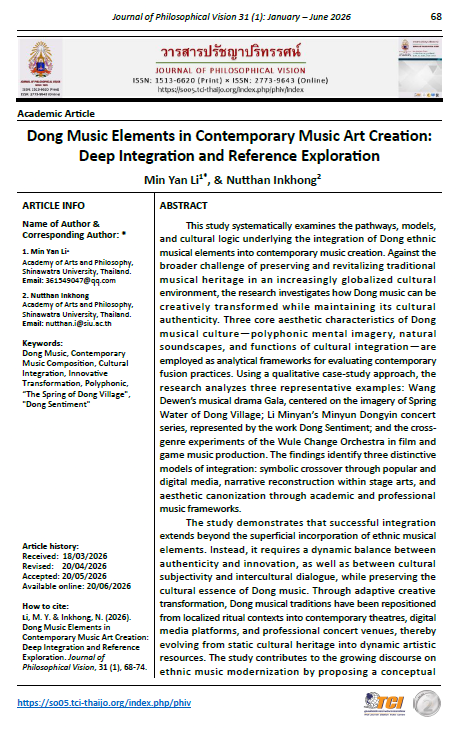
Dong Music Elements in Contemporary Music Art Creation: Deep Integration and Reference Exploration
บทคัดย่อ
This study systematically examines the pathways, models, and cultural logic underlying the integration of Dong ethnic musical elements into contemporary music creation. Against the broader challenge of preserving and revitalizing traditional musical heritage in an increasingly globalized cultural environment, the research investigates how Dong music can be creatively transformed while maintaining its cultural authenticity. Three core aesthetic characteristics of Dong musical culture—polyphonic mental imagery, natural soundscapes, and functions of cultural integration—are employed as analytical frameworks for evaluating contemporary fusion practices. Using a qualitative case-study approach, the research analyzes three representative examples: Wang Dewen’s musical drama Gala, centered on the imagery of Spring Water of Dong Village; Li Minyan’s Minyun Dongyin concert series, represented by the work Dong Sentiment; and the cross-genre experiments of the Wule Change Orchestra in film and game music production. The findings identify three distinctive models of integration: symbolic crossover through popular and digital media, narrative reconstruction within stage arts, and aesthetic canonization through academic and professional music frameworks.
The study demonstrates that successful integration extends beyond the superficial incorporation of ethnic musical elements. Instead, it requires a dynamic balance between authenticity and innovation, as well as between cultural subjectivity and intercultural dialogue, while preserving the cultural essence of Dong music. Through adaptive creative transformation, Dong musical traditions have been repositioned from localized ritual contexts into contemporary theatres, digital media platforms, and professional concert venues, thereby evolving from static cultural heritage into dynamic artistic resources. The study contributes to the growing discourse on ethnic music modernization by proposing a conceptual framework for understanding the sustainable transmission and contemporary adaptation of indigenous musical traditions. It offers both theoretical insights and practical strategies for cultural preservation, creative innovation, and the integration of traditional music within contemporary artistic ecosystems.
Downloads
เอกสารอ้างอิง
Li Minyan. (2019). "Min Yun" and "Dong Yin": Cultural Dialogues in My Vocal Art Practice. Journal of the Central Conservatory of Music, 3, 88-95.
Nettl, B. (2005). The study of ethnomusicology: Thirty-one issues and concepts. University of Illinois Press.
Sirathanakul, K., Harnpanich, B., Channuwong, S., Bangbon, P., Niangchaem, L., Sutthadaanantaphokin, K. (2023). The influence of human resource management on
Educational Administration of Thai Private Universities. Migration Letters, 20 (S1), 423-436.
Stokes, M. (1994). Ethnicity Identity and Music: The Musical Construction of Place. Berg
Publishing.
Tian, L. (2001). Traditional music of China's ethnic minorities. Central University for Nationalities Press.
Wang, D. (2014). The creative concept and application of Dong ethnic music elements in the musical 'Gala". Journal of Guizhou Art Research, 2, 15-22.
Xu, X. (2016). The local sensibility of sound: A study on the music and auditory ecology of the Dong people in Southeast Guizhou. Shanghai Conservatory of Music Press.
Xiao, M. (2017). A Study of music anthropology returning to sound. Music Art, 1,6-18.
Yang, X. &, Liu, L. (2023). When Dong Songs meet the 2D World: Singing of Chan Yi Ge' in Hollow Knight: Star Railways. China Youth Daily, 08-11/02/2023.
Yinliu, Y. (1981). A draft history of ancient Chinese music. People's Music Publishing House.
Zhang, Z., & Yang, F. (2007). Fifty years of research on Dong Grand Song. Guizhou Ethnic Publishing House.
ดาวน์โหลด
เผยแพร่แล้ว
รูปแบบการอ้างอิง
ฉบับ
ประเภทบทความ
สัญญาอนุญาต
ลิขสิทธิ์ (c) 2026 Journal of Philosophical Vision

อนุญาตภายใต้เงื่อนไข Creative Commons Attribution-NonCommercial-NoDerivatives 4.0 International License.
บทความวิชาการและบทความวิจัย ในวารสารฉบับนี้ ถือเป็นความรับผิดชอบของผู้เขียนเท่านั้น
สงวนลิขสิทธิ์ตามพระราชบัญญัติลิขสิทธิ์



