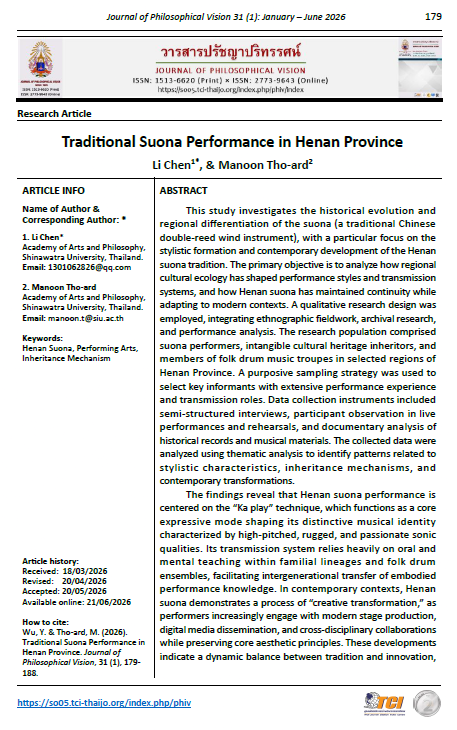
Traditional Suona Performance in Henan Province
บทคัดย่อ
This study investigates the historical evolution and regional differentiation of the suona (a traditional Chinese double-reed wind instrument), with a particular focus on the stylistic formation and contemporary development of the Henan suona tradition. The primary objective is to analyze how regional cultural ecology has shaped performance styles and transmission systems, and how Henan suona has maintained continuity while adapting to modern contexts. A qualitative research design was employed, integrating ethnographic fieldwork, archival research, and performance analysis. The research population comprised suona performers, intangible cultural heritage inheritors, and members of folk drum music troupes in selected regions of Henan Province. A purposive sampling strategy was used to select key informants with extensive performance experience and transmission roles. Data collection instruments included semi-structured interviews, participant observation in live performances and rehearsals, and documentary analysis of historical records and musical materials. The collected data were analyzed using thematic analysis to identify patterns related to stylistic characteristics, inheritance mechanisms, and contemporary transformations.
The findings reveal that Henan suona performance is centered on the “Ka play” technique, which functions as a core expressive mode shaping its distinctive musical identity characterized by high-pitched, rugged, and passionate sonic qualities. Its transmission system relies heavily on oral and mental teaching within familial lineages and folk drum ensembles, facilitating intergenerational transfer of embodied performance knowledge. In contemporary contexts, Henan suona demonstrates a process of “creative transformation,” as performers increasingly engage with modern stage production, digital media dissemination, and cross-disciplinary collaborations while preserving core aesthetic principles. These developments indicate a dynamic balance between tradition and innovation, offering empirical insights into the resilience and adaptive mechanisms of intangible cultural heritage in China.
Downloads
เอกสารอ้างอิง
Chen, X. (2020). Research on the lineage and repertoire of inheritors of Qingshan suona (Qingshan suona chuanchengren puxi yu chuancheng qumu yanjiu). Guangming Daily Press.
Gao, C. C. (2015). The development of suona music and the cultivation of professional talents. Yellow River Voice, 6, 78–79.
Gao, C. C. (2023). A comparative study on the development of Chinese suona art schools from the perspective of comparative art studies. Symphony Journal of Xi'an Conservatory of Music, 1, 128–132.
Gao, Changchun. (2023). A comparative artistic perspective on the development of China suona art schools.
Hao, Y. Q. (1986). Performance characteristics of Henan suona. People's Music, 2, 26–27.
Hao, Y. Q. (1992). On the styles of Henan and Shandong suona. Huangzhong Journal of Wuhan Conservatory of Music, 1, 87–91.
Hao, Yuqi. (1992). Study on the localization development of Henan suona tradition.
Hu, Y. (2021). On the inheritance and innovation of traditional and modern suona works. Yellow River Voice, 18, 115–117.
Liu, Y. (2020). Contemporary transformations of Chinese folk instrumental music. Journal of Ethnomusicology Studies, 45(2), 112–130.
Liu, Yanchun. (2006). Henan music records.
Mei, X. L. (2004). Three topics on suona research. New Voice of Yuefu (Journal of Shenyang Conservatory of Music), (02), 46–50.
Mei, Xuelin. (2004). Research on the cultural meaning and social function of the suona.
Qureshi, R. (2007). Musical sound and cultural meaning in ritual performance. Ethnomusicology Forum, 16(1), 45–67.
Selected Suona Etudes. (n.d.). Educational compilation of suona repertoires and exercises.
Sun, Z. G. (2012). The inheritance and innovation of Henan folk music. Chinese Music, 4, 45–51.
Tian, Q. (2005). Research on Chinese funeral music. Art Research, 3, 22–28.
UNESCO. (2003). Convention for the safeguarding of the intangible cultural heritage. Paris: UNESCO.
Wang, Z. Z. (2020). The inheritance of contemporary suona art. People's Music, 11, 30–33.
Wong, D. (2012). Sounding the center: History and aesthetics in Chinese music. University of Chicago Press.
Yang, M. (2018). Regional identity and performance practice in Chinese folk wind music. Asian Music Review, 29(3), 78–95.
Yang, Y. L. (1981). Draft history of ancient Chinese music (Zhongguo gudai yinyue shigao). People's Music Publishing House.
Zhang, F. (2022). The historical background and performance techniques of the suona piece “Chunhua Lanman”. Thesis, Shandong University of Arts, China.
Zhang, G. L. (2008). Traditional music (Chuantong yinyue). Shandong Friendship Press.
Zhang, Z. K. (2005). A preliminary exploration of the cultural connotations of folk suona tunes. New Voice of Yuefu (Journal of Shenyang Conservatory of Music), (01), 43–46.
Zhang, Zhike. (2005). Research on the historical development of suona and its socio-cultural context.
Zhou, Z. C. (2016). A brief discussion on the characteristics and development of Henan school suona. Northern Music, 10, 15–25.
ดาวน์โหลด
เผยแพร่แล้ว
รูปแบบการอ้างอิง
ฉบับ
ประเภทบทความ
สัญญาอนุญาต
ลิขสิทธิ์ (c) 2026 Journal of Philosophical Vision

อนุญาตภายใต้เงื่อนไข Creative Commons Attribution-NonCommercial-NoDerivatives 4.0 International License.
บทความวิชาการและบทความวิจัย ในวารสารฉบับนี้ ถือเป็นความรับผิดชอบของผู้เขียนเท่านั้น
สงวนลิขสิทธิ์ตามพระราชบัญญัติลิขสิทธิ์



