
Interpretation of Religion to Religious philosophy
Keywords:
อรรถปริวรรต; , ปรัชญา; , ศาสนาAbstract
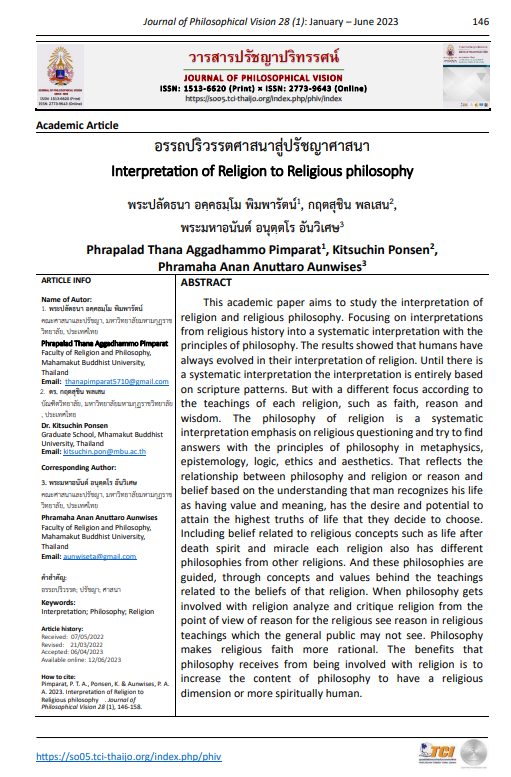
This academic paper aims to study the interpretation of religion and religious philosophy. Focusing on interpretations from religious history into a systematic interpretation with the principles of philosophy. The results showed that humans have always evolved in their interpretation of religion. Until there is a systematic interpretation the interpretation is entirely based on scripture patterns. But with a different focus according to the teachings of each religion, such as faith, reason and wisdom. The philosophy of religion is a systematic interpretation emphasis on religious questioning and try to find answers with the principles of philosophy in metaphysics, epistemology, logic, ethics and aesthetics. That reflects the relationship between philosophy and religion or reason and belief based on the understanding that man recognizes his life as having value and meaning, has the desire and potential to attain the highest truths of life that they decide to choose. Including belief related to religious concepts such as life after death spirit and miracle each religion also has different philosophies from other religions. And these philosophies are guided, through concepts and values behind the teachings related to the beliefs of that religion. When philosophy gets involved with religion analyze and critique religion from the point of view of reason for the religious see reason in religious teachings which the general public may not see. Philosophy makes religious faith more rational. The benefits that philosophy receives from being involved with religion is to increase the content of philosophy to have a religious dimension or more spiritually human.
Downloads
References
กีรติ บุญเจือ. (2546). ปรัชญาและศาสนาเพื่อสันติภาพ ชุดรวมบทความเล่มที่ 6 มนุษย์กับสันติภาพ. พิมพ์ ครั้งที่ 3. กรุงเทพฯ: จุฬาลงกรณมหาวิทยาลัย.
พระมหาสมบูรณ์ วุฑฺฒิกโร, “ศาสตร์แห่งการตีความแนวพุทธ”. 9 กุมภาพันธ์ 2555. <http://oldweb.mcu.ac.th/site/articlecontent_desc.php?article_id=449&articlegroup_id=102> (7 February 2022).
ญาณวชิระ. (2549). ทฤษฎีเบื้องต้นแห่งปรัชญาไทย : กำเนิดและพัฒนาการความคิดด้านอภิปรัชญา ญาณวิทยา จริยศาสตร์ จักรวาลวิทยา และสุนทรียศาสตร์ไทย. กรุงเทพมหานคร : วชิราสำนักพิมพ์.
Briggs, R. S. (2006). What Does Hermeneutics Have to Do With Biblical Interpretation? Heythrop Journal XLVII.
Bleicher, J. (1980). Contemporary Hermeneutics: Hermeneutics as Method, Philosophy and Critique. London: Routledge.
Duke, J. (1977).Schleiermacher: On Hermeneutics. In F. D. E. Schleiermacher. Hermeneutics: The Handwritten Manuscripts.
Hoy, D. C. (1993). Heidegger and the Hermeneutic Turn. In Charles Guignon (ed.). The Cambridge Companion to Heidegger. Cambridge: Cambridge University Press.
Inwood, M. (1998). Hermeneutics. In Edward Craig (ed.). Routledge Encyclopedia of Philosophy. London: Routledge. [CD- Rom Version 1.0].
Prasad, A. (2002). The Contest over Meaning: Hermeneutics as an Interpretive Methodology for Understanding Texts. Organizational Research Method 5(1):
Ricoeur, P. (1981). The Task of Hermeneutics. In Hermeneutics and the Human Sciences: Essays on Language, Action and Interpretation, (Ed. and Trans. John B. Thompson). Cambridge: Cambridge University Press.
Seebohm, T. M. (2004). Hermeneutics. Method and Methodology. Dordrecht: Kluwer Academic Publishers.
Wallace, V. A. (2003). The Methodological Relevance of Contemporary Biblical Scholarship to the Study of Buddhism. In Roger Jackson and John Makransky (eds.). Buddhist Theology: Critical Reflections by Contemporary Buddhist Scholars. London: RoutledgeCurzon.
Downloads
Published
How to Cite
Issue
Section
License
Copyright (c) 2023 Journal of Philosophical Vision

This work is licensed under a Creative Commons Attribution-NonCommercial-NoDerivatives 4.0 International License.
บทความวิชาการและบทความวิจัย ในวารสารฉบับนี้ ถือเป็นความรับผิดชอบของผู้เขียนเท่านั้น
สงวนลิขสิทธิ์ตามพระราชบัญญัติลิขสิทธิ์



