Analysis of Abandoning Reason in Kesaputta Sutta
Keywords:
Abandoning reason; , Logic; , Kesaputta SuttaAbstract
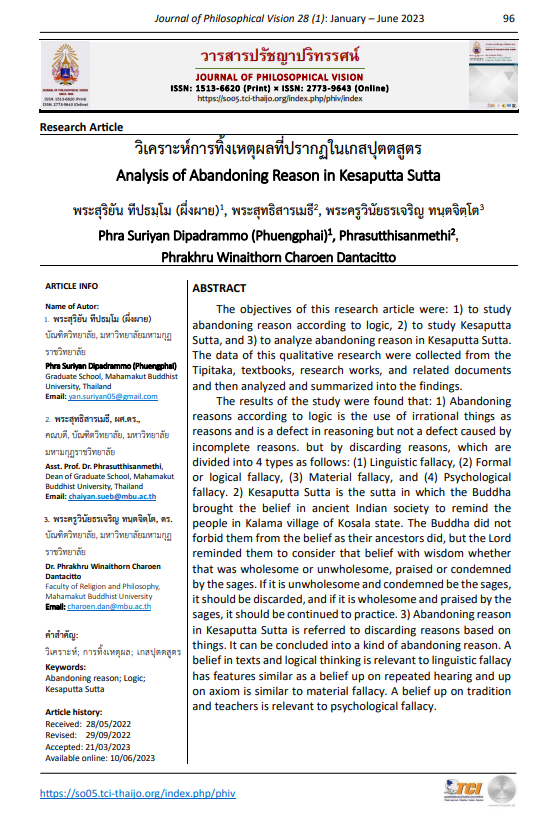
The objectives of this research article were: 1) to study abandoning reason according to logic, 2) to study Kesaputta Sutta, and 3) to analyze abandoning reason in Kesaputta Sutta. The data of this qualitative research were collected from the Tipitaka, textbooks, research works, and related documents and then analyzed and summarized into the findings.
The results of the study were found that: 1) Abandoning reasons according to logic is the use of irrational things as reasons and is a defect in reasoning but not a defect caused by incomplete reasons. but by discarding reasons, which are divided into 4 types as follows: (1) Linguistic fallacy, (2) Formal or logical fallacy, (3) Material fallacy, and (4) Psychological fallacy. 2) Kesaputta Sutta is the sutta in which the Buddha brought the belief in ancient Indian society to remind the people in Kalama village of Kosala state. The Buddha did not forbid them from the belief as their ancestors did, but the Lord reminded them to consider that belief with wisdom whether that was wholesome or unwholesome, praised or condemned by the sages. If it is unwholesome and condemned be the sages, it should be discarded, and if it is wholesome and praised by the sages, it should be continued to practice. 3) Abandoning reason in Kesaputta Sutta is referred to discarding reasons based on things. It can be concluded into a kind of abandoning reason. A belief in texts and logical thinking is relevant to linguistic fallacy has features similar as a belief up on repeated hearing and up on axiom is similar to material fallacy. A belief up on tradition and teachers is relevant to psychological fallacy.
Downloads
References
โกเมนทร์ ชินวงศ์. 2556. ตรรกศาสตร์เบื้องต้น. กรุงเทพฯ: สำนักพิมพ์มหาวิทยาลัยเกษตรศาสตร์.
คณาจารย์ มหาวิทยามหาจุฬาลงกรณราชวิทยาลัย. 2558. ตรรกศาสตร์เบื้องต้น. พิมพ์ครั้งที่ 3. กรุงเทพมหานคร: โรงพิมพ์มหาจุฬาลงกรณราชวิทยาลัย. 2558.
ชเอิญศรี อิศรางกูร ณ อยุธยา และวิโรจน์ นาคชาตรี. 2542. การใช้เหตุผล. พิมพ์ครั้งที่ 2. กรุงเทพมหานคร: สำนักพิมพ์มหาวิทยารามคำแหง.
ชูศักดิ์ ทิพย์เกษร. 2547. พระพุทธเจ้าสอนอะไร แปลจากภาษาอังกฤษเป็นภาษาไทย. กรุงเทพมหานคร: โรงพิมพ์มหาจุฬาลงกรณราชวิทยาลัย.
ปรีชา ช้างขวัญยืนและคณะ. 2559. การใช้เหตุผล: ตรรกวิทยาเชิงปฏิบัติ. พิมพ์ครั้งที่ 12. กรุงเทพมหานคร: โรงพิมพ์แห่งจุฬาลงกรณ์มหาวิทยาลัย.
มหาจุฬาลงกรณราชวิทยาลัย. 2539. พระไตรปิฎกภาษาไทย ฉบับมหาจุฬาลงกรณราชวิทยาลัย. กรุงเทพมหานคร: โรงพิมพ์มหาจุฬาลงกรณราชวิทยาลัย.
Downloads
Published
How to Cite
Issue
Section
License
Copyright (c) 2023 Journal of Philosophical Vision

This work is licensed under a Creative Commons Attribution-NonCommercial-NoDerivatives 4.0 International License.
บทความวิชาการและบทความวิจัย ในวารสารฉบับนี้ ถือเป็นความรับผิดชอบของผู้เขียนเท่านั้น
สงวนลิขสิทธิ์ตามพระราชบัญญัติลิขสิทธิ์



