Phrasirimankalacaraya “Philosopher of Lan Na” Author of Mangalatthadipani
Keywords:
Phrasiri Mangkalajarn, Philosopher of Lan Na, MangalatthadipaniAbstract
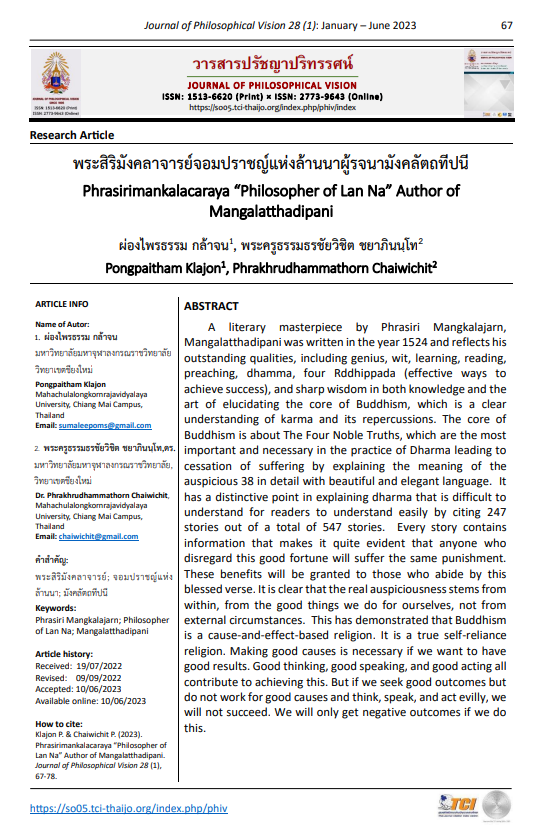
A literary masterpiece by Phrasiri Mangkalajarn, Mangalatthadipani was written in the year 1524 and reflects his outstanding qualities, including genius, wit, learning, reading, preaching, dhamma, four Rddhippada (effective ways to achieve success), and sharp wisdom in both knowledge and the art of elucidating the core of Buddhism, which is a clear understanding of karma and its repercussions. The core of Buddhism is about The Four Noble Truths, which are the most important and necessary in the practice of Dharma leading to cessation of suffering by explaining the meaning of the auspicious 38 in detail with beautiful and elegant language. It has a distinctive point in explaining dharma that is difficult to understand for readers to understand easily by citing 247 stories out of a total of 547 stories. Every story contains information that makes it quite evident that anyone who disregard this good fortune will suffer the same punishment. These benefits will be granted to those who abide by this blessed verse. It is clear that the real auspiciousness stems from within, from the good things we do for ourselves, not from external circumstances. This has demonstrated that Buddhism is a cause-and-effect-based religion. It is a true self-reliance religion. Making good causes is necessary if we want to have good results. Good thinking, good speaking, and good acting all contribute to achieving this. But if we seek good outcomes but do not work for good causes and think, speak, and act evilly, we will not succeed. We will only get negative outcomes if we do this.
Downloads
References
กรมการศาสนา. 2539, พระไตรปิฎกภาษาไทย ฉบับมหาจุฬาลงกรณราชวิทยาลัย. กรุงเทพมหานคร: โรงพิมพ์มหาจุฬาลงกรณราชวิทยาลัย.
ใจเพชร กล้าจน. 2563. บททบทวนธรรม. พิมพ์ครั้งที่ 3. กรุงเทพมหานคร: บริษัทพิมพ์ดี.
ธีระ อุษณกรกุล. 2556. ธรรมพุทธสุดลึก. (พิมพ์ครั้งที่ 6). กรุงเทพมหานคร: อุษาการพิมพ์.
พระครูศิริปัญญามุนี (อ่อน). (ม.ป.ป.). คัมภีร์มงคลทีปนีแปลโดยพิสดารเล่มเดียวจบ.
พระครูธีรสุดพจน์ (พระมหาสง่า ธีรสํวโร). 2556. ตามรอยพระสิริมังคลาจารย์สังฆปราชญ์ล้านนา. เชียงใหม่: มหาวิทยาลัยมหาจุฬาลงกรณราชวิทยาลัย วิทยาเขตเชียงใหม่.
พระมหาอดุลย์ คนแรง. 2541. การศึกษาเชิงวิเคราะห์มังคลัตถทีปนี. วิทยานิพนธ์ปริญญาศิลปศาสตรมหา บัณฑิต สาขาวิชาจารึกภาษาไทย. บัณฑิตวิทยาลัย: มหาวิทยาลัยศิลปากร,
พระมหาพิเชษฎ์ จตฺตมโล. 2559. การศึกษาเชิงวิเคราะห์การพัฒนาคุณภาพชีวิตตามหลักคำสอนในมงคล สูตร. พุทธมัคค์. ปีที่ 1 ฉบับที่ 2 (กรกฎาคม-ธันวาคม): 19-24.
พระสิริมังคลาจารย์ มหาปราชญ์แห่งล้านนา. 2564. แหล่งที่มา: http://historicallanna01.blogspot.com/2011/04/blog-post_14.html [เข้าถึง 10 กันยายน 2564].
พระเจ้าติโลกราช. 2564. แหล่งที่มา: https://th.wikipedia.org/wiki/มังคลัตถปนี [25 สิงหาคม 2564]
สมณะโพธิรักษ์. 2564. รวมเปิดโลกบุญนิยม เล่ม 2. กรุงเทพฯ: ฟ้าอภัย.
สมิทธิพล เนตรนิมิต. 2560. มังคลัตถทีปนี : แนวทางการดำรงอยุ่แห่งชีวิตที่ยั่งยืน. มหาวิทยาลัยมหาจุฬา ลงกรณราชวิทยาลัย. มหาจุฬาวิชาการ. ปีที่ 4 ฉบับที่ 1: 17-32.
อภิสิน ศิวยาธร. 2563. อภิธานศัพท์อโศก. กรุงเทพฯ: บริษัท วิสคอมเซ็นเตอร์ จำกัด.
Downloads
Published
How to Cite
Issue
Section
License
Copyright (c) 2023 Journal of Philosophical Vision

This work is licensed under a Creative Commons Attribution-NonCommercial-NoDerivatives 4.0 International License.
บทความวิชาการและบทความวิจัย ในวารสารฉบับนี้ ถือเป็นความรับผิดชอบของผู้เขียนเท่านั้น
สงวนลิขสิทธิ์ตามพระราชบัญญัติลิขสิทธิ์



