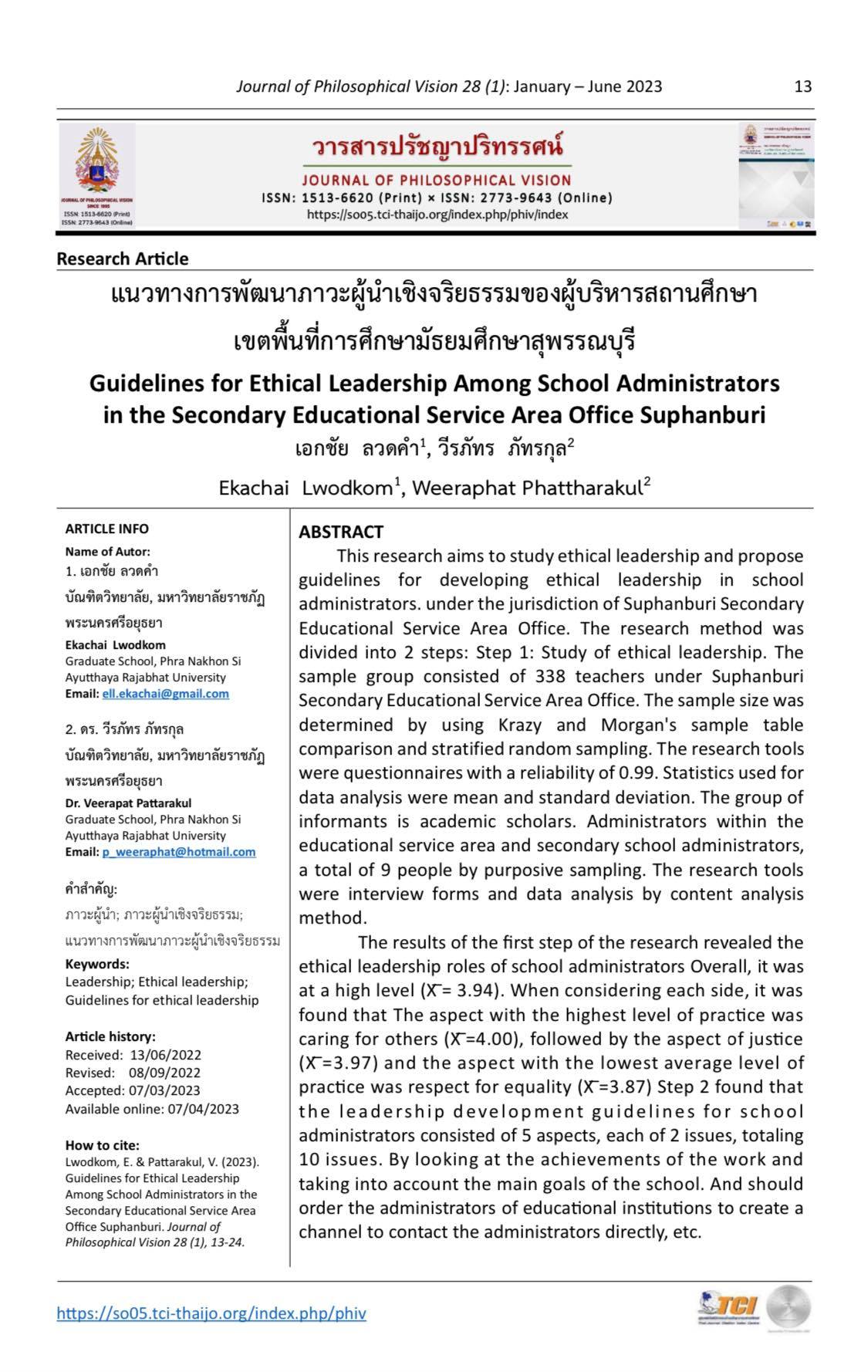
Guidelines for Ethical Leadership Among School Administrators in the Secondary Educational Service Area Office Suphanburi
Keywords:
Leadership, Ethical leadership, Guidelines for ethical leadershipAbstract
This research aims to study ethical leadership and propose guidelines for developing ethical leadership in school administrators. under the jurisdiction of Suphanburi Secondary Educational Service Area Office. The research method was divided into 2 steps: Step 1: Study of ethical leadership. The sample group consisted of 338 teachers under Suphanburi Secondary Educational Service Area Office. The sample size was determined by using Krazy and Morgan's sample table comparison and stratified random sampling. The research tools were questionnaires with a reliability of 0.99. Statistics used for data analysis were mean and standard deviation. The group of informants is academic scholars. Administrators within the educational service area and secondary school administrators, a total of 9 people by purposive sampling. The research tools were interview forms and data analysis by content analysis method.
The results of the first step of the research revealed the ethical leadership roles of school administrators Overall, it was at a high level (X ̅= 3.94). When considering each side, it was found that The aspect with the highest level of practice was caring for others (X ̅=4.00), followed by the aspect of justice (X ̅=3.97) and the aspect with the lowest average level of practice was respect for equality (X ̅=3.87) Step 2 found that the leadership development guidelines for school administrators consisted of 5 aspects, each of 2 issues, totaling 10 issues. By looking at the achievements of the work and taking into account the main goals of the school. And should order the administrators of educational institutions to create a channel to contact the administrators directly, etc.
Downloads
References
ชาญสิทธิ์ คำเทศ. (2560). การพัฒนารูปแบบการบริหารผลการปฏิบัติงานของครูสังกัดสำนักงานเขตพื้นที่การศึกษาประถมศึกษานนทบุรี. วารสารวิชาการมหาวิทยาลัยอิสเทิร์นเอเชีย ฉบับสังคมสาศตร์และมนุษย์ศาสตร์, 7(1), 132-137.
พิมพ์ใจ โนนธิง. (2558). การบริหารสถานศึกษาตามหลักพรหมวิหาร 4 ในโรงเรียนขยายโอกาสทางการศึกษาสังกัดสำนักงานเขตพื้นที่การศึกษาประถมศึกษาขอนแก่น เขต 4. ธรรมทรรศน์, 15(1), 135-142.
ลัดดา จุลวงศ์. (2563). การบริหารสถานศึกษาด้วยภาวะผู้นำเชิงจิตวิญญาณ. วารสารวิชาการและวิจัยสังคมศาสตร์, 15(1), 17-30.
วาริษา ประเสริฐทรง. (2558). ทักษะภาวะผู้นำด้าน SOFT SKILLS ของผู้บริหารสถานศึกษา สังกัดสำนักงานเขตพื้นที่การศึกษามัธยมศึกษา เขต 25. วารสารศึกษาศาสตร์ มหาวิทยาลัยขอนแก่น, 38(2), 88-95.
วินัย ทองมั่น. (2563). คุณธรรมและจริยธรรม แนวทางป้องกันความไม่โปร่งใสในการบริหารสถานศึกษา.บัณฑิตศึกษาปริทรรศน์ วิทยาลัยสงฆ์นครสวรรค์. 8(1), 367-375.
สำนักงานเขตพื้นที่การศึกษามัธยมศึกษา เขต 9. (2563). เอกสารหมายเลข 5/2563 แผนพัฒนาคุณภาพการศึกษาสำนักงานเขตพื้นที่การศึกษามัธยมศึกษา เขต 9 พ.ศ.2563-2565. สุพรรณบุรี.
สำนักงานคณะกรรมการการศึกษาแห่งชาติ. (2543). ปฏิรูปการเรียนรู้ผู้เรียนสำคัญที่สุด. กรุงเทพฯ : บริษัทพิมพ์ดี.
สำนักงานเลขาธิการวุฒิสภา ปฏิบัติหน้าที่สำนักงานเลขาธิการสภานิติบัญญัติแห่งชาติ. (2560). รัฐธรรมนูญแห่งราชอาณาจักรไทย พุทธศักราช 2560. พิมพ์ครั้งที่ 3 กรุงเทพฯ: สำนักงานเลขาธิการวุฒิสภา, 4.
สุรเชษฐ์ โซวเกียรติรุ่ง. (2553). คุณธรรมและจริยธรรมสำหรับผู้นำ. วารสารการพัฒนาทรัพยากรมนุษย์, 6, 166-175.
Brown, M. E., Trevino, L. K., & Harrison, D. (2005). Ethical Leadership: A Social Learning Perspective for Construct Development and Testing. Organizational Behavior and Human Decision Processes. 97, 117-134.
Krejcie, R.V., & D.W. Morgan. (1970). “Determining Sample Size for Research Activities”. Educational and Psychological Measurement. 30(3), 607 – 610.
Downloads
Published
How to Cite
Issue
Section
License
Copyright (c) 2023 Journal of Philosophical Vision

This work is licensed under a Creative Commons Attribution-NonCommercial-NoDerivatives 4.0 International License.
บทความวิชาการและบทความวิจัย ในวารสารฉบับนี้ ถือเป็นความรับผิดชอบของผู้เขียนเท่านั้น
สงวนลิขสิทธิ์ตามพระราชบัญญัติลิขสิทธิ์



