An Analytical Study of Dangers in Buddhism
Keywords:
Dangers in Buddhism, Analysis of dangers, BuddhismAbstract
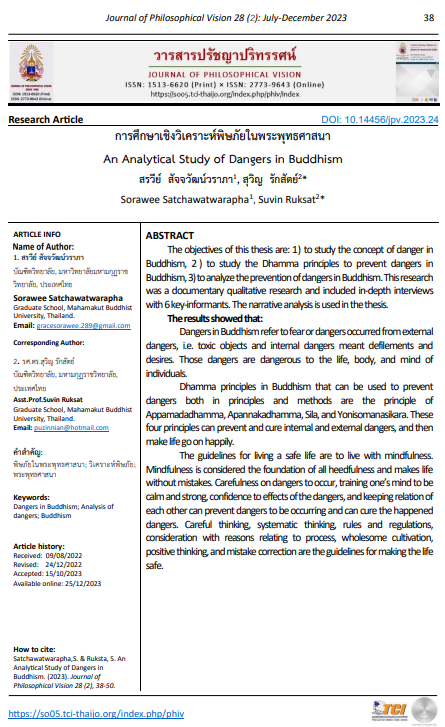
ABSTRACT
The objectives of this thesis are: 1) to study the concept of danger in Buddhism, 2) to study the Dhamma principles to prevent dangers in Buddhism, 3) to analyze the prevention of dangers in Buddhism. This research was a documentary qualitative research and included in-depth interviews with 6 key-informants. The narrative analysis is used in the thesis.
The results showed that:
Dangers in Buddhism refer to fear or dangers occurred from external dangers, i.e. toxic objects and internal dangers meant defilements and desires. Those dangers are dangerous to the life, body, and mind of individuals.
Dhamma principles in Buddhism that can be used to prevent dangers both in principles and methods are the principle of Appamadadhamma, Apannakadhamma, Sila, and Yonisomanasikara. These four principles can prevent and cure internal and external dangers, and then make life go on happily.
The guidelines for living a safe life are to live with mindfulness. Mindfulness is considered the foundation of all heedfulness and makes life without mistakes. Carefulness on dangers to occur, training one’s mind to be calm and strong, confidence to effects of the dangers, and keeping relation of each other can prevent dangers to be occurring and can cure the happened dangers. Careful thinking, systematic thinking, rules and regulations, consideration with reasons relating to process, wholesome cultivation, positive thinking, and mistake correction are the guidelines for making the life safe.
Downloads
References
กรุงเทพธุรกิจ, (2563). สสจ.บุรีรัมย์พบ'สารฟอร์มาลิ่นในอาหารทะเล. สืบค้นเมื่อ 28 มกราคม 2563, จาก https://www.bangkokbiznews.com/news/detail/623745>
จิตศริณย์พร ปัญจวัฒนคุณ. (2559). ศึกษาวิเคราะห์กระบวนการขัดเกลากิเลสที่ปรากฏในสัลเลขสูตร. วารสารบัณฑิตศาส์น มมร. 14(1), 1-11.
เดลินิวส์, (2563). ความรุนแรงของพฤติกรรมก้าวร้าว, สืบค้นเมื่อ 28 มกราคม 2563, จาก https://www.dailynews.co.th/article/5374477
มหาจุฬาลงกรณราชวิทยาลัย. พระไตรปิฎกภาษาไทย ฉบับมหาจุฬาลงกรณราชวิทยาลัย เฉลิมพระเกียรติ สมเด็จพระนางเจ้าสิริกิติ์พระบรมราชินีนาถ เล่มที่ 20, 21, 22, 29, 32.. (2539).
พระครูสมุห์สมชาย สิริสมฺปนฺโน และคนอื่น ๆ. (2560). ความโลภ : การแก้ปัญหาในสังคมปัจจุบันตามหลัก พระพุทธศาสนา. วารสารปัญญาปณิธาน, 2(2), 1-15.
พุทธทาสภิกขุ. (2560). ตัวกู-ของกู. (พิมพ์ครั้งที่ 1). สำนักพิมพ์อมรินทร์ธรรมะ: กรุงเทพมหานคร, 267.
สมเด็จพระญาณสังวร สมเด็จพระสังฆราช สกลมหาสังฆปริณายก. (2549). ชีวิตนี้น้อยนักกรุงเทพมหานคร : วัดบวรนิเวศวิหาร, 63.
สมเด็จพระพุทธโมษาจารย์ (ป. อ.ปยุตฺโต). (2562). พุทธธรรมฉบับปรับขยาย. (พิมพ์ครั้งที่ 52). สำนักพิมพ์ผลิธัมม์ในเครือ บริษัท สำนักพิมพ์เพ็กแอนด์โฮม จำกัด: กรุงเทพมหานคร, 1191
อุทัย กมลศิลป์และคนอื่น ๆ. (2562). การศึกษาวิเคราะห์กระบวนการเวียนว่ายตายเกิดในพระพุทธศาสนาเถรวาท, วารสารบัณฑิตศึกษามหาจุฬาขอนแก่น, 6(3), 1-11
Thai PBS, (2562). สัญญาณเตือน เด็กติดเกม, สืบค้นเมื่อ 21 ตุลาคม2562,จาก https://news.thaipbs.or.th/content/28536
Downloads
Published
How to Cite
Issue
Section
License
Copyright (c) 2023 Journal of Philosophical Vision

This work is licensed under a Creative Commons Attribution-NonCommercial-NoDerivatives 4.0 International License.
บทความวิชาการและบทความวิจัย ในวารสารฉบับนี้ ถือเป็นความรับผิดชอบของผู้เขียนเท่านั้น
สงวนลิขสิทธิ์ตามพระราชบัญญัติลิขสิทธิ์



