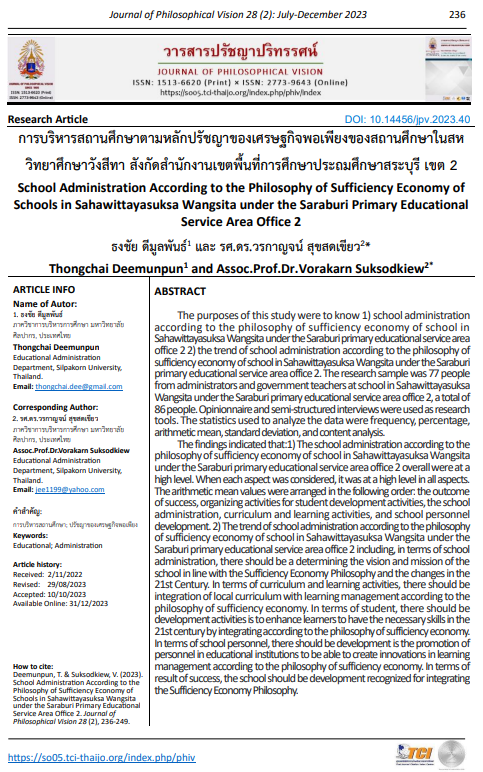
School Administration According to the Philosophy of Sufficiency Economy of Schools in Sahawittayasuksa Wangsita under the Saraburi Primary Educational Service Area Office 2
Keywords:
Educational; , AdministrationAbstract
The purposes of this study were to know 1) school administration according to the philosophy of sufficiency economy of school in Sahawittayasuksa Wangsita under the Saraburi primary educational service area office 2 2) the trend of school administration according to the philosophy of sufficiency economy of school in Sahawittayasuksa Wangsita under the Saraburi primary educational service area office 2. The research sample was 77 people from administrators and government teachers at school in Sahawittayasuksa Wangsita under the Saraburi primary educational service area office 2, a total of 86 people. Opinionnaire and semi-structured interviews were used as research tools. The statistics used to analyze the data were frequency, percentage, arithmetic mean, standard deviation, and content analysis.
The findings indicated that:1) The school administration according to the philosophy of sufficiency economy of school in Sahawittayasuksa Wangsita under the Saraburi primary educational service area office 2 overall were at a high level. When each aspect was considered, it was at a high level in all aspects. The arithmetic mean values were arranged in the following order: the outcome of success, organizing activities for student development activities, the school administration, curriculum and learning activities, and school personnel development. 2) The trend of school administration according to the philosophy of sufficiency economy of school in Sahawittayasuksa Wangsita under the Saraburi primary educational service area office 2 including, in terms of school administration, there should be a determining the vision and mission of the school in line with the Sufficiency Economy Philosophy and the changes in the 21st Century. In terms of curriculum and learning activities, there should be integration of local curriculum with learning management according to the philosophy of sufficiency economy. In terms of student, there should be development activities is to enhance learners to have the necessary skills in the 21st century by integrating according to the philosophy of sufficiency economy. In terms of school personnel, there should be development is the promotion of personnel in educational institutions to be able to create innovations in learning management according to the philosophy of sufficiency economy. In terms of result of success, the school should be development recognized for integrating the Sufficiency Economy Philosophy.
Downloads
References
กระทรวงศึกษาธิการ. (2559). คู่มือแนวทางการขับเคลื่อนการพัฒนาตามปรัชญาของเศรษฐกิจพอเพียงในภาคการศึกษา. กรุงเทพฯ : ม.ป.ท.,
ณัฐพร เอี่ยมหรุ่น. (2561). การบริหารสถานศึกษาตามหลักปรัชญาของเศรษฐกิจพอเพียงกับคุณภาพชีวิตการทำงานของครู สังกัดสำนักงานเขตพื้นที่การศึกษามัธยมศึกษา เขต 8. วิทยานิพนธ์ปริญญาศึกษาศาสตรมหาบัณฑิต สาขาวิชาบริหารการศึกษา มหาวิทยาลัยศิลปากร.
ผู้อำนวยการกลุ่มนิเทศติดตามและประเมินผลการจัดการศึกษา. (2565). พระราชบัญญัติการศึกษาแห่งชาติ พ.ศ. 2542. ราชกิจจานุเบกษา เล่ม 116. ตอนที่ 74 ก (19 สิงหาคม 2542). (สัมภาษณ์. 22 เมษายน 2565).
สำนักงานเขตพื้นที่การศึกษาประถมศึกษาสระบุรี เขต 2. (2564). รายงานผลการดำเนินงานประจำปีงบประมาณ พ.ศ. 2563. สระบุรี: สำนักงานเขตพื้นที่การศึกษาประถมศึกษาสระบุรี เขต 2.
_______. (2560). แผนพัฒนาเศรษฐกิจและสังคมแห่งชาติ ฉบับที่ 12 (พ.ศ.2560 - 2564). กรุงเทพฯ : สำนักงานคณะกรรมการพัฒนาการเศรษฐกิจและสังคมแห่งชาติ.
สำนักงานปลัดกระทรวงศึกษาธิการ. (2559). แผนพัฒนาการศึกษาของกระทรวงศึกษาธิการ ฉบับที่ 12 พ.ศ. 2560 – 2564. กรุงเทพฯ: สำนักนโยบายและยุทธศาสตร์ สำนักงานปลัดกระทรวงศึกษาธิการ กระทรวงศึกษาธิการ.
_______. (2553). ข้อเสนอการปฏิรูปการศึกษาในทศวรรษที่สอง (พ.ศ.2552- 2561). กรุงเทพฯ : พริกหวานกราฟฟิค.
Glauber, J. and other. (2020). COVID-19: Trade Restrictions Are Worst Possible Response to Safeguard Food Security. 27.
Krejcie R.V. and D.W. Morgan. (1970). Determining Sample Size for Research Activities. Educational and Psychological Measurement 30.
Rensis Likert. (1961). New Pattern of Management. New York: McGraw – Hill Book Company.
Downloads
Published
How to Cite
Issue
Section
License
Copyright (c) 2023 Journal of Philosophical Vision

This work is licensed under a Creative Commons Attribution-NonCommercial-NoDerivatives 4.0 International License.
บทความวิชาการและบทความวิจัย ในวารสารฉบับนี้ ถือเป็นความรับผิดชอบของผู้เขียนเท่านั้น
สงวนลิขสิทธิ์ตามพระราชบัญญัติลิขสิทธิ์



