Educational institution management skills based on the ESG model
Keywords:
Educational Administration Skills;, ESG Concepts;, Educational Institution Administration; , 21st Century LearningAbstract
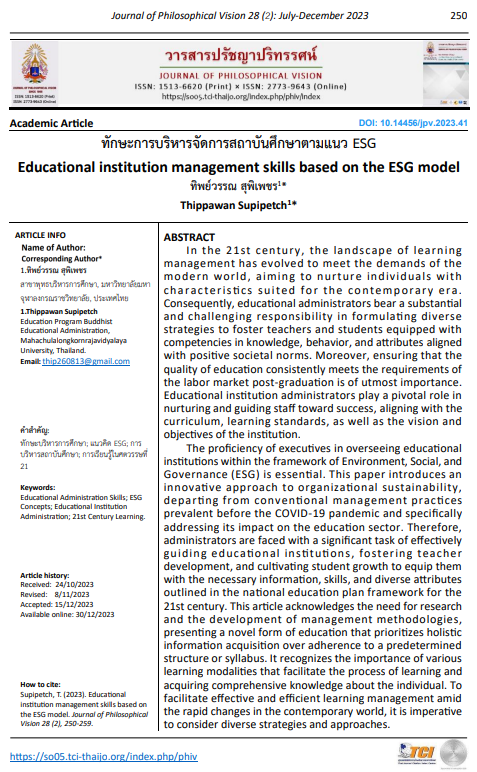
In the 21st century, the landscape of learning management has evolved to meet the demands of the modern world, aiming to nurture individuals with characteristics suited for the contemporary era. Consequently, educational administrators bear a substantial and challenging responsibility in formulating diverse strategies to foster teachers and students equipped with competencies in knowledge, behavior, and attributes aligned with positive societal norms. Moreover, ensuring that the quality of education consistently meets the requirements of the labor market post-graduation is of utmost importance. Educational institution administrators play a pivotal role in nurturing and guiding staff toward success, aligning with the curriculum, learning standards, as well as the vision and objectives of the institution.
The proficiency of executives in overseeing educational institutions within the framework of Environment, Social, and Governance (ESG) is essential. This paper introduces an innovative approach to organizational sustainability, departing from conventional management practices prevalent before the COVID-19 pandemic and specifically addressing its impact on the education sector. Therefore, administrators are faced with a significant task of effectively guiding educational institutions, fostering teacher development, and cultivating student growth to equip them with the necessary information, skills, and diverse attributes outlined in the national education plan framework for the 21st century. This article acknowledges the need for research and the development of management methodologies, presenting a novel form of education that prioritizes holistic information acquisition over adherence to a predetermined structure or syllabus. It recognizes the importance of various learning modalities that facilitate the process of learning and acquiring comprehensive knowledge about the individual. To facilitate effective and efficient learning management amid the rapid changes in the contemporary world, it is imperative to consider diverse strategies and approaches.
Downloads
References
กฤษฎาภรณ์ รุจิธำรงกุล. (2560). ภาวะผู้นำเชิงวสัยทัศน์เหนือชั้นกับการจัดการสถาบันอุดมศึกษาภาคเอกชนในศตวรรษที่ 21. วารสารสมาคมวิจัย. 22(3): 132-142.
ศุภโชค ปิยะสันต์. (2564). 5 ทักษะสำหรับผู้บริหารสถานศึกษาในศตวรรษที่ 21. สืบค้นเมื่อ 20 ตุลาคม 2565, จาก https://www.starfishlabz.com/blog/600-5- ทักษะสำหรับผู้บริหารสถานศึกษาในศตวรรษที่ 21
สมเด็จพระพุทธโฆษาจารย์ (ป. อ. ปยุตฺโต). (พฤษภาคม 2531). เพื่ออนาคตของการศึกษาไทย. สืบค้นเมื่อ 20 สิงหาคม 2565, จาก https://www.watnyanaves.net/th/book-reading/326/5
สำนักงานเลขาธิการสภาการศึกษา. 2560. แผนการศึกษาแห่งชาติ พ.ศ. 2560-2579. กรุงเทพมหานคร: พริกหวานกราฟฟิค.
Grob-Zakhary, R. (2020). COVID-19 is an opportunity to reset education. Here are 4 ways how. Retrieved November 12, 2022 from https://www.weforum.org/agenda/2020/10/covid-19-education-reset
Usak, M. et al. (2021). A Concretizing Research on Making Higher-Education Sustainability Count. Sustainability. 13(2724), 1-14.
WEF. (2016). New Vision for Education: Fostering Social and Emotional Learning through Technology. Geneva: World Economic Forum.
Downloads
Published
How to Cite
Issue
Section
License
Copyright (c) 2023 Journal of Philosophical Vision

This work is licensed under a Creative Commons Attribution-NonCommercial-NoDerivatives 4.0 International License.
บทความวิชาการและบทความวิจัย ในวารสารฉบับนี้ ถือเป็นความรับผิดชอบของผู้เขียนเท่านั้น
สงวนลิขสิทธิ์ตามพระราชบัญญัติลิขสิทธิ์



