Human Resource Development Based on Theravada Buddhist Philosophy
Keywords:
Development;, Human resources;, Theravada Buddhist PhilosophyAbstract
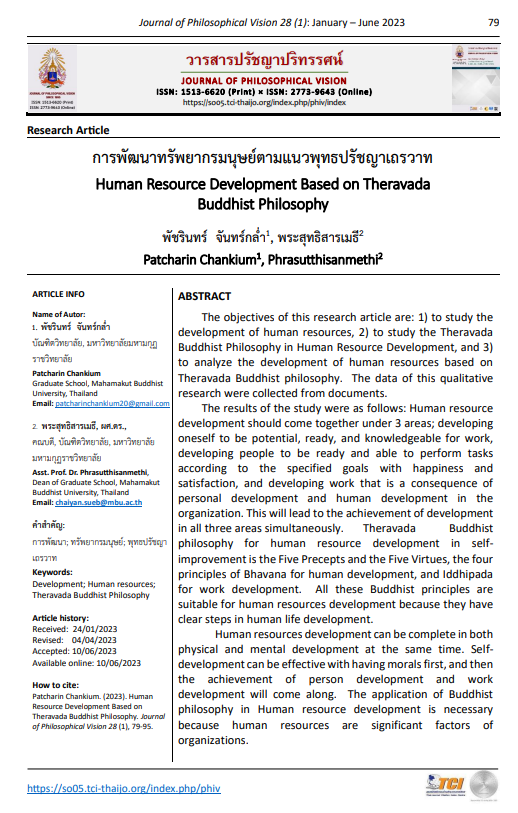
The objectives of this research article are: 1) to study the development of human resources, 2) to study the Theravada Buddhist Philosophy in Human Resource Development, and 3) to analyze the development of human resources based on Theravada Buddhist philosophy. The data of this qualitative research were collected from documents.
The results of the study were as follows: Human resource development should come together under 3 areas; developing oneself to be potential, ready, and knowledgeable for work, developing people to be ready and able to perform tasks according to the specified goals with happiness and satisfaction, and developing work that is a consequence of personal development and human development in the organization. This will lead to the achievement of development in all three areas simultaneously. Theravada Buddhist philosophy for human resource development in self-improvement is the Five Precepts and the Five Virtues, the four principles of Bhavana for human development, and Iddhipada for work development. All these Buddhist principles are suitable for human resources development because they have clear steps in human life development.
Human resources development can be complete in both physical and mental development at the same time. Self- development can be effective with having morals first, and then the achievement of person development and work development will come along. The application of Buddhist philosophy in Human resource development is necessary because human resources are significant factors of organizations.
Downloads
References
เดโช แขน้ำแก้ว. 2563. พุทธศาสนา: ขัดขวาง หรือพัฒนาสังคม?. วารสารบัณฑิตสาเกตปริทรรศน์, 5(1), 1-11.
พระธรรมปิฎก (ป.อ.ปยุตฺโต). 2544. แก่นแท้ของพระพุทธศาสนา, กรุงเทพมหานคร : กองทุนวุฒิธรรม.
พระพรหมคุณาภรณ์ (ป.อ. ปยุตฺโต). 2550. การพัฒนาที่ยั่งยืน, พิมพ์ครั้งที่ 6, กรุงเทมมหานคร : บริษัทสหธรรมิก จำกัด.
พระพรหมคุณาภรณ์. 2550. การศึกษาฝึกฝนพัฒนาตนให้สูงสุด, พิมพ์ครั้งที่ 4, กรุงเทพมหานคร :
สำนักพิมพ์สวยจำกัด.
พระครูปทุมภาวนาจารย์ และ เสริมศิริ อัครพุฒิพันธ์. 2562. วารสารพุทธจิตวิทยา, 4(1), 137
มหามกุฏราชวิทยาลัย. 2556. พระไตรปิฏกและอรรถกถาแปล ฉบับ 91 เล่ม. พิมพ์ลักษณ์: กรุงเทพมหานคร.
วิษณุ กฤตเลิศชาย. 2565. รูปแบบการพัฒนาทรัพยากรบุคคลขององค์กรปกครองส่วนท้องถิ่นยุค 4.0. มจร.เลยปริทัศน์, 3(1), 50-58.
สำลี รักสุทธิ. 2543. ศีลสุดยอดวินัยของศาสนาพุทธ, กรุงเทพมหานคร : ธนธัชการพิมพ์.
อุสา วงศ์ศิริกุล. 2566. การประยุกต์หลักพุทธธรรมเพื่อส่งเสริมสมรรถนะการบริหารงานของสถาบัน พัฒนาอุตสาหกรรมสิ่งทอกระทรวงอุตสาหกรรม. วารสารสหวิทยาการนวัตกรรมปริทรรศน์, 6(2), A174-A181.
Nakamura, J., & Csikszentmihalyi, M. (2009). Flow theory and research. Handbook of positive psychology, 195, 206.
Thepa, P. C. A., Sutthirat, N., & Phanthanaphruet, N. (2022). Buddhist Philosophical Approach On The Leadership Ethics in Management. Journal of Positive School Psychology, 6(2), 1289-1297.
Downloads
Published
How to Cite
Issue
Section
License
Copyright (c) 2023 Journal of Philosophical Vision

This work is licensed under a Creative Commons Attribution-NonCommercial-NoDerivatives 4.0 International License.
บทความวิชาการและบทความวิจัย ในวารสารฉบับนี้ ถือเป็นความรับผิดชอบของผู้เขียนเท่านั้น
สงวนลิขสิทธิ์ตามพระราชบัญญัติลิขสิทธิ์



