Guideline for Enhancing Honesty in Thai Society
Keywords:
Honesty, Morality, Thai societyAbstract
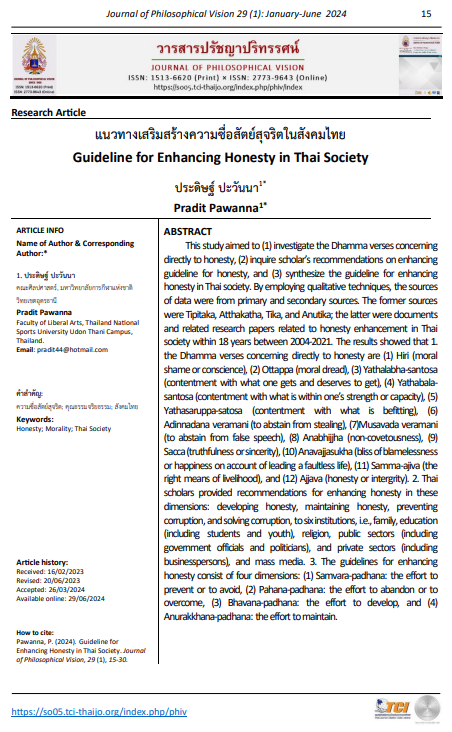
This study aimed to (1) investigate the Dhamma verses concerning directly to honesty, (2) inquire scholar’s recommendations on enhancing guideline for honesty, and (3) synthesize the guideline for enhancing honesty in Thai society. By employing qualitative techniques, the sources of data were from primary and secondary sources. The former sources were Tipitaka, Atthakatha, Tika, and Anutika; the latter were documents and related research papers related to honesty enhancement in Thai society within 18 years between 2004-2021. The results showed that 1. the Dhamma verses concerning directly to honesty are (1) Hiri (moral shame or conscience), (2) Ottappa (moral dread), (3) Yathalabha-santosa (contentment with what one gets and deserves to get), (4) Yathabala-santosa (contentment with what is within one’s strength or capacity), (5) Yathasaruppa-satosa (contentment with what is befitting), (6) Adinnadana veramani (to abstain from stealing), (7)Musavada veramani (to abstain from false speech), (8) Anabhijjha (non-covetousness), (9) Sacca (truthfulness or sincerity), (10) Anavajjasukha (bliss of blamelessness or happiness on account of leading a faultless life), (11) Samma-ajiva (the right means of livelihood), and (12) Ajjava (honesty or intergrity). 2. Thai scholars provided recommendations for enhancing honesty in these dimensions: developing honesty, maintaining honesty, preventing corruption, and solving corruption, to six institutions, i.e., family, education (including students and youth), religion, public sectors (including government officials and politicians), and private sectors (including businesspersons), and mass media. 3. The guidelines for enhancing honesty consist of four dimensions: (1) Samvara-padhana: the effort to prevent or to avoid, (2) Pahana-padhana: the effort to abandon or to overcome, (3) Bhavana-padhana: the effort to develop, and (4) Anurakkhana-padhana: the effort to maintain.
Downloads
References
ขัตติยา กรรณสูต และคณะ. (2547). คุณธรรม พฤติกรรมความซื่อสัตย์ของคนไทย. นนทบุรี: สำนักงาน ป.ป.ช..
ถวิลวดี บุรีกุล และคณะ. (2554). การศึกษาเพื่อเสริมสร้างความซื่อตรงในสังคมไทย. กรุงเทพฯ: สำนักวิจัยและพัฒนา สถาบันพระปกเกล้า.
ธิฏิรัตน์ พิมลศรี และคณะ. (2564). การปลูกฝังวัฒนธรรมสุจริต เพื่อการป้องกันและปราบปรามการทุจริตในองค์การ. วารสารสุทธิปริทัศน์, 13(3), 81-97.
นพวรรณ ธรรมสิทธิ์ และคณะ. (2560). การสร้างค่านิยมสุจริตของเยาวชนภายใต้วัฒนธรรมการยอมรับคอร์รัปชันในสังคมไทย พื้นที่อำเภอเมือง จังหวัดเชียงราย. (รายงานผลการวิจัย). เชียงราย: มหาวิทยาลัยราชภัฏเชียงราย.
ปรียานุช วัฒนกูล และธีรภัทร์ ลอยวิรัตน์. (2563). การศึกษารูปแบบการสร้างเครือข่ายเยาวชนเพื่อส่งเสริมค่านิยมสุจริตและการต่อต้านการคอร์รัปชัน จังหวัดมหาสารคาม. (รายงานผลการวิจัย). มหาสารคาม: มหาวิทยาลัยราชภัฏมหาสารคาม.
เปิดวิกฤติ ‘คุณธรรม’ ในสังคมไทย พบทุจริตคอร์รัปชันปัญหารุนแรง. (29 สิงหาคม 2559). แนวหน้า. สืบค้นเมื่อ 23 ธันวาคม 2563, จาก https://www.naewna.com/local/232661.
พระพรหมเวที (สุเทพ ผสส̣ธมโ̣ม) และพระครูสังฆรักษณ์ทรงพรรณ ชยทตโ̣ต. (2563). การพัฒนาศึกยภาพสถาบันทางสังคมในการปลูกฝังจิตสำนึกคุณธรรมและค่านิยมสุจริตในสังคมไทย. วารสาร มจร สังคมศาสตร์ปริทรรศน์, 9(3), 14-26.
ภักดี โพธิสิงห์. (2560). การวิจัยและพัฒนากระบวนการสร้างค่านิยมสุจริตสำหรับนักศึกษามหาวิทยาลัยราชภัฏ. (รายงานผลการวิจัย). ร้อยเอ็ด: มหาวิทยาลัยราชภัฏร้อยเอ็ด.
มหาจุฬาลงกรณราชวิทยาลัย. (2539). พระไตรปิฎกภาษาไทย ฉบับมหาจุฬาลงกรณราชวิทยาลัย เล่ม 1-45. กรุงเทพฯ: โรงพิมพ์มหาจุฬาลงกรณราชวิทยาลัย.
ศุภวัฒนากร วงศ์ธนวสุ และคณะ. (2564). สรุปรายงานการวิจัยประเมินผลพฤติกรรมเด็กและเยาวชนไทยที่ยึดมั่นความซื่อสัตย์สุจริต และรายงานการประเมินผลสัมฤทธิ์ในการใช้หลักสูตรต้านทุจริตศึกษา. นนทบุรี: สำนักงาน ป.ป.ช..
ศูนย์คุณธรรม. (2554). แผนพัฒนาความซื่อตรงแห่งชาติ พ.ศ. 2555-2559. กรุงเทพฯ: พริกหวาน.
ศูนย์สำรวจความคิดเห็น “นิด้าโพล” (NIDA Poll: โพลแห่งแรกในประเทศไทย). (2557). คุณธรรมตามหลักปรัชญาของเศรษฐกิจพอเพียง. สืบค้นเมื่อ 23 ธันวาคม 2563, จาก https://nidapoll. nida.ac.th/survey_detail?survey_id=415
สำนักงานคณะกรรมการพัฒนาระบบราชการ (สำนักงาน ก.พ.ร.). (ม.ป.ป.). การเสริมสร้างความซื่อตรงในการบริหารงานภาครัฐของประเทศไทย. กรุงเทพฯ: สำนักงานคณะกรรมการพัฒนาระบบราชการ (สำนักงาน ก.พ.ร.).
สำนักงานเลขาธิการสภาการศึกษา. (2562). การวิจัยและพัฒนารูปแบบ กลไกการเสริมสร้างวินัยนักเรียนในสถานศึกษาระดับการศึกษาขั้นพื้นฐาน ด้านความซื่อสัตย์สุจริต. กรุงเทพฯ: พริกหวาน.
Burikul, T., et al. (2011). Study on integrity and transparency of Thai society. Center for Moral Promotion.
Center for Moral Promotion. (2011). Promoting moral and ethical standards in Thai society.
D’Alessandro, A. M., Butterfield, K. M., Hanceroglu, L., & Roberts, K. P. (2022). Listen to the Children: Elementary School Students’ perspectives on a mindfulness intervention. Journal of Child and Family Studies, 31(8), 2108–2120. Retrieved December 23, 2020, from https://doi.org/10.1007/s10826-022-02292-3
Dawson, A. F., Brown, W. W., Anderson, J., Datta, B., Donald, J. N., Hong, K., Allan, S., Mole, T. B., Jones, P. B., & Galante, J. (2020). Mindfulness-based interventions for university students: A systematic review and meta-analysis of randomized controlled trials. Applied Psychology: Health and Wellbeing, 12(2), 384–410. Retrieved December 23, 2020, from https://doi.org/10.1111/aphw.12188
de Zoysa, P. (2016). When east meets west: Reflections on the use of Buddhist mindfulness practice in mindfulness-based interventions. Mental Health, Religion & Culture, 19(4), 362–370. Retrieved December 23, 2020, from https://doi.org/10.1080/ 13674676.2016.1200542
Dhammaratana, K. S. (2019). Buddhist maha vihara, 2019 almanac. Sasana Abhiwurdhi Wardhana Society.
Eberth, J., & Sedlmeier, P. (2012). The effects of mindfulness meditation: A meta-analysis. Mindfulness, 3(3), 174–189. Retrieved December 23, 2020, from https://doi.org/10.1007/ s12671-012-0101-x
Ferguson, G. J. (2020). Buddhism. In D. Yaden, Y. Zhao, K. Peng, & A. Newberg (Eds.), Rituals and practices in world religions. Springer. Retrieved December 23, 2020, from https://doi.org/10.1007/978-3-030-27953-0_5
Flett, J. A. M., Hayne, H., Riordan, B. C., Thompson, L. M., & Conner, T. S. (2019). Mobile mindfulness meditation: A randomised controlled trial of the effect of two popular apps on mental health. Mindfulness, 10(5), 863–876. Retrieved December 23, 2020, from https://doi.org/10.1007/s12671-018-1050-9
Kanasoot, K., et al. (2004). Ethical behavior and integrity promotion in Thai culture. Journal of Thai Ethics.
Office of the Education Council. (2019). Policies and strategies for promoting integrity in the education system.
Office of the Public Sector Development Commission. (n.d.). Enhancing public sector integrity and transparency.
Phromwethee, P. (Suthep Phasuthammo), & Chayatattho, P. (2020). Religious ethics in promoting integrity in Thai society.
Pimolsri, T., et al. (2021). Educational approaches to fostering ethical behavior and integrity among youth. Journal of Educational Innovation.
Sutthirat, N., Pettongma, P. W. C., & Thepa, P. C. A. (2023). Buddhism Moral Courage Approach on Fear, Ethical Conduct and Karma. RES MILITARIS, 13(3), 3504-3516.
Thamsithi, N., et al. (2017). Family education and integrity promotion. Family Studies Journal.
Thepa, P. C. A. (2022). Buddhist Psychology: Corruption and Honesty Phenomenon. Journal of Positive School Psychology, 6(2), 5986-6005.
Transparency International. (2020). Corruption Perceptions Index 2020. Retrieved December 23, 2020, from https://www.transparency.org/en/cpi/2020
Wattanakul, P., & Loyvirat, T. (2020). Innovative teaching methods for ethical development in students. Journal of Educational Innovation.
Wongthanavasu, S., et al. (2021). Corporate governance and ethical business practices in Thailand. Business Ethics Journal.
Downloads
Published
How to Cite
Issue
Section
License
Copyright (c) 2024 Journal of Philosophical Vision

This work is licensed under a Creative Commons Attribution-NonCommercial-NoDerivatives 4.0 International License.
บทความวิชาการและบทความวิจัย ในวารสารฉบับนี้ ถือเป็นความรับผิดชอบของผู้เขียนเท่านั้น
สงวนลิขสิทธิ์ตามพระราชบัญญัติลิขสิทธิ์



