Using Financial Innovation to Solve Problem of Lack of Financial Resources of SMEs
Keywords:
Financial Innovation; , Fintech; , The small and medium enterprises (SMEs)Abstract
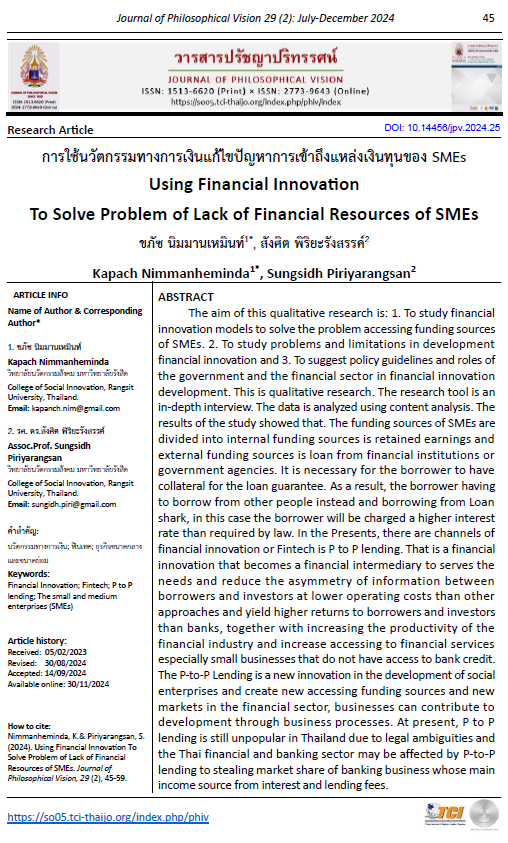
The aim of this qualitative research is to study: 1. To study financial innovation models to solve the problem accessing funding sources of SMEs. 2. To study problems and limitations in development financial innovation and 3. To suggest policy guidelines and roles of the government and the financial sector in financial innovation development. The results of the study showed that, The funding sources of SMEs are divided into internal funding sources is retained earnings and external funding sources is loan from financial institutions or government agencies, it is necessary for the borrower to have collateral for the loan guarantee. As a result, the borrower having to borrow from other people instead and borrowing from Loan shark, in this case the borrower will be charged a higher interest rate than required by law. In the Presents, there are channels of financial innovation or Fintech is P to P lending. That is a financial innovation that becomes a financial intermediary to serves the needs and reduce the asymmetry of information between borrowers and investors at lower operating costs than other approaches and yield higher returns to borrowers and investors than banks, together with increasing the productivity of the financial industry and increase accessing to financial services especially small businesses that do not have access to bank credit. The P to P Lending is a new innovation in the development of social enterprises and create new accessing funding sources and new markets in the financial sector, businesses can contribute to development through business processes. At present, P to P lending is still unpopular in Thailand due to legal ambiguities and the Thai financial and banking sector may be affected by P to P lending to stealing market share of banking business whose main income source from interest and lending fees.
Downloads
References
กิ่งกาญจน์ เกษศิริ และ นุชนารถ ปานทอง. (2559). แหล่งเงินทุนสำหรับ SMEs ไทย...หัวใจนักสู้. สืบค้น 18 มิถุนายน 2565 จาก https://www.bot.or.th/Thai/ResearchAndPublications/DocLib_/Article27_10_59.pdf
ปรีติ เกตุวรสุนทร. (2564). การศึกษาปัจจัยอุปสรรคที่มีต่อผู้ประกอบการฐานนวัตกรรมขนาดกลางและขนาดย่อมในการเข้าถึงแหล่งเงินทุนที่มีต่อการตัดสินใจของผู้ให้บริการทางการเงินธุรกิจและนักลงทุนของประเทศไทย. มหาวิทยาลัยมหิดล. สืบค้นจาก https://archive.cm.mahidol.ac.th/handle/123456789/3992
พชร อารยะการกุล. (2020). เรื่องเงิน เรื่องใหญ่ ฉุด SMEs ติดหล่มวิกฤต. สืบค้น 18 มิถุนายน 2565 จาก https://thestandard.co/smes-money-problem
ภคมน โภคะธีรกุล. (2563). แนวทางการพัฒนาวิสาหกิจขนาดกลางและขนาดย่อมของผลิตภัณฑ์อาหารแปรรูป. วารสารวิชาการการจัดการภาครัฐและเอกชน, 1(2), 116-125.
ธิติ พรหมสูงวงษ์. (2564). ปัจจัยที่มีผลต่อความรู้ความเข้าใจในธุรกรรมสินเชื่อระหว่างบุคคล P2P Lending (Peer to Peer Lending) ประเทศไทย. วิทยานิพนธ์เศรษฐศาสตรมหาบัณฑิต. มหาวิทยาลัยรังสิต. สืบค้นจาก https://rsuir-library.rsu.ac.th/handle/123456789/1554
สิริเกียรติ รัชชุศานติ. (2533). การจัดหาเงินทุน VS การเตรียมตัวเพื่อขอสินเชื่อ. สืบค้น 18 มิถุนายน 2565 จาก http://mis2.rmutt.ac.th/
Bhujell, K., Khemraj, S., Chi, H. K., Lin, W. T., Wu, W., & Thepa, P. C. A. (2021). Trust in the Sharing Economy: An Improvement in Terms of Customer Intention. Indian Journal of Economics and Business, 20(1), 713-730. Retrieved from https://www.ashwinanokha.com/resources/55.%20Karun%20Bhujel%20and%20Others_pagenumber.pdf
Chen, H., Chiang, R., & Storey, V. (2012). Business Intelligence and Analytics: From Big Data to Big Impact. MIS Quarterly, 36(4), 1165-1188.
Elkington, J. (1998). Partnerships from cannibals with forks: The triple bottom line of 21st‐century business. Environmental Quality Management, 8(1), 37-51.
Härle, P., Havas, A., & Samandari, H. (2016). The Future of Bank Risk Management. Publisher House: McKinsey & Company.
Patrick, R. (2017). For Whose Benefit? The Everyday Realities of Welfare Reform. Bristol: Policy Press.
Downloads
Published
How to Cite
Issue
Section
License
Copyright (c) 2024 Journal of Philosophical Vision

This work is licensed under a Creative Commons Attribution-NonCommercial-NoDerivatives 4.0 International License.
บทความวิชาการและบทความวิจัย ในวารสารฉบับนี้ ถือเป็นความรับผิดชอบของผู้เขียนเท่านั้น
สงวนลิขสิทธิ์ตามพระราชบัญญัติลิขสิทธิ์



