
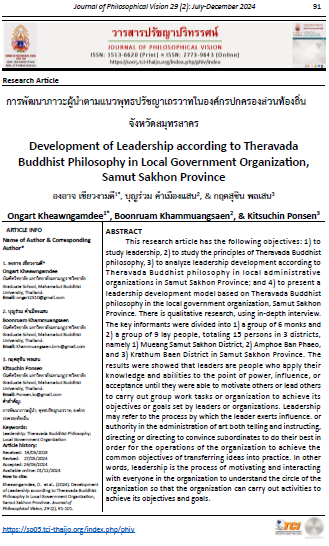
Development of Leadership According to Theravada Buddhist Philosophy in Local Government Organization, Samut Sakhon Province
Keywords:
Leadership;, Theravada Buddhist Philosophy;, Local Government OrganizationAbstract
The objectives of this research article are follows: 1) to study leadership 2) tostudy the principles of Theravada Buddhist philosophy 3 ) to analyze leadership development according to Theravada Buddhist philosophy in local administrative organizations in Samut Sakhon Province; and 4) to present a leadership development model based on Theravada Buddhist philosophy in the local government organization, Samut Sakhon Province. There is a qualitative research, using in-depth interviews and the key informants were divided into 1) a group of 6 monks and 2) a group of 9 lay people, totaling 15 persons in 3 districts, namely 1 ) Mueang Samut Sakhon District 2) Amphoe Ban Phaeo and 3) Krathum Baen District in Samut Sakhon Province.
The results were showed that: leaders are people who apply their knowledge and abilities to the point of power, influence, or acceptance. Until being able to motivate others or lead others to carry out group work tasks or organization to achieve its objectives or goals set by leaders or organizations and that leadership It may refer to the process by which the leader exerts influence. or authority in the administration of art both telling and instructing, directing or directing to convince subordinates to do their best. In order for the operations of the organization to achieve the common objectives of transferring ideas into practice. In other words, leadership is the process of motivating and interacting with everyone in the organization to understand the circle of the organization so that the organization can carry out activities to achieve its objectives and goals.
Downloads
References
บุญช่วย ศรีเปรม,เรื่อง “การดำเนินชีวิตที่ดีของเยาวชนไทยตามหลักสัปปุริสธรรม : ศึกษาเฉพาะกรณีนักเรียนช่วงชั้นที่ 4 โรงเรียนศึกษานารีวิทยา เขตบางบอน กรุงเทพมหานคร”, วิทยานิพนธ์ศาสนศาสตรดุษฎี บัณฑิต,บัณฑิตวิทยาลัย : มหาวิทยาลัยมหามกุฏราชวิทยาลัย, 2553.
พระสามารถ อานนฺโท (เนตรแสง), “ภาวะผู้นำตามหลักสัปปุริสธรรม”,วิทยานิพนธ์ศาสนศาสตรมหาบัณฑิต, บัณฑิตวิทยาลัย : มหาวิทยาลัยมหามกุฏราชวิทยาลัย, 2552 .
พระมหาอาคม ไกรอ่อน ,“การพัฒนาแผนและสื่อประกอบการเรียนรู้ วิชาธรรมวินัย เรื่องสัปปุริสธรรม 7 ชั้น มัธยมศึกษาปีที่ 2” วิทยานิพนธ์ ศาสนศาสตรมหาบัณฑิต,บัณฑิตวิทยาลัย : มหาวิทยาลัยมหามกุฏราช วิทยาลัย, 2553.
มหาจุฬาลงกรณราชวิทยาลัย. พระไตรปิฎกภาษาไทย ฉบับมหาจุฬาลงกรณราชวิทยาลัย. กรุงเทพฯ: โรงพิมพ์ มหาจุฬาลงกรณราชวิทยาลัย, 2539.
ว่าที่ร้อยโทสมโพชน์ กวักหิรัญ, บูรณาการการดำเนินงานขององค์การบริหารส่วนตำบลด้วยหลักสัปปุริสธรรม,หลักสูตรศาสนศาสตรดุษฎีบัณฑิต, สาขาวิชาพุทธศาสนาและปรัชญา, บัณฑิตวิทยาลัย มหาวิทยาลัยมหามกุฏราชวิทยาลัย, 2554.
อนุวัช แก้วสว่าง. การพัฒนารูปแบบการจัดสรรงบประมาณเพื่อการจัดการศึกษาขั้นพื้นฐานในระบบโรงเรียนของ องค์กรปกครองส่วนท้องถิ่น กรณีศึกษาเทศบาลตำบล. กรุงเทพฯ: มหาวิทยาลัยราชภัฏวไลยอลงกรณ์ ในพระบรมราชูปถัมภ์, 2557.
Clark, John J. Outline of Local Government of The United Kingdom. London: Sir Issac Pitman and Son Ltd. 1957.
Hawkins, L.D. & Coney, K.A. Consumer behavior: building marketing strategy. (8th ed). McGraw-Hill : C ompanies. 2001. Pp. 124-125.
Robson, William A. “Local Governmen” in Encyclopedia of Social Science. New York: The .Macmillan. 1953.
Holloway, William V. State and Local Government in the United States. New York: McGraw-Hill. 1959.
Downloads
Published
How to Cite
Issue
Section
License
Copyright (c) 2024 Journal of Philosophical Vision

This work is licensed under a Creative Commons Attribution-NonCommercial-NoDerivatives 4.0 International License.
บทความวิชาการและบทความวิจัย ในวารสารฉบับนี้ ถือเป็นความรับผิดชอบของผู้เขียนเท่านั้น
สงวนลิขสิทธิ์ตามพระราชบัญญัติลิขสิทธิ์



