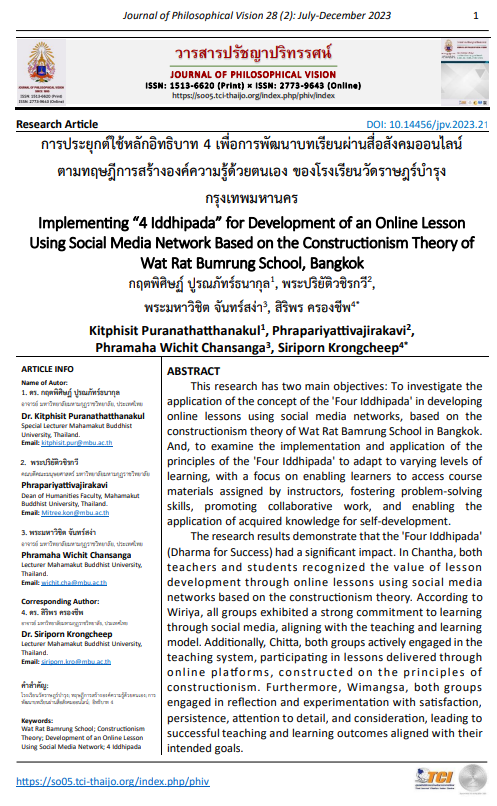
Implementing “4 Iddhipada” for Development of an Online Lesson Using Social Media Network Based on the Constructionism Theory of Wat Rat Bumrung School, Bangkok
Keywords:
Wat Rat Bamrung School; , Constructionism Theory; , Development of an Online Lesson Using Social Media Network; , 4 IddhipadaAbstract
This research has two main objectives: To investigate the application of the concept of the 'Four Iddhipada' in developing online lessons using social media networks, based on the constructionism theory of Wat Rat Bamrung School in Bangkok. And, to examine the implementation and application of the principles of the 'Four Iddhipada' to adapt to varying levels of learning, with a focus on enabling learners to access course materials assigned by instructors, fostering problem-solving skills, promoting collaborative work, and enabling the application of acquired knowledge for self-development.
The research results demonstrate that the 'Four Iddhipada' (Dharma for Success) had a significant impact. In Chantha, both teachers and students recognized the value of lesson development through online lessons using social media networks based on the constructionism theory. According to Wiriya, all groups exhibited a strong commitment to learning through social media, aligning with the teaching and learning model. Additionally, Chitta, both groups actively engaged in the teaching system, participating in lessons delivered through online platforms, constructed on the principles of constructionism. Furthermore, Wimangsa, both groups engaged in reflection and experimentation with satisfaction, persistence, attention to detail, and consideration, leading to successful teaching and learning outcomes aligned with their intended goals.
Downloads
References
โกนิษฐ์ ศรีทอง. (2556). เอกสารประกอบการสอนวิชา “แนวคิดและทฤษฎีทางการพัฒนาสังคม”. กรุงเทพฯ: มหาวิทยาลัยมหาจุฬาลงกรณราชวิทยาลัย.
โจ พลัมเมอร์, & คณะ. (2551). The Online Advertising PLAYBOOK (สุชาดา เชาวรียวงษ์ & ศิวัตร เชาวรียวงษ์, Trans.). Thailand: Advertising Research Foundation.
จารุมาศ เรืองสุวรรณ, พันเอก. (2548). การสังเคราะห์แบบจำลองการสอนวิชาชีพช่างตามหลักอิทธิบาท 4 ของพลทหารในส่วนสนับสนุนกองบัญชาการทองทัพบก. ปริญญาดุษฎีบัณฑิต ปร.ด.อาชีวศึกษา. บัณฑิตวิทยาลัย:มหาวิทยาลัยเกษตรศาสตร์, ถ่ายเอกสาร.
พระธรรมปิฎก (ป.อ.ปยุตฺ โต). (2543). ธรรมะกับการทำงาน. (พิมพ์ครั้งที่ 3). กรุงเทพฯ: สำนักพิมพ์มูลนิธิพุทธธรรม.
มหาจุฬาลงกรณราชวิทยาลัย. (2535). พระไตรปิฎกภาษาบาลีฉบับมหาจุฬาเตปิฏกํ 2500. กรุงเทพมหานคร:โรงพิมพ์มหาจุฬาลงกรณราชวิทยาลัย.
มหาจุฬาลงกรณราชวิทยาลัย. (2539). พระไตรปิฎกภาษาไทยฉบับมหาจุฬาลงกรณราชวิทยาลัย. กรุงเทพมหานคร:โรงพิมพ์มหาจุฬาลงกรณราชวิทยาลัย.
ไพโรจน์ ชินศิรประภา. (2550). สนุก สุขใจ ได้ปัญญา = Constructionism. กรุงเทพฯ: มูลนิธิไทยคม.
กระทรวงศึกษาธิการ. (2563). ตัวชี้วัดและสาระกาเรรียนรู้แกนกลาง กลุ่มสาระการเรียนรู้การงาน อาชีพและเทคโนโลยี ตามหลักสูตรแกนกลางการศึกษาขั้นพื้นฐาน พุทธศักราช 2551.,สืบค้น 22 พฤษภาคม 2563. จาก https://www.curriculum51.net.
ล้วน สายยศ และอังคณา สายยศ. (2543). เทคนิคการวัดผลการเรียนรู้. กรุงเทพฯ: สุวีริยาสาส์น.
วัดราษฎร์บำรุง (งามศิริวิทยาคาร). (2558). ข้อมูลประวัติโรงเรียนวัดราษฎร์บำรุง กรุงเทพมหานคร. บางแค, กรุงเทพฯ: สำเริงราษฎร์.
Armstrong, J., & Franklin, T. (2008). A Review of Current and Developing International Practice in the use of Social Networking (Web 2.0) in Higher Education. [n.p.]. NY. USA.
Downloads
Published
How to Cite
Issue
Section
License
Copyright (c) 2023 Journal of Philosophical Vision

This work is licensed under a Creative Commons Attribution-NonCommercial-NoDerivatives 4.0 International License.
บทความวิชาการและบทความวิจัย ในวารสารฉบับนี้ ถือเป็นความรับผิดชอบของผู้เขียนเท่านั้น
สงวนลิขสิทธิ์ตามพระราชบัญญัติลิขสิทธิ์



