Guidelines for Developing Creative Thinking Skills according to the Principles of Wisdom 3 of Personnel of the School Group, Efficiency Promotion Network No. 4 Pathum Thani Province
Keywords:
Skill Development, Creativity, 3-Step IntelligenceAbstract
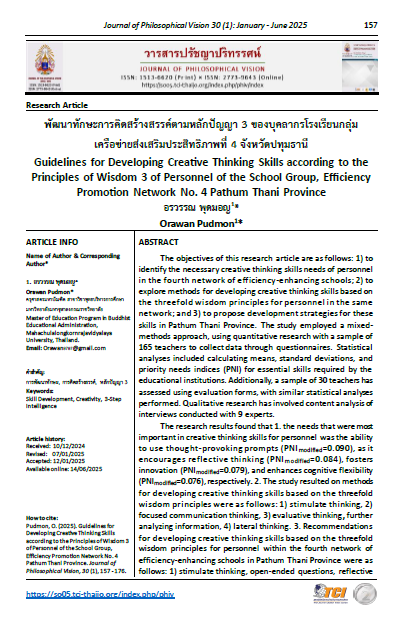
The objectives of this research article are as follows: 1) to identify the necessary creative thinking skills needs of personnel in the fourth network of efficiency-enhancing schools; 2) to explore methods for developing creative thinking skills based on the threefold wisdom principles for personnel in the same network; and 3) to propose development strategies for these skills in Pathum Thani Province. The study employed a mixed-methods approach, using quantitative research with a sample of 165 teachers to collect data through questionnaires. Statistical analyses included calculating means, standard deviations, and priority needs indices (PNI) for essential skills required by the educational institutions. Additionally, a sample of 30 teachers has assessed using evaluation forms, with similar statistical analyses performed. Qualitative research has involved content analysis of interviews conducted with 9 experts.
The research results found that 1. the needs that were most important in creative thinking skills for personnel was the ability to use thought-provoking prompts (PNImodified=0.090), as it encourages reflective thinking (PNImodified=0.084), fosters innovation (PNImodified=0.079), and enhances cognitive flexibility (PNImodified=0.076), respectively. 2. The study resulted on methods for developing creative thinking skills based on the threefold wisdom principles were as follows: 1) stimulate thinking, 2) focused communication thinking, 3) evaluative thinking, further analyzing information, 4) lateral thinking. 3. Recommendations for developing creative thinking skills based on the threefold wisdom principles for personnel within the fourth network of efficiency-enhancing schools in Pathum Thani Province were as follows: 1) stimulate thinking, open-ended questions, reflective experiences, 2) focused communication thinking, focused questions, data analysis, 3) evaluative thinking, additional data analysis, the creation of examples, 4) lateral thinking, seeking alternative methods, thinking outside the box, and welcoming new perspectives are encouraged.
Downloads
References
จันทิมา รุ่งเรือง. (2563). โมเดลเชิงสาเหตุของปัจจัยที่มีอิทธิพลต่อประสิทธิผลโรงเรียนเอกชนในยุคดิจิทัล. วารสารสังคมศาสตร์วิจัย. 11 (1), 55-75.
ธานินทร์ ศิลป์จารุ. (2560). การวิจัยและการวิเคราะห์ข้อมูลทางสถิติด้วย SPSS และ AMOS, พิมพ์ครั้งที่ 17. กรุงเทพฯ: เอส.อาร์.พริ้นติ้ง แมสโปรดักส์.
ธานี ชั้นบุญ. (2551). ทักษะการบริหารงานของผู้บริหารสถานศึกษาขั้นพื้นฐานสำนักงานเขตพื้นที่การศึกษาปทุมธานี เขต 2. วิทยานิพนธ์ปริญญาครุศาสตรมหาบัณฑิต มหาวิทยาลัยราชภัฏวไลยอลงกรณ์ในพระบรมราชูปถัมภ์.
ประกอบ กรรณสูต. (2542) สถิติเพื่อการวิจัยทางพฤติกรรมศาสตร์, พิมพ์ครั้งที่ 3. กรุงเทพฯ: ด่านสุทธาการพิมพ์.
พระธานินทร์ ชินเมโธ (พุกเนียม). (2558). การใช้หลักปัญญา 3 ในการบริหารงานวิชาการของครู โรงเรียนรัตนโกสินทร์สมโภชบางขุนเทียน เขตบางขุนเทียน กรุงเทพมหานคร. วิทยานิพนธ์ปริญญาพุทธศาสตรมหาบัณฑิต มหาวิทยาลัยมหาจุฬาลงกรณราชวิทยาลัย.
พระพรหมคุณาภรณ์ (ป.อ. ปยุตฺโต). (2551). พจนานุกรมฉบับพุทธศาสตร์ ประมวลธรรม, พิมพ์ครั้งที่ 17. กรุงเทพฯ: โรงพิมพ์มหาวิทยาลัยมหาจุฬาลงกรณราชวิทยาลัย.
ภัทรา จรรยาธรรม. (2564). การบริหารสถานศึกษาเอกชนในยุคดิจิทัล. วิทยานิพนธ์ปริญญาปรัชญาดุษฎีบัณฑิต มหาวิทยาลัยศิลปากร.
มหาจุฬาลงกรณราชวิทยาลัย. (2539). พระไตรปิฎกภาษาไทย ฉบับมหาจุฬาลงกรณราชวิทยาลัย เล่ม 11. กรุงเทพฯ: โรงพิมพ์มหาจุฬาลงกรณราชวิทยาลัย.
ลัดดาวัลย์ สะอิ้งทอง. (2564). แนวทางการพัฒนาทักษะการจัดการเรียนรู้ของครูในศตวรรษที่ 21 สังกัดสำนักงานเขตพื้นที่การศึกษาประถมศึกษาสุพรรณบุรี เขต 1. วิทยานิพนธ์ปริญญาครุศาสตรมหาบัณฑิต มหาวิทยาลัยราชภัฎพระนครศรีอยุธยา.
ศรัญญา น้อยพิมาย. (2562). ทักษะการบริหารของผู้บริหารสถานศึกษา สังกัดสำนักงานเขตพื้นที่การศึกษาประถมศึกษาปทุมธานีเขต 2. วิทยานิพนธ์ปริญญาศึกษาศาสตรมหาบัณฑิต มหาวิทยาลัยเทคโนโลยีราชมงคลธัญบุรี.
สำนักงานปลัดกระทรวงศึกษาธิการ. (2566). แผนปฏิบัติการด้านการพัฒนาบุคลากรสำนักปลัดกระทรวงศึกษาธิการประจำปีงบประมาณ พ.ศ. 2566 ตามงบประมาณที่ได้รับการจัดสรร. กรุงเทพฯ: สำนักงานปลัดกระทรวงศึกษาธิการ.
สุจินตนา พรมพุ้ย. (2566). แนวทางการบริหารสถานศึกษาในยุคดิจิทัลตามหลักพุทธธรรม กลุ่มสหวิทยาเขตสวนเทพรัตน์ทีปไท้เฉลิมพระเกียรติ จังหวัดปทุมธานี. วิทยานิพนธ์ปริญญาครุศาสตรมหาบัณฑิต มหาวิทยาลัยมหาจุฬาลงกรณาราชวิทยาลัย.
สุภาคย์ อินทองคง. (2550). การใช้หลักพุทธธรรมนำการวิจัยและพัฒนาตามปรัชญาเศรษฐกิจพอเพียงสู่สุขภาพองค์รวม. สงขลา: ศูนย์เรียนรู้ชุมชนภาคใต้ (ศรช.).
สุภานี สินไชย. (2565). กระบวนการพัฒนาครูโค้ชสู่วิถีชีวิตด้วยหลักปัญญา 3 ฐาน. วารสารครุศาสตร์ปริทรรศน์ฯ. 9 (2), 431-440.
Downloads
Published
How to Cite
Issue
Section
License
Copyright (c) 2025 Journal of Philosophical Vision

This work is licensed under a Creative Commons Attribution-NonCommercial-NoDerivatives 4.0 International License.
บทความวิชาการและบทความวิจัย ในวารสารฉบับนี้ ถือเป็นความรับผิดชอบของผู้เขียนเท่านั้น
สงวนลิขสิทธิ์ตามพระราชบัญญัติลิขสิทธิ์



