Guidelines for Maintaining Student Discipline Based on the Four Principles of Meditation for Students in Schools in the 4th Efficiency Promotion Network, Pathum Thani Province
Keywords:
Guidelines for Maintaining Students’ Discipline, Four Principles of MeditationAbstract
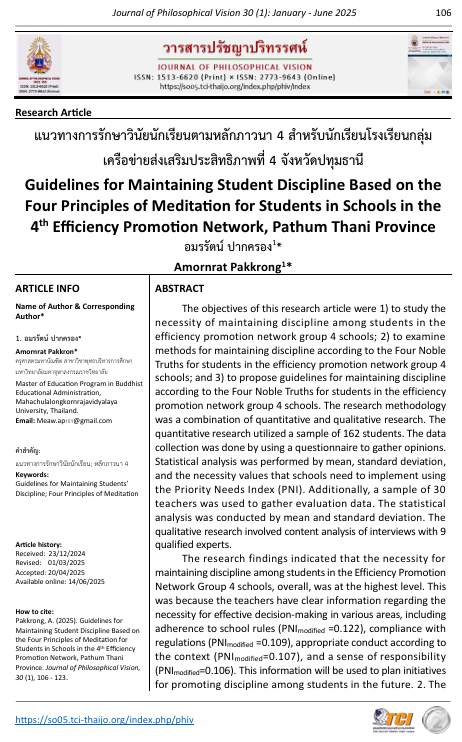
The objectives of this research article were 1) to study the necessity of maintaining discipline among students in the efficiency promotion network group 4 schools; 2) to examine methods for maintaining discipline according to the Four Noble Truths for students in the efficiency promotion network group 4 schools; and 3) to propose guidelines for maintaining discipline according to the Four Noble Truths for students in the efficiency promotion network group 4 schools. The research methodology was a combination of quantitative and qualitative research. The quantitative research utilized a sample of 162 students. The data collection was done by using a questionnaire to gather opinions. Statistical analysis was performed by mean, standard deviation, and the necessity values that schools need to implement using the Priority Needs Index (PNI). Additionally, a sample of 30 teachers was used to gather evaluation data. The statistical analysis was conducted by mean and standard deviation. The qualitative research involved content analysis of interviews with 9 qualified experts.
The research findings indicated that the necessity for maintaining discipline among students in the Efficiency Promotion Network Group 4 schools, overall, was at the highest level. This was because the teachers have clear information regarding the necessity for effective decision-making in various areas, including adherence to school rules (PNImodified =0.122), compliance with regulations (PNImodified =0.109), appropriate conduct according to the context (PNImodified=0.107), and a sense of responsibility (PNImodified=0.106). This information will be used to plan initiatives for promoting discipline among students in the future. 2. The study of methods for maintaining discipline according to the Four Noble Truths for students in the Efficiency Promotion Network Group 4 revealed the following: 1) in terms of student discipline; 2) in terms of generosity; 3) in terms of responsibility; 4) in terms of problem-solving. 3) Guidelines for maintaining discipline according to the Four Noble Truths for students in the Efficiency Promotion Network Group 4 were as follows: 1) in terms of student discipline; 2) in terms of generosity; 3) in terms of responsibility; and 4) In terms of problem-solving.
Downloads
References
ดลรวี เติมงาม. (2560). ศึกษาแนวทางการส่งเสริมวินัยนักเรียนโรงเรียนในอำเภอบางใหญ่ สังกัดองค์การบริหารส่วนจังหวัดนนทบุรี. วิทยานิพนธ์ปริญญาพุทธศาสตรมหาบัณฑิต มหาวิทยาลัยมหาจุฬาลงกรณราชวิทยาลัย.
นวรัตน์ สถาพรพานิช. (2564). แนวทางการสร้างวินัยตามหลักพุทธบริหารการศึกษาสำหรับนักเรียนประถมศึกษาโรงเรียน สังกัดสำนักงานเขตพื้นที่การศึกษาประถมศึกษานนทบุรี เขต 1. วิทยานิพนธ์ปริญญาพุทธศาสตรมหาบัณฑิต มหาวิทยาลัยมหาจุฬาลงกรณราชวิทยาลัย.
ประกอบ กรรณสูต. (2542). สถิติเพื่อการวิจัยทางพฤติกรรมศาสตร์, พิมพ์ครั้งที่ 3. กรุงเทพฯ: ด่านสุทธาการพิมพ์.
พระครูใบฎีกาพงษ์พันธุ์ ปุญฺวํโส (บุญสอน). (2552). ศึกษาการส่งเสริมวินัยนักเรียนมัธยมศึกษาตอนปลายเขตพื้นที่การศึกษากรุงเทพมหานคร เขต 3. วิทยานิพนธ์ปริญญาพุทธศาสตรมหาบัณฑิต มหาวิทยาลัยมหาจุฬาลงกรณราชวิทยาลัย.
พระเทพโสภณ (ประยูร ธมฺมจิตฺโต). (2548). อภิธรรมกับการพัฒนาทรัพยากรมนุษย์. กรุงเทพฯ: โรงพิมพ์มหาวิทยาลัยมหาจุฬาลงกรณราชวิทยาลัย.
พระธานี จนฺทิโก (กลมนอก). (2560). การพัฒนาตนเองตามหลักภาวนา 4 ของเยาวชนตำบลตาขัน อำเภอบ้านค่าย จังหวัดระยอง. วิทยานิพนธ์ปริญญาพุทธศาสตรมหาบัณฑิต มหาวิทยาลัยมหาจุฬาลงกรณราชวิทยาลัย.
พระประพงศ์ โสภณจิตฺโต (ไชยศรี). (2562). การจัดการเรียนรู้ตามหลักภาวนา 4 เพื่อพัฒนาผลสัมฤทธิ์ทางการเรียน วิชาสังคมศึกษา ศาสนา และวัฒนธรรม นักเรียนชั้นประถมศึกษาปีที่ 6 โรงเรียนวัดรัชฏาธิฐาน เขตตลิ่งชัน กรุงเทพมหานคร. วิทยานิพนธ์ปริญญาพุทธศาสตรมหาบัณฑิต มหาวิทยาลัยมหาจุฬาลงกรณราชวิทยาลัย.
มหาจุฬาลงกรณราชวิทยาลัย. (2539). พระไตรปิฎกภาษาไทย ฉบับมหาจุฬาลงกรณราชวิทยาลัย เล่ม 22. กรุงเทพฯ: โรงพิมพ์มหาจุฬาลงกรณราชวิทยาลัย.
ราชบัณฑิตยสถาน. (2556). พจนานุกรมฉบับราชบัณฑิตยสถาน พ.ศ. 2554, พิมพ์เฉลิมพระเกียรติพระบาทสมเด็จพระเจ้าอยู่หัวเนื่องในโอกาสเฉลิมพระชนมพรรษา 7 รอบ 5 ธันวาคม 2556, พิมพ์ครั้งที่ 2. กรุงเทพฯ: นานมีบุคส์พับลิเคชั่นส์.
ลมัย บัวขันธ์. (2562). การพัฒนาการเรียนรู้ตามหลักภาวนา 4 เพื่อส่งเสริมความเป็นพลเมืองที่ดีตามหลักประชาธิปไตยของนักเรียนชั้นมัธยมศึกษาปีที่ 4 โรงเรียนหนองแวงวิทยา จังหวัดสกลนคร. วิทยานิพนธ์ปริญญาพุทธศาสตรมหาบัณฑิต มหาวิทยาลัยมหาจุฬาลงกรณราชวิทยาลัย.
สำนักงานคณะกรรมการพัฒนาการเศรษฐกิจและสังคมแห่งชาติ. (2554). แผนพัฒนาเศรษฐกิจและสังคมแห่งชาติฉบับที่ 11 พ.ศ. 2555-2559. กรุงเทพฯ: สำนักงานคณะกรรมการพัฒนาการเศรษฐกิจและสังคมแห่งชาติ.
สำนักงานเลขาธิการสภาการศึกษา. (2553). แผนการศึกษาแห่งชาติ ฉบับปรับปรุง (พ.ศ. 2559-2559). กรุงเทพฯ: สำนักงานเลขาธิการสภาการศึกษา.
อธิคุณ วิเชียรศร. (2564). แนวทางการส่งเสริมสมรรถนะนักเรียนตามหลักภาวนา 4 ของนักเรียน กลุ่มโรงเรียนวิเศษเมืองทองสำนักงานเขตพื้นที่ การศึกษาประถมศึกษาอ่างทอง. วิทยานิพนธ์ปริญญาครุศาสตรมหาบัณฑิต มหาวิทยาลัยมหาจุฬาลงกรณราชวิทยาลัย.
อัครเดช อินทรสถาพร. (2560). การเสริมสร้างวินัยนักเรียนด้านความรับผิดชอบโดยการมีส่วนร่วมของผู้ปกครอง: กรณีศึกษาโรงเรียนอนุบาลอัจฉรา อำเภอสูงเนิน จังหวัดนครราชสีมา. วิทยานิพนธ์ปริญญาศึกษาศาสตรมหาบัณฑิต มหาวิทยาลัยสุโขทัยธรรมาธิราช.
อินทิรา บุญวาที. (2550). สภาพปัญหาวินัยและการเสริมสร้างวินัยนักเรียน โรงเรียนบ้านจัดสรรจังหวัดตราด. วิทยานิพนธ์ปริญญาการศึกษามหาบัณฑิต มหาวิทยาลัยบูรพา.
Downloads
Published
How to Cite
Issue
Section
License
Copyright (c) 2025 Journal of Philosophical Vision

This work is licensed under a Creative Commons Attribution-NonCommercial-NoDerivatives 4.0 International License.
บทความวิชาการและบทความวิจัย ในวารสารฉบับนี้ ถือเป็นความรับผิดชอบของผู้เขียนเท่านั้น
สงวนลิขสิทธิ์ตามพระราชบัญญัติลิขสิทธิ์



