A Study of Creative Leadership Based on the Four Principles of Samparāyikatthanikadham Principles of School of Administrators in Nakhon Luang District, Phra Nakhon Si Ayutthaya Province
Keywords:
Creative Leadership, Samparāyikatthanikadham, Principle of School AdministrationAbstract
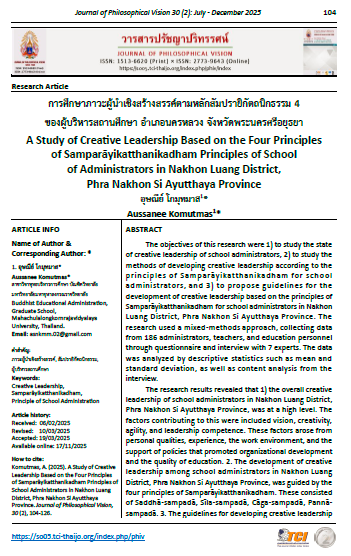
The objectives of this research were 1) to study the state of creative leadership of school administrators, 2) to study the methods of developing creative leadership according to the principles of Samparāyikatthanikadham for school administrators, and 3) to propose guidelines for the development of creative leadership based on the principles of Samparāyikatthanikadham for school administrators in Nakhon Luang District, Phra Nakhon Si Ayutthaya Province. The research used a mixed-methods approach, collecting data from 186 administrators, teachers, and education personnel through questionnaire and interview with 7 experts. The data was analyzed by descriptive statistics such as mean and standard deviation, as well as content analysis from the interview.
The research results revealed that 1) the overall creative leadership of school administrators in Nakhon Luang District, Phra Nakhon Si Ayutthaya Province, was at a high level. The factors contributing to this were included vision, creativity, agility, and leadership competence. These factors arose from personal qualities, experience, the work environment, and the support of policies that promoted organizational development and the quality of education. 2. The development of creative leadership among school administrators in Nakhon Luang District, Phra Nakhon Si Ayutthaya Province, was guided by the four principles of Samparāyikatthanikadham. These consisted of Saddhā-sampadā, Sīla-sampadā, Cāga-sampadā, Pannā-sampadā. 3. The guidelines for developing creative leadership based on the four principles of Samparāyikatthanikadham were as follows: 1) Saddhā-sampadā: building confidence and inspiration in both oneself and the team, 2) Sīla-sampadā: being a role model in ethics and integrity to create a positive organizational culture, 3) Cāga-sampadā: supporting participation and teamwork, 4) Pannā-sampadā: applying wisdom in analytical thinking and innovation to solve problems.
Downloads
References
จินดารัตน์ แย้มวงษ์. (2560). กลยุทธ์การพัฒนาภาวะผู้นำของผู้บริหารโรงเรียนมัธยมศึกษาตามแนวคิดการพัฒนานักเรียนให้มีภาวะผู้นำแบบโลกาภิวัตน์. วิทยานิพนธ์ปริญญาครุศาสตรดุษฎีบัณฑิต จุฬาลงกรณ์มหาวิทยาลัย.
บัณฑิตา สิทธิพงศากุล. (2564). ภาวะผู้นำของผู้บริหารกับองค์กรสมรรถนะสูงของสถานศึกษาสังกัดสำนักงานเขตพื้นที่การศึกษาประถมศึกษาสมุทรสงคราม. วิทยานิพนธ์ปริญญาการศึกษาศาสตรมหาบัณฑิตมหาวิทยาลัยศิลปากร.
ประภาพรรณ ไชยวงษ์. (2551). การกระจายอำนาจการศึกษาสู่ท้องถิ่น. วารสารการศึกษาไทย. 5 (50), 22-26.
พระมหาช่วง ชุติมนฺตี (ฤทธิวัน). (2559). ภาวะผู้นำเชิงสร้างสรรค์ของผู้บริหารสำนักเรียนพระปริยัติธรรมแผนกบาลี ในเขตปกครองคณะสงฆ์หนกลาง. วิทยานิพนธ์ปริญญาศึกษาศาสตรมหาบัณฑิต มหาวิทยาลัยมหามกุฏราชวิทยาลัย.
พิมพ์ศนิตา จึงสุทธิวงษ์ (2563). การพัฒนาภาวะผู้นำเชิงสร้างสรรค์สำหรับนักวิชาการศึกษา สังกัดองค์กรปกครองส่วนท้องถิ่นในภาคตะวันออกเฉียงเหนือ. วิทยานิพนธ์ปริญญาครุศาสตรดุษฎีบัณฑิต มหาวิทยาลัยราชภัฏสกลนคร.
มหาจุฬาลงกรณราชวิทยาลัย. (2539). พระไตรปิฎกภาษาไทย ฉบับมหาจุฬาลงกรณราชวิทยาลัย เล่ม 23กรุงเทพฯ: โรงพิมพ์มหาจุฬาลงกรณราชวิทยาลัย.
รัตนา คนไว. (2565). ภาวะผู้นำเชิงวิสัยทัศน์ของผู้บริหารสถานศึกษาที่ส่งผลต่อประสิทธิผลการปฏิบัติงานของครูในโรงเรียน สังกัดสำนักงานเขตพื้นที่การศึกษามัธยมศึกษามุกดาหาร. วิทยานิพนธ์ปริญญาครุศาสตรมหาบัณฑิต มหาวิทยาลัยราชภัฏสกลนคร.
วิโรจน์ ไชยภักดี. (2562). แนวปฏิบัติที่เป็นเลิศในการบริหารงานโรงเรียนท่านผู้หญิงจันทิมาพึ่งบารมี ในโครงการพัฒนาเด็กและเยาวชนในถิ่นทุรกันดารตามพระราชดำริของสมเด็จพระกนิษฐาธิราชเจ้า กรมสมเด็จพระเทพรัตนราชสุดาฯ สยามบรมราชกุมารี. วิทยานิพนธ์ปริญญาปรัชญาดุษฎีบัณฑิต มหาวิทยาลัยศิลปากร.
ศรุตานนท์ ไรแสง. (2559). จินตนาการ: สิ่งสรรค์สร้างความเป็นอัตลักษณ์. วารสารพุทธมัคค์, 1 (2), 42-47.
สมเด็จพระพุทธโฆษาจารย์ (ป.อ. ปยุตฺโต). (2564). พจนานุกรมพุทธศาสตร์ ฉบับประมวลธรรม. พิมพ์ครั้งที่ 43. กรุงเทพฯ: สหธรรมิก.
สำนักงานคณะกรรมการพัฒนาการเศรษฐกิจและสังคมแห่งชาติ. (2562). ยุทธศาสตร์ชาติระยะ 20 ปี (พ.ศ. 2561-2580). พิมพ์ครั้งที่ 2. กรุงเทพฯ: สำนักงานเลขานุการของคณะกรรมการ.
สำนักงานราชบัณฑิตยสภา. (2558). พจนานุกรมศัพท์ศึกษาศาสตร์ร่วมสมัย. กรุงเทพฯ: กองธรรมศาสตร์และการเมือง.
สุภาคย์ อินทองคง. (2550). การใช้หลักพุทธธรรมนำการวิจัยและพัฒนาตามปรัชญาเศรษฐกิจพอเพียงสู่สุขภาพองค์รวม. สงขลา: ศูนย์เรียนรู้ชุมชนภาคใต้ (ศรช.).
สุภาพร กสิกร. (2566). แนวทางการส่งเสริมแรงจูงใจในการปฏิบัติงานตามหลักทิฏฐธัมมิกัตถประโยชน์ของครู กลุ่มโรงเรียนวังชลสินธุ์ จังหวัดพระนครศรีอยุธยา. วิทยานิพนธ์ปริญญาครุศาสตรมหาบัณฑิต มหาวิทยาลัยมหาจุฬาลงกรณราชวิทยาลัย.
Downloads
Published
How to Cite
Issue
Section
License
Copyright (c) 2025 Journal of Philosophical Vision

This work is licensed under a Creative Commons Attribution-NonCommercial-NoDerivatives 4.0 International License.
บทความวิชาการและบทความวิจัย ในวารสารฉบับนี้ ถือเป็นความรับผิดชอบของผู้เขียนเท่านั้น
สงวนลิขสิทธิ์ตามพระราชบัญญัติลิขสิทธิ์



