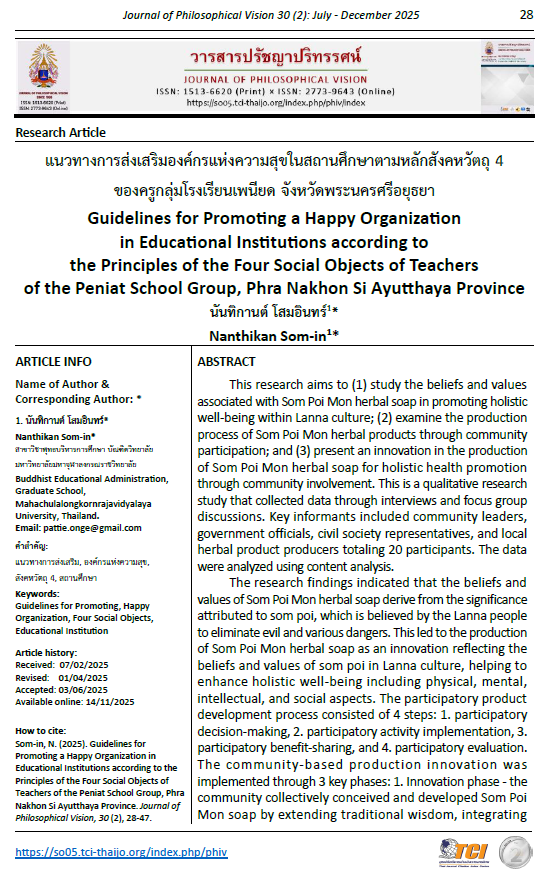
Guidelines for Promoting a Happy Organization in Educational Institutions according to the Principles of the Four Social Objects of Teachers of the Peniat School Group, Phra Nakhon Si Ayutthaya Province
Keywords:
Guidelines for Promoting, Happy Organization, Four Social Objects, Educational InstitutionAbstract
This research aims to (1) study the beliefs and values associated with Som Poi Mon herbal soap in promoting holistic well-being within Lanna culture; (2) examine the production process of Som Poi Mon herbal products through community participation; and (3) present an innovation in the production of Som Poi Mon herbal soap for holistic health promotion through community involvement. This is a qualitative research study that collected data through interviews and focus group discussions. Key informants included community leaders, government officials, civil society representatives, and local herbal product producers totaling 20 participants. The data were analyzed using content analysis.
The research findings indicated that the beliefs and values of Som Poi Mon herbal soap derive from the significance attributed to som poi, which is believed by the Lanna people to eliminate evil and various dangers. This led to the production of Som Poi Mon herbal soap as an innovation reflecting the beliefs and values of som poi in Lanna culture, helping to enhance holistic well-being including physical, mental, intellectual, and social aspects. The participatory product development process consisted of 4 steps: 1. participatory decision-making, 2. participatory activity implementation, 3. participatory benefit-sharing, and 4. participatory evaluation. The community-based production innovation was implemented through 3 key phases: 1. Innovation phase - the community collectively conceived and developed Som Poi Mon soap by extending traditional wisdom, integrating scientific concepts, and adding Buddhist spiritual value through blessing ceremonies, creating an innovation different from ordinary soap. 2. Development phase - production was carried out by dividing roles according to villagers' expertise, and 3. Implementation phase - real-world testing, market expansion through online marketing and faith networks, community training implementation, result monitoring, and product quality improvement.
Downloads
References
กองสวัสดิการแรงงาน. (2547). คุณภาพชีวิตการทำงาน (Quality of Work Life). กรุงเทพมหานคร: อนุสารพริ้น.
กฤตัชญ์ สุริยนต์. (2562). ความสัมพันธ์ระหว่างความสุขในการทำงานของครูกับประสิทธิผลของโรงเรียนในเครือสวนกุหลาบวิทยาลัย สังกัดสำนักงานคณะกรรมการการศึกษาขั้นพื้นฐาน. วารสารสังคมศาสตร์วิจัย. 10 (2) น. 12-14, กรกฎาคม-ธันวาคม.
ปุญญพัฒน์ คุ้มภัย และวิโรจน์ สุรสาครม. (2567). องค์กรแห่งความสุขของสถานศึกษา สังกัดสำนักงานเขตพื้นที่การศึกษาประถมศึกษาเพชรบุรี เขต 2. วารสารชมรมบัณฑิตศิลป์. 2 (3) น 11, กรกฎาคม-กันยายน.
พสชนัน นิรมิตไชยนนท์ และคณะ. (2561). ปัจจัยที่ส่งผลต่อความสุขในการทำงานของครูเจเนอเรชั่นวาย ในโรงเรียนของรัฐในกรุงเทพมหานคร. วารสารมนุษยศาสตร์ สังคมศาสตร์ และศิลปะ มหาวิทยาลัยศิลปากร. 11 (3) น. 23, กันยายน-ธันวาคม.
เด่นชัย อาทิตย์เจริญชัย. (2548). องค์กรแห่งความสุขของโรงเรียนศรีบุณยานนท์. (วิทยานิพนธ์ปริญญาศึกษาศาสตรมหาบัณฑิตมหาบัณฑิต สาขาวิชาการบริหารการศึกษา). บัณฑิตวิทยาลัย: มหาวิทยาลัยศิลปากร.
รุจิกร ตุลาธาร. (2565). ภาวะผู้นําการเปลี่ยนแปลงของผู้บริหารกับการเป็นองค์กรแห่งความสุขของโรงเรียนสังกัดสำนักงานเขตพื้นที่การศึกษามัธยมศึกษากาญจนบุรี. (วิทยานิพนธ์ปริญญาศึกษาศาสตรมหาบัณฑิตมหาบัณฑิต สาขาวิชาการบริหารการศึกษา). บัณฑิตวิทยาลัย: มหาวิทยาลัยศิลปากร.
ศราวุฒิ อินดา และวันทนา อมตาริยกุล. (2565). แนวทางการพัฒนาสู่องค์กรแห่งความสุขของสถานศึกษา สังกัดสำนักงานเขตพื้นที่การศึกษาประถมศึกษาจังหวัดหนองคาย. วารสารปัญญาปณิธาน. 7 (1) น. 83-84, มกราคม-มิถุนายน.
ศุภณัฏฐ์ ศศิวุฒิวัฒน์. (2567). นโยบายลดภาระงานครู (บางส่วน) ไม่พอคืนครูสู่ห้องเรียน (ออนไลน์), แหล่งที่มา: https://www.komchadluek.net/kom-lifestyle/ 9 กันยายน 2567.
สำนักงานสภาพัฒนาการเศรษฐกิจแห่งชาติ. (2567). แผนพัฒนาเศรษฐกิจและสังคมแห่งชาติฉบับที่ 12 พ.ศ. 2560-2564. (ออนไลน์), แหล่งที่มา: https://www.nesdc.go.th/ 8 สิงหาคม 2567.
สุทธิศักดิ์ อ่อนตะวัน. (2563). สมรรถนะของผู้บริหารกับความสุขของครูโรงเรียนสังกัดกรุงเทพมหานคร. (วิทยานิพนธ์ปริญญาศึกษาศาสตรมหาบัณฑิตมหาบัณฑิต สาขาวิชาการบริหารการศึกษา). บัณฑิตวิทยาลัย: มหาวิทยาลัยศิลปากร.
สำนักงานกองทุนสนับสนุนการสร้างเสริมสุขภาพ. (2552). คู่มือมาสร้างองค์กรแห่งความสุขกันเถอะ. กรุงเทพมหานคร: แผนงานสุขภาวะองค์กรภาคเอกชน.
อริศรา จันทยุทธ. (2560). การศึกษาความสุขในการทำงานของครูกลุ่มโรงเรียนประถมศึกษา อำเภอสันติสุข สังกัดสำนักงานเขตพื้นที่การศึกษาประถมศึกษาน่าน เขต 1. (วิทยานิพนธ์ปริญญาศึกษาศาสตรมหาบัณฑิตมหาบัณฑิต สาขาวิชาการบริหารการศึกษา). บัณฑิตวิทยาลัย: มหาวิทยาลัยรามคำแหง.
Joan Burton. (2010). WHO Healthy Workplace Framework and Model Background Document and Supporting Literature and Practices. (WHO Headquaters, Geneva, Switzerland.
Downloads
Published
How to Cite
Issue
Section
License
Copyright (c) 2025 Journal of Philosophical Vision

This work is licensed under a Creative Commons Attribution-NonCommercial-NoDerivatives 4.0 International License.
บทความวิชาการและบทความวิจัย ในวารสารฉบับนี้ ถือเป็นความรับผิดชอบของผู้เขียนเท่านั้น
สงวนลิขสิทธิ์ตามพระราชบัญญัติลิขสิทธิ์



