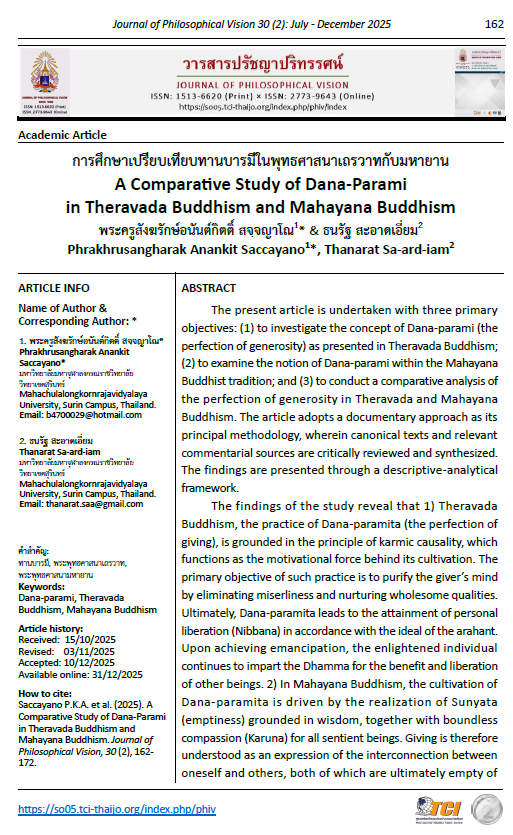
A Comparative Study of Dana-parami in Theravada Buddhism and Mahayana Buddhism
Keywords:
Dana-parami, Theravada Buddhism, Mahayana BuddhismAbstract
The present article is undertaken with three primary objectives: (1) to investigate the concept of Dana-parami (the perfection of generosity) as presented in Theravada Buddhism; (2) to examine the notion of Dana-parami within the Mahayana Buddhist tradition; and (3) to conduct a comparative analysis of the perfection of generosity in Theravada and Mahayana Buddhism. The article adopts a documentary approach as its principal methodology, wherein canonical texts and relevant commentarial sources are critically reviewed and synthesized. The findings are presented through a descriptive-analytical framework.
The findings of the study reveal that 1) Theravada Buddhism, the practice of Dana-paramita (the perfection of giving), is grounded in the principle of karmic causality, which functions as the motivational force behind its cultivation. The primary objective of such practice is to purify the giver’s mind by eliminating miserliness and nurturing wholesome qualities. Ultimately, Dana-paramita leads to the attainment of personal liberation (Nibbana) in accordance with the ideal of the arahant. Upon achieving emancipation, the enlightened individual continues to impart the Dhamma for the benefit and liberation of other beings. 2) In Mahayana Buddhism, the cultivation of Dana-paramita is driven by the realization of Sunyata (emptiness) grounded in wisdom, together with boundless compassion (Karuna) for all sentient beings. Giving is therefore understood as an expression of the interconnection between oneself and others, both of which are ultimately empty of inherent existence. This practice aligns with the Bodhisattva ideal, wherein one aspires to liberate all beings from Samsara before attaining the Nibbana oneself, vowing to enter final liberation only as the last. 3) The comparative analysis between Theravada and Mahayana perspectives on the perfection of generosity reveals that, although the two traditions differ in terms of doctrinal viewpoints, motivational foundations, and philosophical premises, they share a common ultimate goal - the perfection of virtue for the welfare and benefit of all.
Downloads
References
ธนิต อยู่โพธิ์. (2511). อุดมคติอันแตกต่างกันระหว่างพระพุทธศาสนาฝ่ายวิญญาณกับฝ่ายมหายาน กับพระโพธิสัตว์และตรีกาย. พระนคร: ศิวพร.
ประพจน์ อัศววิรุฬหการ. (2523). การศึกษาเชิงวิเคราะห์เรื่องพระโพธิสัตว์ในคัมภีร์เถรวาทและคัมภีร์มหายาน. วิทยานิพนธ์ปริญญาอักษรศาสตรมหาบัณฑิต มหาวิทยาลัยจุฬาลงกรณ์ราชวิทยาลัย.
พระพรหมคุณาภรณ์ (ป.อ. ปยุตฺโต). (2551). พจนานุกรมพุทธศาสตร์ ฉบับประมวลธรรม, พิมพ์ครั้งที่ 17. กรุงเทพมหานคร: มหาจุฬาลงกรณราชวิทยาลัย.
พระมหาพุทธรักษ์ ปราบนอก. (10 พฤศจิกายน 2555). มหายานลังกาวตารสูตร. สืบค้นเมื่อ 10 กันยายน 2568, จาก https://www.gonghoog.com/main/index.php/2012-11-10-06-51-10
พระมหาวิชาญ กำเนิดกลับ. (2549). การศึกษาเชิงวิเคราะห์คัมภีร์โพธิจรรยาวตาร. วิทยานิพนธ์ปริญญาศิลปศาสตรมหาบัณฑิต มหาวิทยาลัยศิลปากร.
พระศุภวัฒน์ สุขวฑฺฒโน (เกตุกระทึก). (2561). ศึกษาวิเคราะห์โพธิสัตว์จริยาในคัมภีร์วิมลเกียรตินิทเทสสูตร. วิทยานิพนธ์ปริญญาศาสนศาสตรมหาบัณฑิต มหาวิทยาลัยมหามกุฏราชวิทยาลัย.
มหาจุฬาลงกรณราชวิทยาลัย. (2539). พระไตรปิฎกภาษาไทย. กรุงเทพมหานคร: โรงพิมพ์มหาจุฬาลงกรณราชวิทยาลัย.
มหาจุฬาลงกรณราชวิทยาลัย. (2557). อรรถกถาภาษาไทย. กรุงเทพมหานคร: โรงพิมพ์มหาจุฬาลงกรณราชวิทยาลัย.
มหามกุฏราชวิทยาลัย. (2531). มังคลัตถทีปนี แปล เล่ม 3. กรุงเทพมหานคร: โรงพิมพ์มหามกุฏราชวิทยาลัย.
เสถียร โพธินันทะ. (2541). ปรัชญามหายาน, พิมพ์ครั้งที่ 4. กรุงเทพมหานคร: โรงพิมพ์มหามกุฏราชวิทยาลัย.
เสถียร โพธินันทะ. (2552). วิมลเกียรตินิรเทสสูตร, พิมพ์ครั้งที่ 9. กรุงเทพมหานคร: โรงพิมพ์มหามกุฏราชวิทยาลัย.
เสถียร โพธินันธะ. (2499). วัชรปรัชญาปารมิตาสูตร. กรุงเทพมหานคร: โรงพิมพ์มหามกุฏราชวิทยาลัย.
โสรัจจ์ หงศ์ลดารมภ์. (2550). วิถีชีวิตของพระโพธิสัตว์ (โพธิจรฺยาวตาร). นนทบุรี: มูลนิธิพันดารา.
อภิชัย โพธิ์ประสิทธิ์ศาสต์. (2539). พระพุทธศาสนามหายาน, พิมพ์ครั้งที่ 4. กรุงเทพมหานคร: สภาการศึกษามหามกุฏราชวิทยาลัย.
Downloads
Published
How to Cite
Issue
Section
License
Copyright (c) 2025 Journal of Philosophical Vision

This work is licensed under a Creative Commons Attribution-NonCommercial-NoDerivatives 4.0 International License.
บทความวิชาการและบทความวิจัย ในวารสารฉบับนี้ ถือเป็นความรับผิดชอบของผู้เขียนเท่านั้น
สงวนลิขสิทธิ์ตามพระราชบัญญัติลิขสิทธิ์



