
การขับเคลื่อนการส่งออกไทยในวิกฤตโรคติดเชื้อไวรัสโคโรนา 2019 (โควิด-19)
คำสำคัญ:
การส่งออก, ภาวะผู้นำ, โรคติดเชื้อไวรัสโคโรนา 2019, การจัดการภาวะวิกฤตบทคัดย่อ
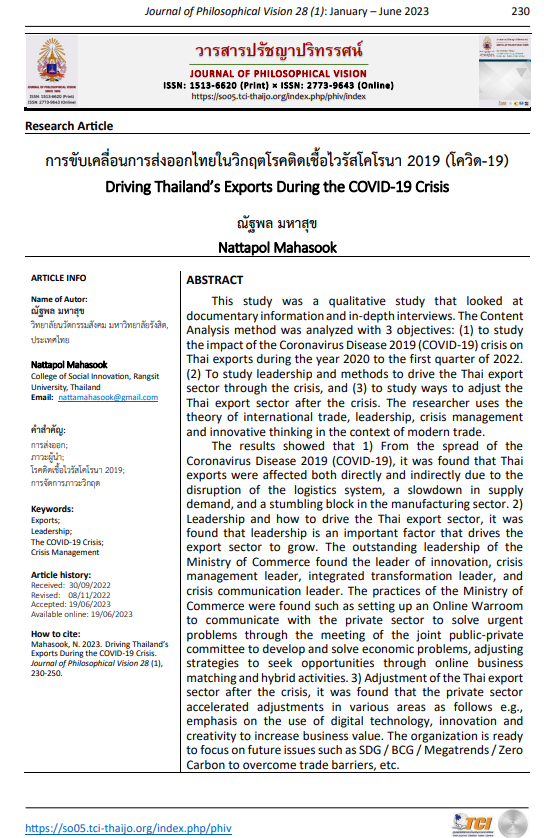
การศึกษาวิจัยนี้ เป็นการวิจัยเชิงคุณภาพที่ศึกษาข้อมูลจากเอกสารและการสัมภาษณ์เชิงลึก ทำการวิเคราะห์เนื้อหาด้วยวิธี Content Analysis มีวัตถุประสงค์ 3 ข้อ คือ (1) ศึกษาผลกระทบของวิกฤตโรคติดเชื้อไวรัสโคโรนา 2019 (โควิด-19) ต่อการส่งออกไทยในช่วงปี 2563 ถึงไตรมาสแรกของปี 2565 (2) ศึกษาภาวะผู้นำและวิธีการขับเคลื่อนภาคส่งออกไทยฝ่าวิกฤต และ (3) ศึกษาแนวทางการปรับตัวของภาคส่งออกไทยหลังวิกฤต โดยผู้วิจัยใช้ทฤษฎีการค้าระหว่างประเทศ ภาวะผู้นำ การบริหารจัดการวิกฤต และแนวคิดนวัตกรรมในบริบทการค้ายุคใหม่
ผลการวิจัยพบว่า 1) จากการแพร่ระบาดของโรคติดเชื้อไวรัสโคโรนา 2019 (โควิด-19) พบว่าการส่งออกไทยได้รับผลกระทบทั้งทางตรงและทางอ้อม เนื่องจากการหยุดชะงักของระบบโลจิสติกส์ การชะลอตัวของอุปสงค์อุปทาน และการสะดุดในภาคการผลิต 2) ภาวะผู้นำและวิธีการขับเคลื่อนภาคส่งออกไทย พบว่า ภาวะผู้นำเป็นปัจจัยสำคัญซึ่งทำให้ภาคส่งออกเติบโต ภาวะผู้นำที่โดดเด่นของกระทรวงพาณิชย์ ได้แก่ ผู้นำแห่งนวัตกรรม ผู้นำแห่งการบริหารจัดการวิกฤต ผู้นำแห่งการเปลี่ยนแปลงแบบคุณลักษณะหลอมรวม และ ผู้นำการสื่อสารในภาวะวิกฤต การปฏิบัติของกระทรวงพาณิชย์ที่พบ อาทิ ตั้ง Online Warroom เพื่อสื่อสาร ร่วมกับภาคเอกชนแก้ปัญหาเร่งด่วนผ่าน คณะกรรมการร่วมภาครัฐและเอกชนด้านการพาณิชย์ปรับกลยุทธ์เพื่อแสวงหาโอกาสผ่านกิจกรรม Online Business Matching และ Hybrid 3) การปรับตัวของภาคส่งออกไทยหลังวิกฤต พบว่า ภาคเอกชนเร่งปรับตัวในด้านต่างๆ ดังนี้ เน้นการใช้เทคโนโลยีดิจิทัล นวัตกรรม และความคิดสร้างสรรค์ในการเพิ่มมูลค่าธุรกิจ พร้อมให้ความสำคัญกับประเด็นแห่งอนาคต ได้แก่ SDG / BCG / Megatrends / Zero Carbon เพื่อก้าวข้ามข้อกีดกันทางการค้า เป็นต้น
Downloads
เอกสารอ้างอิง
กรมส่งเสริมการค้าระหว่างประเทศ. (2557). เอกสารประกอบการบรรยายเรื่องภาพรวมการค้าระหว่างประเทศของไทย ปัญหา อุปสรรค จุดแข็ง จุดอ่อน. กรุงเทพฯ : กรมส่งเสริมการค้าระหว่างประเทศ.
กระทรวงพาณิชย์. (2564). ภาวะการค้าระหว่างประเทศของไทยประจำเดือนธันวาคม 2563. สืบค้นจาก http://www.tpso.moc.go.th/th/node/10905.
กระทรวงพาณิชย์. (2565ก). ภาวะการค้าระหว่างประเทศของไทยประจำเดือนธันวาคม 2564. สืบค้นจาก http://www.tpso.moc.go.th/th/node/11414.
กระทรวงพาณิชย์. (2565ข). ภาวะการค้าระหว่างประเทศของไทยประจำเดือนมีนาคม 2565. สืบค้นจาก http://www.tpso.moc.go.th/th/node/11612.
กฤษมันต์ วัฒนาณรงค์. (2536). เทคโนโลยีเทคนิคศึกษา. กรุงเทพ: สถาบันเทคโนโลยีพระจอมเกล้าพระนครเหนือ.
ธนาคารกรุงศรีอยุธยา. (2563). พลิกโฉมธุรกิจหลังวิกฤตโควิด-19. สืบค้นจากhttps://www.krungsri. com/th/plearn-plearn/business-transformative-after-covid.
ธนาคารแห่งประเทศไทย. (2563). ผลวิกฤต COVID-19 กับธุรกิจเทรนด์ใหม่ การขนส่งภายใต้ Next Normal. สืบค้นจาก https://www.bot.or.th/Thai/ResearchAndPublications/articles/Pages/ Article_14Apr2020.aspx.
นุช สัทธาฉัตรมงคล และคณะ. (2559). ผู้นําการเปลี่ยนแปลงในยุคโลกาภิวัฒน์ สู่การพัฒนาอยางยั่งยืน. วารสารธุรกิจปริทัศน์, 3(1), 167-182.
วรินทร ตะนะคี. (2564). ภาวะผู้นำ: การพัฒนา องค์ประกอบและการจัดการสถานการณ์การแพร่ระบาดของโควิด 19 . วารสารสังคมศาสตร์ มหาวิทยาลัยมหามกุฏราชวิทยาลัย. 4(1), 39–47.
วันวิสาข์ เจริญนาน และ เฮนเซล เอมบาลซาโด (2564). ผลกระทบโรคระบาดโควิด-19 และการตอบสนองเชิงกลยุทธ์: ข้อมูลเชิงลึกจากผู้ประกอบการในประเทศไทย. จุฬาลงกรณ์ธุรกิจปริทัศน์, 168, 47 - 71.
วิมลพรรณ ช่างคิด. (2560). ภาวะผู้นำการเปลี่ยนแปลงของผู้บริหารสถานศึกษา สังกัดสำนักงานส่งเสริมการศึกษานอกระบบและการศึกษาตามอัธยาศัยในภาคตะวันออก. จันทบุรี : มหาวิทยาลัยราชภัฏรำไพพรรณี.
เศรษฐพุฒิ สุทธิวาทนฤพุฒิ. (2563). ปาฐกถาพิเศษ “เศรษฐกิจไทยหลังโควิด-19 จุดยืนของไทยในเวทีโลก” ในงาน Sharing Our Common Future โดยไทยรัฐ. สืบค้นจาก https://www.bangkokbiz news.com/business/907365
สถาบันวิจัยเพื่อการพัฒนาประเทศไทย (ทีดีอาร์ไอ). (2563). บทเรียนสภาวะผู้นำในสถานการณ์วิกฤติโควิด-19. สืบค้นจาก https://tdri.or.th/2020/01/covid-1.
สถาบันวิจัยเพื่อการพัฒนาประเทศไทย (ทีดีอาร์ไอ). (2564). ทางออกให้กับเศรษฐกิจไทยช่วงวิกฤตโควิด ผ่าน 3 มุมมอง. สืบค้นจาก https://tdri.or.th/2021/04/covid-118/
สำนักงานนโยบายและยุทธศาสตร์การค้า กระทรวงพาณิชย์. (2563). COVID-19 ไวรัสเปลี่ยนโลก. กระทรวงพาณิชย์. สืบค้นจาก http://www.tpso.moc.go.th/th/node/10701.
สำนักงานนโยบายและยุทธศาสตร์การค้า กระทรวงพาณิชย์. (2564). แนวโน้มการปรับตัวของภาคการส่งออกไทย หลังสถานการณ์โควิด-19. กระทรวงพาณิชย์. สืบค้นจาก http://www.tpso. moc.go.th/th/node/11169.
สำนักงานพัฒนาการเศรษฐกิจและสังคมแห่งชาติ. (2564). ร่างแผนพัฒนาเศรษฐกิจและสังคมแห่งชาติฉบับที่13. สืบค้นจาก https://www.nesdc.go.th/download/document/Yearend/2021/plan13.pdf
สำนักงานพัฒนาวิทยาศาสตร์และเทคโนโลยีแห่งชาติ. (2565). BCG Economy Model. สืบค้นจาก https://www.nstda.or.th/home/knowledge_post/nstda-bcg/.
อนุรักษ์ โชติดิลก. (2559). ตัวแบบการพัฒนาผู้นำที่เหมาะสมในสถานการณ์วิกฤติ. วารสารสถาบันวิชาการป้องกันประเทศ. 7(1), 31-37.
อภิรัตน์ กังสดารพร. (2564). เอกสารการสอนวิชาทฤษฎีผู้นำและการพัฒนาวิสัยทัศน์ผู้นำ, หลักสูตรศิลปศาสตรมหาบัณฑิต สาขาผู้นำทางสังคม ธุรกิจ และการเมืองมหาวิทยาลัยรังสิต.
Braden, V. et al. (2005). Crisis-a Leadership Opportunity. Cambridge, M.A.: Harvard University, John F. Kennedy School of Government National Security Program.
Coombs, W.T. (1999). Ongoing crisis communication: Planning, managing, and responding. Thousand Oaks, CA: Sage Publications, Inc.
Deloitte. (2020). Leadership styles of the Future: How COVID-19 is shaping leadership beyond the crisis. สืบค้นจาก https://www2.deloitte.com/content/dam/Deloitte/de/Documents/ human-capital-consulting/COVID19_Leadership_Styles.pdf.
Dzenan, Karic. (2017). A study about internal crisis communication strategies in Swedish private and public companies. University of Gothenburg Department of Applied Information Technology. สืบค้นจาก https://gupea.ub.gu.se/bitstream/handle/2077/53758/gupea_ 2077_53758_1.pdf?sequence=1&isAllowed=y.
Fink, S. (1986). Crisis management: planning for the inevitable. New York, NY: American Management Association.
Lagowska, U., et al. (2020). Leadership under crises: A research agenda for the post-COVID-19 era. Brazilian Administration Review.17(2). สืบค้นจากhttps://doi.org/10.1590/1807-7692bar2020200062.
Mikušová. M. et al. (2019). Prepared for a crisis? Basic elements of crisis management in an organization. Economic Research-Ekonomska Istraživanja,32:1 (1844-1868). สืบค้นจาก https://www.tandfonline.com/doi/pdf/10.1080/1331677X.2019.1640625.
Mitroff, Ian. (2004). Crisis Leadership. Hoboken: John Wiley & Sons, Inc.
Olsson, E. (2014). Crisis Communication in Public Organisations: Dimensions of Crisis Communication Revisited. Journal of Contingencies and Crisis Management, 22(2), 113-125.
ดาวน์โหลด
เผยแพร่แล้ว
รูปแบบการอ้างอิง
ฉบับ
ประเภทบทความ
สัญญาอนุญาต
ลิขสิทธิ์ (c) 2023 Journal of Philosophical Vision

อนุญาตภายใต้เงื่อนไข Creative Commons Attribution-NonCommercial-NoDerivatives 4.0 International License.
บทความวิชาการและบทความวิจัย ในวารสารฉบับนี้ ถือเป็นความรับผิดชอบของผู้เขียนเท่านั้น
สงวนลิขสิทธิ์ตามพระราชบัญญัติลิขสิทธิ์



