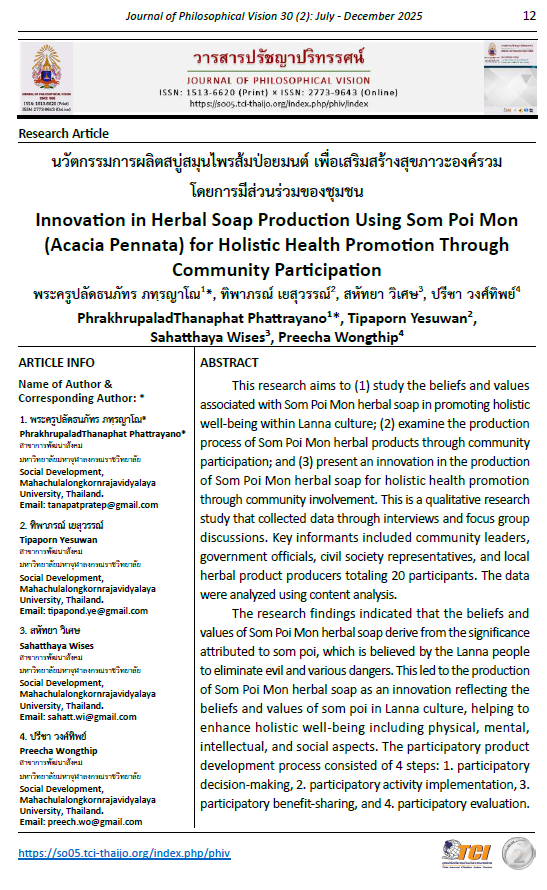
Innovation in Herbal Soap Production Using Som Poi Mon (Acacia Pennata) for Holistic Health Promotion Through Community Participation
Keywords:
Innovation, Som Poi Herbal Soap, Health Promotion, Community ParticipationAbstract
This research aims to (1) study the beliefs and values associated with Som Poi Mon herbal soap in promoting holistic well-being within Lanna culture; (2) examine the production process of Som Poi Mon herbal products through community participation; and (3) present an innovation in the production of Som Poi Mon herbal soap for holistic health promotion through community involvement. This is a qualitative research study that collected data through interviews and focus group discussions. Key informants included community leaders, government officials, civil society representatives, and local herbal product producers totaling 20 participants. The data were analyzed using content analysis.
The research findings indicated that the beliefs and values of Som Poi Mon herbal soap derive from the significance attributed to som poi, which is believed by the Lanna people to eliminate evil and various dangers. This led to the production of Som Poi Mon herbal soap as an innovation reflecting the beliefs and values of som poi in Lanna culture, helping to enhance holistic well-being including physical, mental, intellectual, and social aspects. The participatory product development process consisted of 4 steps: 1. participatory decision-making, 2. participatory activity implementation, 3. participatory benefit-sharing, and 4. participatory evaluation. The community-based production innovation was implemented through 3 key phases: 1. Innovation phase - the community collectively conceived and developed Som Poi Mon soap by extending traditional wisdom, integrating scientific concepts, and adding Buddhist spiritual value through blessing ceremonies, creating an innovation different from ordinary soap. 2. Development phase - production was carried out by dividing roles according to villagers' expertise, and 3. Implementation phase - real-world testing, market expansion through online marketing and faith networks, community training implementation, result monitoring, and product quality improvement.
Downloads
References
กระทรวงสาธารณสุข และสำนักงานคณะกรรมการสุขภาพแห่งชาติ. (2564). รายงานสถานการณ์สมุนไพรไทย และแนวโน้มอุตสาหกรรมสมุนไพรในอนาคต. กรุงเทพฯ: สำนักงานคณะกรรมการสุขภาพแห่งชาติ.
กระทรวงสาธารณสุข. (2566). แผนปฏิบัติการด้านสมุนไพรแห่งชาติ ฉบับที่ 2 พ.ศ. 2566–2570. กรุงเทพฯ: เปเปอรี่.
กัญญารัตน์ แซ่ตั้ง. (2563). การมีส่วนร่วมของชุมชนและการจัดการท่องเที่ยวอย่างยั่งยืนของชุมชนบ้านม้งดอยปุย. วิทยานิพนธ์ปริญญาศิลปศาสตมหาบัณฑิต มหาวิทยาลัยเชียงใหม่.
คลังความรู้ล้านนา. (28 มกราคม 2564). ส้มป่อยกับพิธีกรรมชำระสิ่งอัปมงคล. สืบค้นเมื่อ 3 เมษายน 2568, จาก https://accl.cmu.ac.th/Knowledge/details/2097
ทรงศักดิ์ ปรางค์วัฒนากุล. (2557). วรรณกรรคำสอนของล้านนา: ลักษณะเด่น ภูมิปัญญา และคุณค่า. เชียงใหม่: วนิดาการพิมพ์.
ประยุทธ์ นิลสุข. (2562). บทบาทของความเชื่อทางไสยศาสตร์ล้านนาในการพัฒนาเศรษฐกิจชุมชน: กรณีศึกษาจังหวัดเชียงใหม่. เชียงใหม่: โรงพิมพ์มหาวิทยาลัยเชียงใหม่.
พระอธิการโยธิน อินทะนะ และคณะ. (2565). พิธีกรรมและคุณค่าการใช้ส้มป่อยในวัฒนธรรมล้านนา. วารสารบัณฑิตแสงโคมคำ. 7 (2), 335–349.
มณี พะยอมยงค์. (2543). ประเพณีสิบสองเดือนล้านนาไทย. เชียงใหม่: ส. ทรัพย์การพิมพ์.
มารุต เหล็กเพชร. (2566). การวิจัยแบบมีส่วนร่วมโดยชุมชนเป็นฐาน: ในฐานะเครื่องมือและปัจจัยแห่งความสำเร็จของการร่วมสร้างระบบสุขภาพชุมชนที่เกาะยาว. วารสารระบบบริการปฐมภูมิและเวชศาสตร์ครอบครัว, 6 (4), 301-315.
ยุพิน เข็มมุกต์. (2554). ความเชื่อ พิธีกรรม สายใยในวิถีล้านนา. เชียงใหม่: เชียงใหม่โรงพิมพ์แสงศิลป์.
ลมูล จันทร์หอม. (2538). วรรณกรรมท้องถิ่นล้านนา. กรุงเทพฯ: โอ.เอส.พริ้นติ้ง เฮ้าส์.
วิชญา ราชกิจ. (2564). การมีส่วนร่วมของชุมชนในการพัฒนาผลิตภัณฑ์ท้องถิ่น: บทเรียนจากภาคเหนือของประเทศไทย. นครปฐม: มหาวิทยาลัยมหิดล.
สมชาย ธนาพิพิธกุล. (2563). การพัฒนาผลิตภัณฑ์ชุมชนเพื่อการพึ่งพาตนเองอย่างยั่งยืน. กรุงเทพฯ: จุฬาลงกรณ์มหาวิทยาลัย.
สมชาย วงศ์แสง. (2564). การพัฒนานวัตกรรมผลิตภัณฑ์ชุมชนบนกระบวนการเรียนรู้แบบมีส่วนร่วม. วารสารพัฒนาชุมชน. 15 (2), 45-62.
อดิศร ณ อุบล. (2558). การพัฒนาแนวทางการส่งเสริมนวัตกรรมแบบเปิดในกระบวนการสร้างสรรค์นวัตกรรมของอุตสาหกรรมซอฟต์แวร์ในประเทศไทย. รายงานการวิจัย. มหาวิทยาลัยธุรกิจบัณฑิตย์.
อรทัย วลีวงศ์. (12 กมภาพันธ์ 2564). Good Health and Well-being สุขภาพดีและความเป็นอยู่ที่ดี: เมื่อนิยามของสุขภาพดีไม่ได้หยุดอยู่แค่ร่างกายแข็งแรง. สืบค้นเมื่อ 3 เมษายน 2568, จาก https://www.sdgmove.com/2021/01/25/sdg-updates-good-health-and-well-being/
Downloads
Published
How to Cite
Issue
Section
License
Copyright (c) 2025 Journal of Philosophical Vision

This work is licensed under a Creative Commons Attribution-NonCommercial-NoDerivatives 4.0 International License.
บทความวิชาการและบทความวิจัย ในวารสารฉบับนี้ ถือเป็นความรับผิดชอบของผู้เขียนเท่านั้น
สงวนลิขสิทธิ์ตามพระราชบัญญัติลิขสิทธิ์



