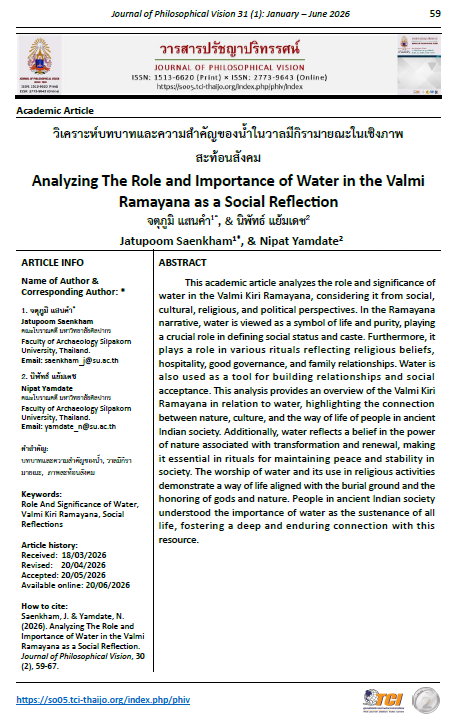
Analyzing The Role and Importance of Water in the Valmi Ramayana as a Social Reflection
Keywords:
Role And Significance of Water, Valmi Kiri Ramayana, Social ReflectionsAbstract
This academic article analyzes the role and significance of water in the Valmi Kiri Ramayana, considering it from social, cultural, religious, and political perspectives. In the Ramayana narrative, water is viewed as a symbol of life and purity, playing a crucial role in defining social status and caste. Furthermore, it plays a role in various rituals reflecting religious beliefs, hospitality, good governance, and family relationships. Water is also used as a tool for building relationships and social acceptance. This analysis provides an overview of the Valmi Kiri Ramayana in relation to water, highlighting the connection between nature, culture, and the way of life of people in ancient Indian society. Additionally, water reflects a belief in the power of nature associated with transformation and renewal, making it essential in rituals for maintaining peace and stability in society. The worship of water and its use in religious activities demonstrate a way of life aligned with the burial ground and the honoring of gods and nature. People in ancient Indian society understood the importance of water as the sustenance of all life, fostering a deep and enduring connection with this resource.
Downloads
References
ดนัย ไชยโยธา. (2553). วัฒนธรรมและอารยธรรมสัมพันธ์ของอนุทวีปอินเดียกับนานาประเทศ. กรุงเทพฯ : โอเดียนสโตร์.
ตรงใจ หุตางกูร. (2554). “มหาอุทกภัยในตำนาน” จดหมายข่าวศูนย์มานุษยวิทยาสิรินทร องค์กรมหาชน). ปีที่ 14. ฉบับที่ 74 ตุลาคม-ธันวาคม 2554, 19-21.
นงลักษณ์ เทพสวัสดิ์. (2549). มหัศจรรย์อินเดีย – แผ่นดินแห่งความหลากหลาย พิมพ์ครั้งที่ 1. กรุงเทพฯ: มหาจุฬาลงกรณราชวิทยาลัย, 2.
เบญจมาศ ขุนประเสริฐ. (2560). การการศึกษาวิเคราะห์บทละครสันสกฤต อภิชญานศากุนตลม องก์ที่ 3-4. ภาควิชาโบราณคดี สาขาวิชาภาษาสันสกฤต มหาวิทยาลัยศิลปากร. วิทยานิพนธ์ ปริญญามหาบัณฑิต.
มณีปิ่น พรหมสุทธิรักษ์. (2551). ประวัติวรรณคดีสันสกฤต. นครปฐม: โรงพิมพ์มหาวิทยาลัยศิลปากร.
เสรียรโกเศส. (2512). ประเพณีปลูกเรือน - แต่งงาน. พระนคร: บรรณาคาร.
Basham, A. L. (1982). The wonder that was India. London: Sidgwick & Jackson.
Chorley, R. J., & Haggett, P. (1967). Models in geography. London: Methuen.
Jones, E. E. (1964). Ingratiation: A social psychological analysis. New York: Appleton-Century-Crofts.
Müller, F. Max. (2006). The Upanishads. New Delhi: Cosmo Publications.
Downloads
Published
How to Cite
Issue
Section
License
Copyright (c) 2026 Journal of Philosophical Vision

This work is licensed under a Creative Commons Attribution-NonCommercial-NoDerivatives 4.0 International License.
บทความวิชาการและบทความวิจัย ในวารสารฉบับนี้ ถือเป็นความรับผิดชอบของผู้เขียนเท่านั้น
สงวนลิขสิทธิ์ตามพระราชบัญญัติลิขสิทธิ์



