The Model of Executive Ethics Influencing Effectiveness of Thai Business Organizations in Bangkok
Abstract
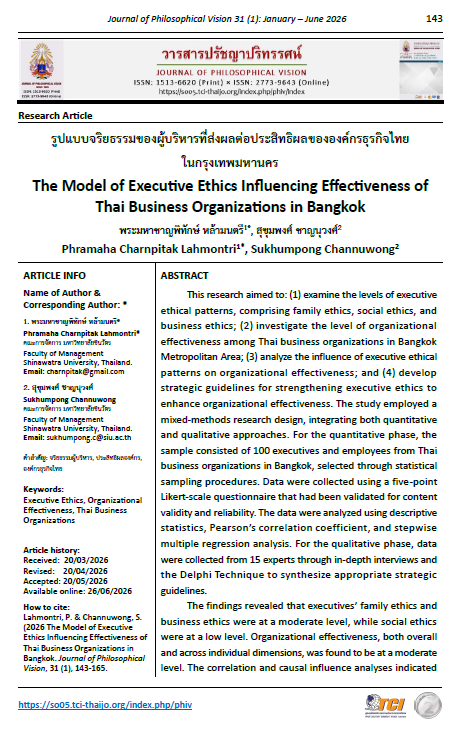
This research aimed to: (1) examine the levels of executive ethical patterns, comprising family ethics, social ethics, and business ethics; (2) investigate the level of organizational effectiveness among Thai business organizations in Bangkok Metropolitan Area; (3) analyze the influence of executive ethical patterns on organizational effectiveness; and (4) develop strategic guidelines for strengthening executive ethics to enhance organizational effectiveness. The study employed a mixed-methods research design, integrating both quantitative and qualitative approaches. For the quantitative phase, the sample consisted of 100 executives and employees from Thai business organizations in Bangkok, selected through statistical sampling procedures. Data were collected using a five-point Likert-scale questionnaire that had been validated for content validity and reliability. The data were analyzed using descriptive statistics, Pearson’s correlation coefficient, and stepwise multiple regression analysis. For the qualitative phase, data were collected from 15 experts through in-depth interviews and the Delphi Technique to synthesize appropriate strategic guidelines.
The findings revealed that executives’ family ethics and business ethics were at a moderate level, while social ethics were at a low level. Organizational effectiveness, both overall and across individual dimensions, was found to be at a moderate level. The correlation and causal influence analyses indicated that the three dimensions of executive ethics jointly predicted organizational effectiveness at a statistically significant level of .01, with a coefficient of determination (R²) of .832. This result suggests that executive ethics accounted for 83.20 percent of the variance in organizational effectiveness. Among the ethical dimensions, family ethics exerted the strongest influence, followed by business ethics and social ethics, respectively. Furthermore, the qualitative findings led to the development of the “FAMILY CORE STRATEGY”, which was evaluated by experts as having the highest level of appropriateness. The study highlights that the systematic development of executive ethics, particularly family ethics, serves as a crucial mechanism for enhancing organizational effectiveness, sustainability, and long-term competitiveness of Thai business organizations.
Downloads
References
ทิพย์วรรณ พิทักษ์ธรรมพงศ์. (2566). ความสัมพันธ์ระหว่างโครงสร้างองค์การ วัฒนธรรมองค์การ และประสิทธิผลขององค์การธุรกิจบริการในจังหวัดเชียงใหม่. วารสารวิชาการมหาวิทยาลัยราชภัฏเชียงใหม่, 25(2), 112–126.
ปัทมา แก้วสุข. (2564). จริยธรรมของผู้บริหารที่ส่งผลต่อการดำเนินงานขององค์กรธุรกิจในจังหวัดนครราชสีมา. วารสารวิจัยและพัฒนา มหาวิทยาลัยราชภัฏนครราชสีมา, 13(2), 45–59.
ปรียาภรณ์ วงษ์สว่าง. (2566). ภาวะผู้นำเชิงจริยธรรมกับความไว้วางใจในองค์การ. วารสารวิชาการมนุษยศาสตร์และสังคมศาสตร์ มรภ.ราชนครินทร์, 9(1), 98–113.
เมธินี อินทร์ม่วง. (2566). รูปแบบการพัฒนาภาวะผู้นำที่สอดคล้องกับบริบทครอบครัวเพื่อการส่งเสริมธรรมาภิบาลในองค์กรธุรกิจไทย. วารสารวิจัยทางสังคมศาสตร์, 16(1), 123–136.
วิชชุดา บุญคำ. (2565). การพัฒนาภาวะผู้นำและจริยธรรมของผู้บริหารในองค์กรธุรกิจของไทย. วารสารสันติศึกษาปริทรรศน์ มจร, 10(1), 160–177.
สุทธิรักษ์ นพคุณ. (2566). แนวทางการพัฒนาทรัพยากรมนุษย์บนพื้นฐานจริยธรรมและคุณธรรมในองค์การธุรกิจ. วารสารวิชาการการบริหารทรัพยากรมนุษย์, 12(2), 55–67.
Bangbon, P., Channuwong, S., Amponstira, F., Rungsuk, A. & Snongtaweeporn, T. (2023). The
influence of transformational leadership on organizational sustainability: A case study of business companies in Bangkok. Journal of Namibian Studies, 33, 4077-4095.
Barnard, C. I. (1938). The functions of the executive. Harvard University Press.
Benlahcene, A., Omar, A., Salim, A., & Haseeb, M. (2023). Role of ethical leadership in enhancing corporate sustainability: Evidence from ASEAN business environments. Social Sciences, 12(1), 35.
Brown, M. E., & Treviño, L. K. (2020). Ethical leadership: A review and future directions. The Leadership Quarterly, 31(2), 101378.
Broom, L., & Selznick, P. (1968). Sociology: A text with adapted readings. Harper & Row.
Cameron, K. S. (1981). Domains of organizational effectiveness in colleges and universities. Academy of Management Journal, 24(1), 25–47.
Cameron, K. S. (1986). A study of organizational effectiveness and its predictors. Management Science, 32(1), 87–112.
Cameron, K. S., & Quinn, R. E. (2022). Diagnosing and changing organizational culture: Based on the competing values framework (4th ed.). John Wiley & Sons.
Campbell, J. P. (1977). On the nature of organizational effectiveness. In P. S. Goodman & J. M. Pennings (Eds.), New perspectives on organizational effectiveness (pp. 13–55). Jossey-Bass.
Carroll, A. B., & Buchholtz, A. K. (2012). Business and society: Ethics and stakeholder management. Cengage Learning.
Chughtai, A. A. (2021). Servant and ethical leadership: Influence on individual and organizational performance. Journal of Business Ethics, 174(1), 29–45.
Channuwong, S., Chaetnaloa, P., Wongwisutthirat, K., Weerachareonchai, P. (2024). Good
governance principles in Buddhism for business and politics administration. Migration Letters, 21(S1), 818-827.
Channuwong, S., & Ruksat. (2022). Buddhist teachings for improving mental health during the COVID-19 pandemic. The Journal of Behavioral Sciences, 17(2), 29-41.
Dickinson, G., & Leming, J. S. (1990). Understanding social issues. Holt, Rinehart and Winston.
Dominguez, L., et al. (2009). Professional ethics and business conduct. Journal of Business Ethics, 90(2), 123–135.
Durkheim, É. (1964). The division of labor in society. Free Press.
Elkin, F. (1989). The child and society: The process of socialization. Oxford University Press.
Epstein, N. B., & Bishop, D. S. (1978). Family functioning: The McMaster model. Journal of Marriage and Family Counseling.
Etzioni, A. (1964). Modern organizations. Prentice-Hall.
Ferrell, O. C., Fraedrich, J., & Ferrell, L. (2013). Business ethics: Ethical decision making and cases. Cengage Learning.
Freeman, R. E. (1984). Strategic management: A stakeholder approach. Pitman.
Friedman, M. (1992). Family systems theory and practice. Family Process, 31(2), 145–156.
Freud, S. (1967). The ego and the id. W. W. Norton.
Green, J. (1964). Socialization and personality development. Routledge.
Kaptein, M. (2010). The ethics of organizations: A measure of organizational ethics. Journal of Business Ethics, 92(2), 135–147.
Kerckhoff, A. C. (1972). Socialization and social class. Sociology of Education, 45(2), 122–134.
Khan, A., Ahmad, S., & Ghauri, T. A. (2023). Ethical leadership and organizational outcomes: The mediating role of emotional intelligence and workplace culture. Journal of Business Ethics. https://doi.org/10.1007/s10551-023-05487-y
Mercer, D., & Merton, R. K. (1958). Social structure and socialization. American Sociological Review, 23(3), 255–262.
Moos, R. H., & Moos, B. S. (1986). Family environment scale manual. Consulting Psychologists Press.
Morrow, W., & Wilson, G. (1961). Family interaction patterns. Journal of Marriage and Family, 23(4), 321–330.
Newman, D. M., & Granuerholz, E. (2002). Sociology of families. Pine Forge Press.
Piaget, J. (1971). The theory of stages in cognitive development. McGraw-Hill.
Posner, B. Z. (2010). Another look at the impact of personal and organizational values congruency. Journal of Business Ethics, 97(4), 535–546.
Post, J. E., Lawrence, A. T., & Weber, J. (2011). Business and society: Corporate strategy, public policy, ethics. McGraw-Hill.
Quinn, R. E., & Rohrbaugh, J. (1983). A spatial model of effectiveness criteria. Management Science, 29(3), 363–377.
Robbins, S. P. (1990). Organization theory: Structure, design, and applications. Prentice-Hall.
Skinner, C. F., et al. (1995). Family functioning and behavioral assessment. Journal of Family Psychology, 9(2), 123–135.
Steers, R. M. (1977). Organizational effectiveness: A behavioral view. Goodyear Publishing.
Steiner, G. A., & Steiner, J. F. (2012). Business, government, and society: A managerial perspective. McGraw-Hill.
Striteska, M., & Spickova, M. (2021). Linking performance measurement and managerial effectiveness: Case study of Czech companies. Journal of Competitiveness, 13(1), 129–144.
Treviño, L. K., & Nelson, K. A. (2021). Managing business ethics: Straight talk about how to do it right (8th ed.). John Wiley & Sons.
Walumbwa, F. O., Christensen, A. L., & Mshomi, M. K. (2023). Authentic leadership and behavioral integrity: A pathway to team effectiveness and trust. Journal of Business Research, 158, 114535.
Weiss, J. W. (2009). Business ethics: A stakeholder and issues management approach. South-Western Cengage Learning.
Downloads
Published
How to Cite
Issue
Section
License
Copyright (c) 2026 Journal of Philosophical Vision

This work is licensed under a Creative Commons Attribution-NonCommercial-NoDerivatives 4.0 International License.
บทความวิชาการและบทความวิจัย ในวารสารฉบับนี้ ถือเป็นความรับผิดชอบของผู้เขียนเท่านั้น
สงวนลิขสิทธิ์ตามพระราชบัญญัติลิขสิทธิ์



