Educational Buddhist Philosophy
Keywords:
Educational Buddhist Philosophy, Buddhist EducationAbstract
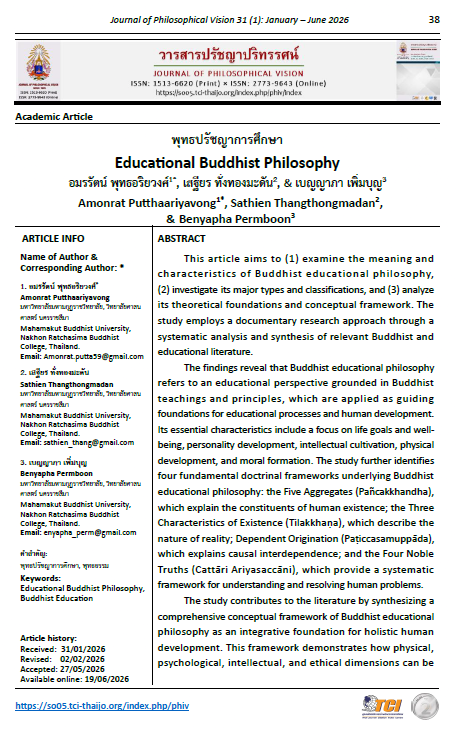
This article aims to (1) examine the meaning and characteristics of Buddhist educational philosophy, (2) investigate its major types and classifications, and (3) analyze its theoretical foundations and conceptual framework. The study employs a documentary research approach through a systematic analysis and synthesis of relevant Buddhist and educational literature.
The findings reveal that Buddhist educational philosophy refers to an educational perspective grounded in Buddhist teachings and principles, which are applied as guiding foundations for educational processes and human development. Its essential characteristics include a focus on life goals and well-being, personality development, intellectual cultivation, physical development, and moral formation. The study further identifies four fundamental doctrinal frameworks underlying Buddhist educational philosophy: the Five Aggregates (Pañcakkhandha), which explain the constituents of human existence; the Three Characteristics of Existence (Tilakkhaṇa), which describe the nature of reality; Dependent Origination (Paṭiccasamuppāda), which explains causal interdependence; and the Four Noble Truths (Cattāri Ariyasaccāni), which provide a systematic framework for understanding and resolving human problems.
The study contributes to the literature by synthesizing a comprehensive conceptual framework of Buddhist educational philosophy as an integrative foundation for holistic human development. This framework demonstrates how physical, psychological, intellectual, and ethical dimensions can be interconnected within educational practice. The findings offer theoretical insights and practical implications for curriculum development, pedagogical design, and educational policy aimed at promoting sustainable human development in contemporary societies.
Downloads
References
กรมการศาสนา, 2554. พระไตรปิฎก ฉบับมหาวิทยาลัยมหามกุฏราชวิทยาลัย. โรงพิมพ์มหามกุฏราชวิทยาลัย. กรุงเทพมหานคร.
จิตรกร ตั้งเกษมสุข. (2525). พุทธปรัชญากับปรัชญาการศึกษาของไทย. สำนักพิมพ์เคล็ดไทย.
ไพฑูรย์ สินลารัตน์. (2523). ปรัชญาการศึกษาและปรัชญาการศึกษาของไทย. ไทยวัฒนาพานิช.
พระธรรมปิฎก (ป.อ. ปยุตฺโต). (2541). หยาดเพชร หยาดธรรม: ภูมิปัญญาเพื่อการศึกษาไทย. โรงพิมพ์คุรุสภาลาดพร้าว.
พระพรหมคุณาภรณ์ (ป.อ. ปยุตฺโต). (2559). พุทธธรรม (ฉบับปรับขยาย). ผลิธัมม์.
มหาจุฬาลงกรณราชวิทยาลัย. (2539). พระไตรปิฎกภาษาไทย ฉบับมหาจุฬาลงกรณราชวิทยาลัย (เล่ม 12). โรงพิมพ์มหาจุฬาลงกรณราชวิทยาลัย.
มหามกุฏราชวิทยาลัย. (2547). พระไตรปิฎกและอรรถกถาแปล ฉบับมหามกุฏราชวิทยาลัย. กรุงเทพมหานคร: มหามกุฏราชวิทยาลัย.
วิไล ตั้งจิตสมคิด. (2539). การศึกษาไทย. โอเดียนสโตร์.
ศักดา ปรางค์ประทานพร. (2526). ปรัชญาการศึกษา ฉบับพื้นฐาน. โอเดียนสโตร์.
ศินีนาถ ศรีบุรัมย์. (2563). พุทธปรัชญา. GotoKnow.
สนิท ศรีสำแดง. (2534). พระพุทธศาสนากับหลักการศึกษา. นีลนาราการพิมพ์.
สมบูรณ์ พรรณาภพ. (2524). ประวัติและปรัชญาการศึกษาไทย. โอเดียนสโตร์.
อบรม สินภิบาล, & ชาญชัย ศรีไสยเพชร. (2522). พื้นฐานการศึกษา. โอเดียนสโตร์.
Downloads
Published
How to Cite
Issue
Section
License
Copyright (c) 2026 Journal of Philosophical Vision

This work is licensed under a Creative Commons Attribution-NonCommercial-NoDerivatives 4.0 International License.
บทความวิชาการและบทความวิจัย ในวารสารฉบับนี้ ถือเป็นความรับผิดชอบของผู้เขียนเท่านั้น
สงวนลิขสิทธิ์ตามพระราชบัญญัติลิขสิทธิ์



