
The Myth of Tattooing on Women’s the Body
Keywords:
Myths;, Tattoos;, Myths of Tattoos;, Tattoos on Women's Bodies;, Myths of Tattoos on Women's BodiesAbstract
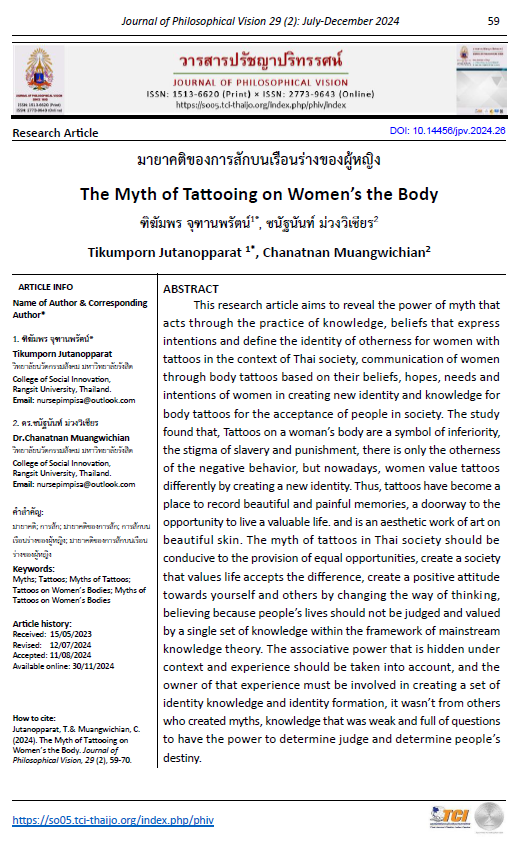
This research article aims to reveal the power of myth that acts through the practice of knowledge, beliefs that express intentions and define the identity of otherness for women with tattoos in the context of Thai society, communication of women through body tattoos based on their beliefs, hopes, needs and intentions of women in creating new identity and knowledge for body tattoos for the acceptance of people in society. The study found that, Tattoos on a woman's body are a symbol of inferiority, the stigma of slavery and punishment, there is only the otherness of the negative behavior, but nowadays, women value tattoos differently by creating a new identity. Thus, tattoos have become a place to record beautiful and painful memories, a doorway to the opportunity to live a valuable life. and is an aesthetic work of art on beautiful skin. The myth of tattoos in Thai society should be conducive to the provision of equal opportunities, create a society that values life accept the difference, create a positive attitude towards yourself and others by changing the way of thinking, believing because people's lives should not be judged and valued by a single set of knowledge within the framework of mainstream knowledge theory. The associative power that is hidden under context and experience should be taken into account, and the owner of that experience must be involved in creating a set of identity knowledge and identity formation, It wasn't from others who created myths, knowledge that was weak and full of questions to have the power to determine judge and determine people's destiny.
Downloads
References
ก้องสกล กวินรวีกุล. (2545). การสร้างร่างกายพลเมืองไทยในสมัยจอมพล ป. พิบูลสงคราม พ.ศ. 2481-2487. วิทยานิพนธ์ ศิลปศาสตรมหาบัณฑิต มหาวิทยาลัยธรรมศาสตร์.
ธนิส พูนวงศ์ประเสริฐ. (2558). รอยสักในสังคมญี่ปุ่น : ยุคก่อนประวัติศาสตร์ถึงยุคเมจิ. วารสารสถาบันวัฒนธรรมและศิลปะ. 17(1), (ก.ค.-ธ.ค. 2558), 20-29.
รัฐกานต์ กัณพิพัฒน์. (2557). พฤติกรรมเลียนแบบกับค่านิยมการสักของวัยรุ่นหญิงในเขตกรุงเทพมหานคร. วารสารวิทยบริการ มหาวิทยาลัยสงขลานครินทร์. 25(3), 39-47.
สังคีต จันทนะโพธิ. (2552). รอยสักสยาม. กรุงเทพฯ : สำนักพิมพ์สยามบันทึก.
อารียา คหะวงค์. (2564). การสัก บริบทของความเชื่อสู่ความงามบนเรือนร่าง : สถาบันวัฒนธรรมและศิลปะมหาวิทยาลัยศรีนครินทรวิโรฒ. สืบค้นเมื่อ 2 มีนาคม 2566 จาก http://ica.swu.ac.th/news/detail/2/151.
Crang, Mike. (1998). Cultural Geography. London; New York : Routledge.
Muto Yasuaki and Fukao Mitsuhiro. (2005). Keizai Bijinesu Yougo Jiten. Tokyo: Nihonkeizaishinbunsha.
Downloads
Published
How to Cite
Issue
Section
License
Copyright (c) 2024 Journal of Philosophical Vision

This work is licensed under a Creative Commons Attribution-NonCommercial-NoDerivatives 4.0 International License.
บทความวิชาการและบทความวิจัย ในวารสารฉบับนี้ ถือเป็นความรับผิดชอบของผู้เขียนเท่านั้น
สงวนลิขสิทธิ์ตามพระราชบัญญัติลิขสิทธิ์



