
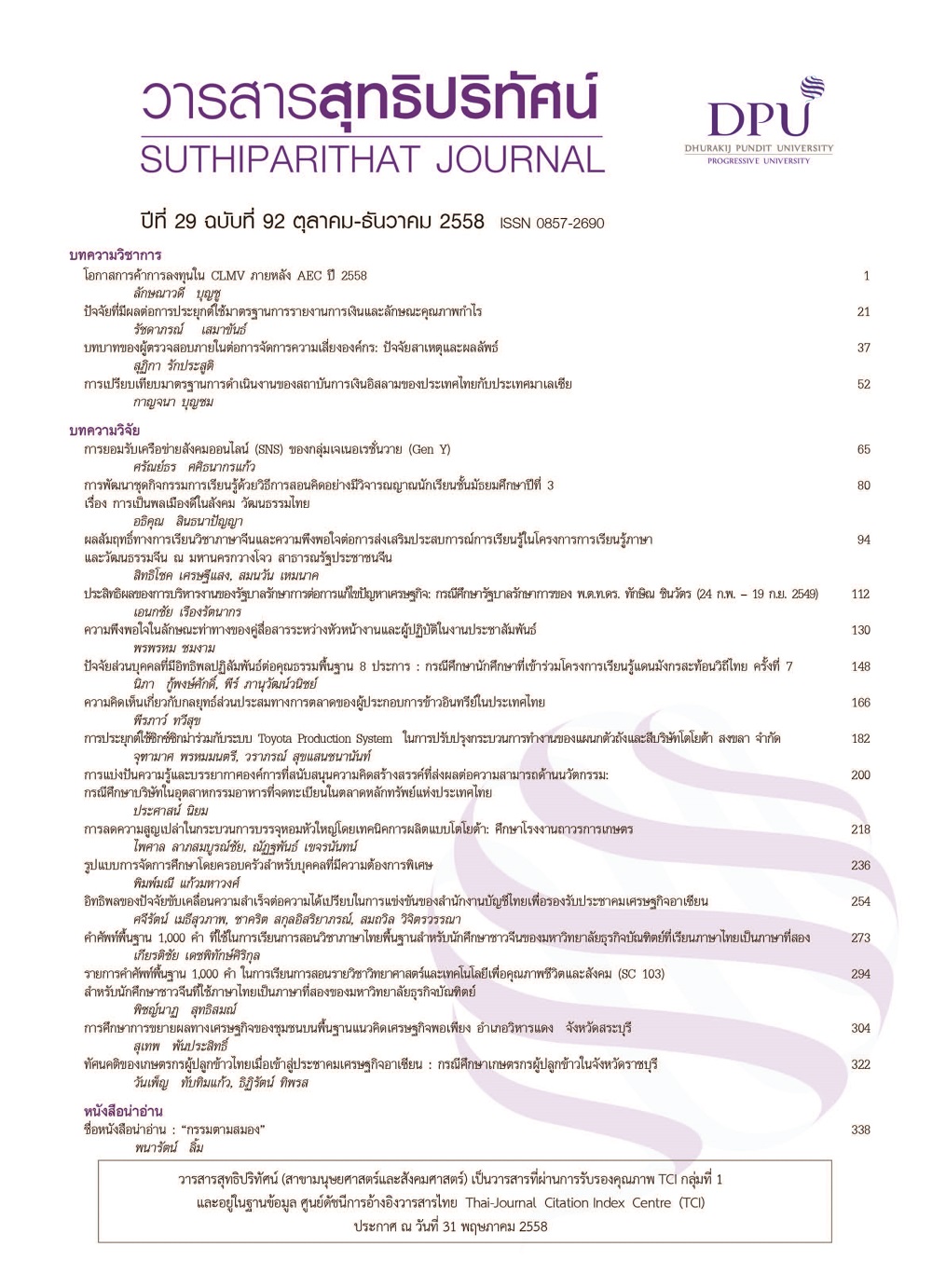
The Acceptance of Social Network Service of Generation Y
Keywords:
Acceptance, Social Network Service, Generation Y, Perceived Usefulness, Perceived Ease of Use, Subjective NormsAbstract
This research “The Acceptance of Social Network Service of Generation Y” is aimed to 1) to study the relationship between Perceived Usefulness in social network service usage and behavior in social network service usage of Generation Y, 2) to study the relationship between Perceived Ease of Use in social network service usage and behavior in social network service usage of Generation Y, and 3) to study the relationship between Subjective Norms and behavior in social network service usage of Generation Y. The samples of this study are Generation Y of age between 20 - 35 years old who use social network service and live in Bangkok. Data are collected by survey questionnaires from 400 respondents. Research results are analyzed with percentage and means. Pearson Product Moment Correlation Coefficient is used to test relationship between variables.
The results of the study showed that most questionnaire respondents were female, 20-35 years old, with Bachelor’s degree and Master’s degree as the highest level of education. They were enterprise employees, with monthly salary of 10,001-20,000 baht. The respondents had Perceived Usefulness, Perceived Ease of Use and Subjective Norms at high level and behavior in social network service usage was at moderate level. From hypothesis test, it is found that Perceived Usefulness, Perceived Ease of Use and Subjective Norms had positively correlated with behavior in social network service usage in Significant level at 0.01
References
คมชัดลึกออนไลน์. (2557). กลยุทธ์มัดใจ ผู้บริโภค Gen Y : โดยศูนย์วิจัยเศรษฐกิจและธุรกิจธนาคารไทยพาณิชย์. สืบค้น 12 พฤษภาคม 2558, จาก http://www.komchadluek.net/detail/20141121/196253.html
ชานนท์ ศิริธร. (2555). การเปิดรับสื่อและการยอมรับนวัตกรรมของผู้บริโภคเจเนอเรชั่นเอ๊กซ์และเจเนอเรชั่นวาย(วิทยานิพนธ์ปริญญามหาบัณฑิต). กรุงเทพฯ: จุฬาลงกรณ์มหาวิทยาลัย.
นีลเส็น ประเทศไทย . (2556). ผลสำรวจ 10 แอปพลิเคชั่นยอดนิยมในเอเซียตะวันออกเฉียงใต้. สืบค้น 10 พฤษภาคม 2558, จาก http://www.nielsen.com/th/th/top10s.html
พชร แก้วเขียว. (2555). การยอมรับการใช้อินเทอร์เน็ตบนโทรศัพท์มือถือของวัยรุ่นในกรุงเทพมหานคร (วิทยานิพนธ์ศิลปศาสตรมหาบัณฑิต). กรุงเทพฯ: มหาวิทยาลัยเกษตรศาสตร์.
ศรัณย์ธร ศศิธนากรแก้ว. ( 2547). การรับรู้และการยอมรับศูนย์บริการสารสนเทศชุมชนในชนบทไทย (วิทยานิพนธ์นิเทศศาสตรดุษฎีบัณฑิต). กรุงเทพฯ: จุฬาลงกรณ์มหาวิทยาลัย.
สถานีโทรทัศน์ไทยพีบีเอส. (2556). วิจัยคน"เจนวาย" ในองค์กรพุ่งปี 2559 แนะธุรกิจปรับกลยุทธ์คนรุ่นใหม่เก่าต้านปัญหาสมองไหล. สืบค้น 10 พฤษภาคม 2558, จาก http.//news.thaipbs.or.th
ส่วนงานดัชนีและสำรวจ สำนักนโยบายและส่งเสริมธุรกรรมทางอิเลคทรอนิคส์ สำนักงานพัฒนาธุรกรรมทางอิเลคทรอนิคส์ (องค์การมหาชน) กระทรวงเทคโนโลยีสารสนเทศและการสื่อสาร. (2556). รายงานผลการสำรวจพฤติกรรมผู้ใช้อินเทอร์เน็ตในประเทศไทยปี 2556, กรุงเทพฯ: สำนักงานพัฒนาธุรกรรมทาง อิเล็กทรอนิกส์ (องค์การมหาชน).
เสาวคนธ์ วิทวัสโอฬาร. (2550). Gen Y: จับให้มั่นคั้นให้เวิร์ค. กรุงเทพฯ : กรุงเทพธุรกิจบิซบุ๊ค.
เสาวคนธ์ ศิรกิดากร. (2554). 45 กระบวนท่าพัฒนา Gen Y. กรุงเทพฯ: อมรินทร์พริ้นติ้งแอนด์พับลิชชิ่ง.
ไอที 24 ชั่วโมง. (2557). เผยพฤติกรรมคนไทย ติด Social Network ตลอดเวลา จนขาดไม่ได้. สืบค้น 16 พฤษภาคม 2558, จาก http://www.it24hrs.com/2014/thai-socialnetwork-day-in-a-life
Ajzen, I. & Fishbein, M. (1970). The prediction of behavior from attitudinal and normative variables. Journal of Experimental Social Psychology, 6, 466-487.
Agarwal, P. (1997). The Role of Innovation Characteristics and Perceived Voluntariness in the Acceptance of Information Technologies. Decision Sciences. 28(3), 557-582.
Chau, P.Y.K. (1996). An empirical assessment of a modified technology acceptance model. Journal of Management Information Systems, 13(2), 185-204.
Davis, F.D. (1989). Perceived Usefulness, Perceived Ease of Use and User acceptance of Information Technology. MIS Quarterly, 13(3), 319-339.
Davis, F.D., Bagozzi, R.P. & Warshaw. (1989). User acceptance of Computer Technology: A Comparison of Two Theoretical Models. Management Science, 35(8), 982-1003.
Igbaria, M. & Iivari, J. (1995). The effects of self-efficacy on computer usage. International Journal of Management Science, 23(6), 587-605. Decision Sciences Institute. 28,(3), 557–582.
Mathieson, K. (1991). Predicting User Intentions: Comparing The Technology acceptance Model with the Theory of Planned Behavior. Information Systems Research. 3(3), 173-179.
Rogers, E. M. (1995). Diffusion of Innovations. New York: Free Press.
Szajna, B. (1996). Software evaluation and choice :Predictive validation of the technology acceptance instrument . MIS Quarterly, 18(3), 319-324.
Taylor, S. & Todd, P.A. (1995). Understanding information technology usage : A test of competing models. Information Systems Research, 6(2), 144-176.
Venkatesh, V. & Davis, F. D. (1996). A Model of the antecedents of perceived ease of use: Development and test. Decision Science, 27(3), 451-481.
Venkatesh, V. & Davis, F. D. (2000). A Theoretical extension of the technology acceptance model: Four longitudinal field studies. Management Science, 46(2), 186-204.
Downloads
Published
How to Cite
Issue
Section
License
Content and information of the article published at Suthiparithat Journal are based on the sole opinions and responsibility of author(s) only. Neither the editorial board involve in......





