
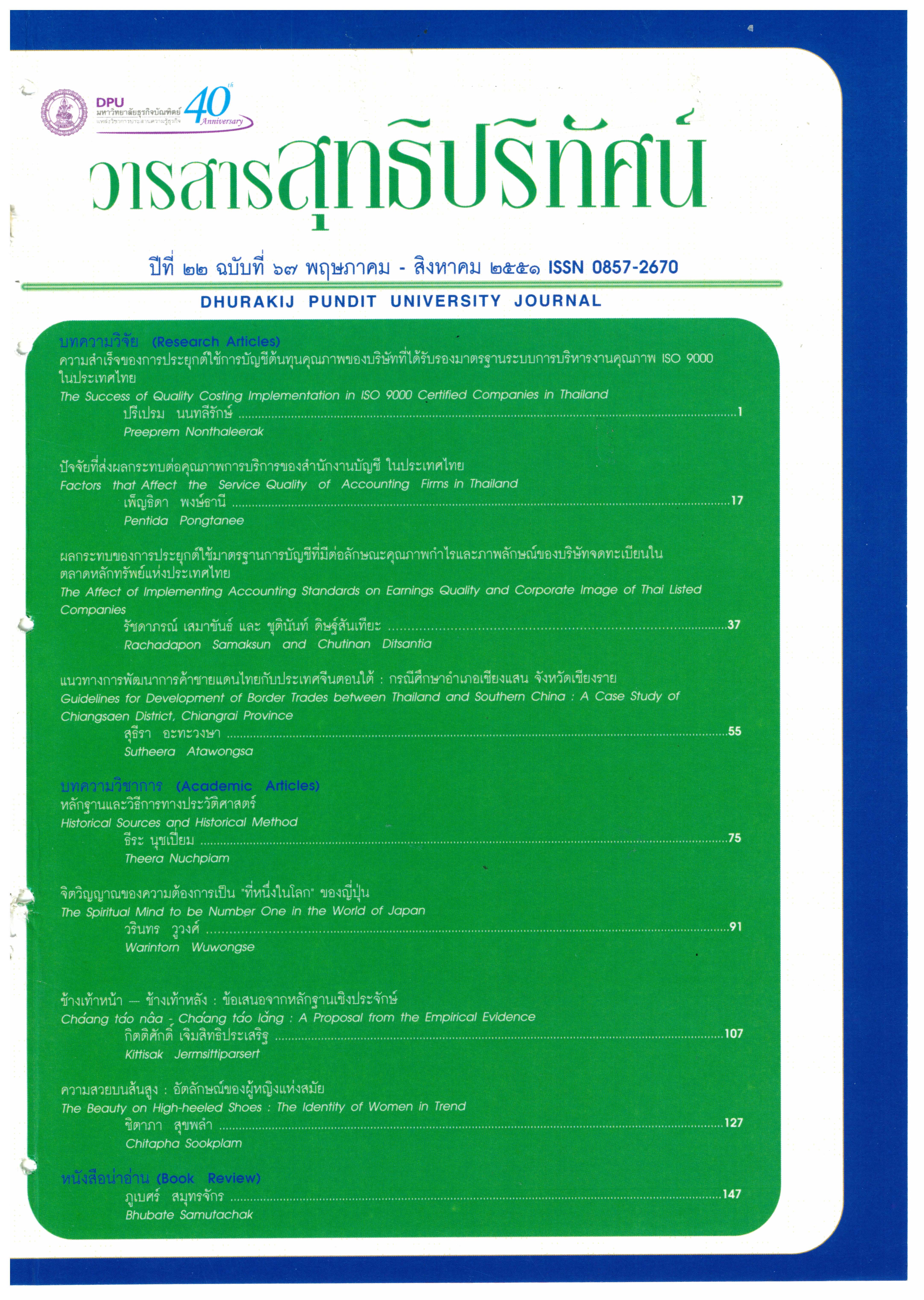
GUIDELINES FOR DEVELOPMENT OF BORDER TRADES BETWEEN THAILAND AND SOUTHERN CHINA : A CASE STUDY OF CHIANGSAEN DISTRICT, CHIANGRAI PROVINCE
Keywords:
Border Trade between Thailand and Southern China, Guidelines for the Development of Border Trades, Border Trades, Chiangsaen DistrictAbstract
This research project investigated the cross-border trade between Thailand and Southern China from the perspectives of the Thai entrepreneurs regarding trading management, and problems and obstacles.
The 110 respondents were chosen using the purposive sampling technique as well as the snowball sampling technique. The respondents included 50 export entrepreneurs, 50 import entrepreneurs, and 10 experienced cross-border traders. The research instruments included a survey questionnaire and an interview questionnaire. The data were systematically analyzed using frequency distribution, percentage, mean, standard deviation, and one way ANOVA. The findings showed several similarities between the cross-border trade patterns of problems and obstacles reported by import and export entrepreneurs. The key findings of the study were classified into two parts: export of Thai goods and products to China and import of Chinese goods and products.
For the export of Thai goods and products to Chinese, the problems and obstacles were the following:
1. There have been problems and obstacles with regard to the border trade between Thailand and Southern China. The export procedures were cited as a problem; in particular, the complex protocol for toxic examination which required the lengthy period of time, followed by the issues related to imitated Thai goods and products, and the fierce price competition.
2. The unstable water level of the Mekong River during the dry season has been cited as being an obstacle to the reading between the two nations.
3. There were problems related the lack of sales promotion to wholesalers, communication due to language differences, and high taxes on goods in Southern China.
4. Goods facing the problem the most were fresh fruits, as Thai exporters had to deal with Chinese customs rules and procedures.
5. There have been problems related to prices and marketability of the Thai goods and products in Southern China.
6. Export of dried longan was facing quality problem; export of consumer goods had to deal with problems related to transport and distribution.
For the import of Chinese goods and products to Thailand, the problems and obstacles were the following:
1. It was found that there have been problems related to the inspection and examination of Chinese goods and products, followed by the fierce competition of goods, especially price competition, the high cost of transportation, sales promotion.
2. Poor communication due to language differences was cited as a problem for traders.
3. According to the Thai traders, it was difficult to deal with the Chinese standard of payment.
4. With regard to the goods problems, it was found that the import of fishery goods and cattle often faced customs & duty problems, including problems related to transport and distribution.
5. For the import of wood and lumber, the problems cited by the samples were market-related problems; the import of minerals often faced price problems and problems related to market promotion.
Close cooperation between government agencies and entrepreneurs is needed to address the problems and obstacles related to the cross-border trade between Thailand and Southern China; such cooperation is the key to developing Chiangrai Province a commercial and transport centre linking Northern Thailand with Southern China.
Downloads
References
ฐิติวรรณ ศรีเจริญ. (2541). ปัจจัยที่กำหนดการลงทุนของไทยในจีน. วิทยานิพนธ์เศรษฐศาสตร์มหาบัณฑิต จุฬาลงกรณ์มหาวิทยาลัย.
ดวงกมล สุนทรขัณฑ์. (2544). การศึกษาผลกระทบต่อไทยเมื่อจีนเข้าเป็นสมาชิกองค์การการค้าโลกโดยใช้แบบจำลอง GTAP. วิทยานิพนธ์เศรษฐศาสตร์มหาบัณฑิต จุฬาลงกรณ์มหาวิทยาลัย.
นิสิต พันธมิตร. (2542). ปัญหาการค้าชายแดนในภาคเหนือตอนบน : กรณีศึกษาจังหวัดเชียงราย เชียงใหม่ น่าน และแม่ฮ่องสอน. เชียงใหม่ : คณะเศรษฐศาสตร์ มหาวิทยาลัยเชียงใหม่.
บัญชา คูอาริยะกุล. (2543). ผลกระทบทางเศรษฐกิจของการค้าชายแดนในจังหวัดน่าน. การค้นคว้าอิสระเศรษฐศาสตร์มหาบัณฑิต มหาวิทยาลัยเชียงใหม่.
ประคอง รักษ์วงค์. (2543). อุปสรรคการค้าในสี่เหลี่ยมเศรษฐกิจ. การศึกษาค้นคว้าอิสระเศรษฐศาสตร์มหาบัณฑิต มหาวิทยาลัยเชียงใหม่.
พรพิมล สันติมณีรัตน์, (2542). เศรษฐศาสตร์ระหว่างประเทศ.กรุงเทพฯ:โรงพิมพ์แห่งมหาวิทยาลัยธรรมศาสตร์.
สุรกิจ จุฑาเทศ. (2547). เปิดเส้นทางการค้า-ลงทุน 6 เหลี่ยมเศรษฐกิจ. กรุงเทพฯ : อินฟอร์มีเดียบุคส์.
สำนักงานปลัดกระทรวงพาณิชย์. (2545). สถิติการค้าระหว่างประเทศของไทย ปี 2545. กรุงเทพฯ : สำนักงานปลัดกระทรวงพาณิชย์ กระทรวงพาณิชย์.
สุรกิจ จุฑาเทศ.. (2547). สถิติการค้าระหว่างประเทศของไทย ปี 2547. กรุงเทพฯ : สำนักงานปลัดกระทรวงพาณิชย์ กระทรวงพาณิชย์.
สุรกิจ จุฑาเทศ. (2548). สถิติการค้าระหว่างประเทศของไทย ปี 2548. กรุงเทพฯ : สำนักงานปลัดกระทรวงพาณิชย์ กระทรวงพาณิชย์.
สำนักงานพาณิชย์จังหวัดเชียงราย. (2542). สรุปภาวการณ์ค้าชายแดนจังหวัดเชียงราย ประจำปี 2542. เชียงราย : สำนักงานพาณิชย์จังหวัดเชียงราย.
สำนักงานพาณิชย์จังหวัดเชียงราย. (2543). สรุปภาวการณ์ค้าชายแดนจังหวัดเชียงราย ประจำปี 2543. เชียงราย : สำนักงานพาณิชย์จังหวัดเชียงราย.
สำนักงานพาณิชย์จังหวัดเชียงราย. (2544). สรุปภาวการณ์ค้าชายแดนจังหวัดเชียงราย ประจำปี 2544. เชียงราย : สำนักงานพาณิชย์จังหวัดเชียงราย.
สำนักงานศุลกากรภาคที่ 3. (2549). คู่มือการปฏิบัติงานด่านศุลกากรเชียงแสน วันที่ 10 กรกฎาคม 2549. สำนักงานศุลกากรภาคที่ 3.
องอาจ สุขุมาลวรรณ์. (2546). การค้าชายแดนไทย-จีนตอนใต้: กรณีศึกษาอำเภอแม่สาย และเชียงแสน จังหวัดเชียงราย. เชียงใหม่ : บัณฑิตวิทยาลัย มหาวิทยาลัยเชียงใหม่
Franklin R. Root. (1994). International Trade and Investment. (7th ed). United States of America: South-Western Publishing Co.
Wifred J. Etheier, Elhanan Helpman, and J.Peter Neary. (1993). Theory, policy and dynamics in international trade. Cambride: Great Britain at the University Press.
Downloads
Published
How to Cite
Issue
Section
License
Content and information of the article published at Suthiparithat Journal are based on the sole opinions and responsibility of author(s) only. Neither the editorial board involve in......



