Seed Storage: Food Security in Agriculturist Way of Life
Keywords:
Seed Storage; , Food Security; , Agriculturist Way of LifeAbstract
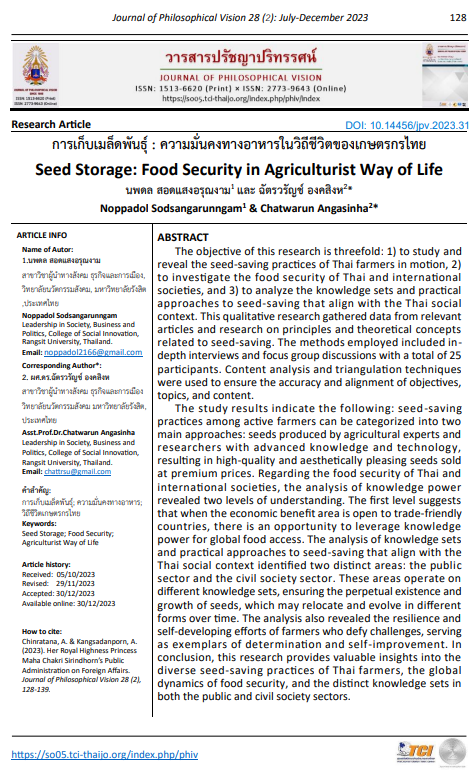
The objective of this research is threefold: 1) to study and reveal the seed-saving practices of Thai farmers in motion, 2) to investigate the food security of Thai and international societies, and 3) to analyze the knowledge sets and practical approaches to seed-saving that align with the Thai social context. This qualitative research gathered data from relevant articles and research on principles and theoretical concepts related to seed-saving. The methods employed included in-depth interviews and focus group discussions with a total of 25 participants. Content analysis and triangulation techniques were used to ensure the accuracy and alignment of objectives, topics, and content.
The study results indicate the following: seed-saving practices among active farmers can be categorized into two main approaches: seeds produced by agricultural experts and researchers with advanced knowledge and technology, resulting in high-quality and aesthetically pleasing seeds sold at premium prices. Regarding the food security of Thai and international societies, the analysis of knowledge power revealed two levels of understanding. The first level suggests that when the economic benefit area is open to trade-friendly countries, there is an opportunity to leverage knowledge power for global food access. The analysis of knowledge sets and practical approaches to seed-saving that align with the Thai social context identified two distinct areas: the public sector and the civil society sector. These areas operate on different knowledge sets, ensuring the perpetual existence and growth of seeds, which may relocate and evolve in different forms over time. The analysis also revealed the resilience and self-developing efforts of farmers who defy challenges, serving as exemplars of determination and self-improvement. In conclusion, this research provides valuable insights into the diverse seed-saving practices of Thai farmers, the global dynamics of food security, and the distinct knowledge sets in both the public and civil society sectors.
Downloads
References
จตุรงค์ บุณยรัตนสุนทร และ กิติพัฒน์ นนทปัทมะดุล (2550) สวัสดิการพื้นฐาน : รากฐานความเป็นธรรมทาง
รายได้ของกลุ่มคนด้อยโอกาส. กรุงเทพฯ : สภาที่ปรึกษาเศรษฐกิจและสังคมแห่งชาติ.
วิรัลพัชร ประเสริฐศักดิ์ (2555). แนวคิดและคำนิยามของความมั่นคงทางอาหาร, สืบค้น: 18 สิงหาคม 2556,
จาก: http://www.polsci.tu.ac.th/fileupload/36/24.pdf)
วิรัลพัชร ประเสริฐศักดิ์ (2558) ความมั่นคงทางอาหาร:จากพัฒนาการเกษตรสู่เศรษฐกิจพอเพียง วารสาร
การเมืองการปกครอง. 5(2), 144-160.
วสวัตติ์ มานู (2560). ความมั่นคงทางอาหารและปัจจัยที่มีผลต่อความมั่นคงทางอาหารของประชาชน ต.นา
มะตูม อ.พนัสนิคม. จังหวัดชลบุรีสืบค้น: 18 สิงหาคม 2556, จาก: http://digital_collect.lib.
buu.ac.th/dcms/files/57920870.pdf
ศยามล เจริญรัตน์(2559). อนาคตของความมั่นคงทางอาหารในกลุ่มชาติพันธุ์กะเหรี่ยงในประเทศไทย: ความท้า
ทายของชุมชน. วารสารวิจัยสังคม, 39(1), 146-180.
Foucault, Michel. (1995). Discipline and Punish. Translated by Alan Sheridan. New York:
Vintage.
Foucault, Michel. (1984). Nietzsche, genealogy, history, The Foucault Reader, edited with
Introduction by Paul Rabinow. New York: Pantheon Books.
The Federal Ministry for Economic Cooperation and Development (BMZ) and ASEAN
Sustainable Agrifood Systems (ASEAN SAS). (2016). Blue Book 2016 EU-ASEAN:
Development Cooperation in 2015. Jl. Jakarta 10220 Indonesia
Downloads
Published
How to Cite
Issue
Section
License
Copyright (c) 2023 Journal of Philosophical Vision

This work is licensed under a Creative Commons Attribution-NonCommercial-NoDerivatives 4.0 International License.
บทความวิชาการและบทความวิจัย ในวารสารฉบับนี้ ถือเป็นความรับผิดชอบของผู้เขียนเท่านั้น
สงวนลิขสิทธิ์ตามพระราชบัญญัติลิขสิทธิ์



