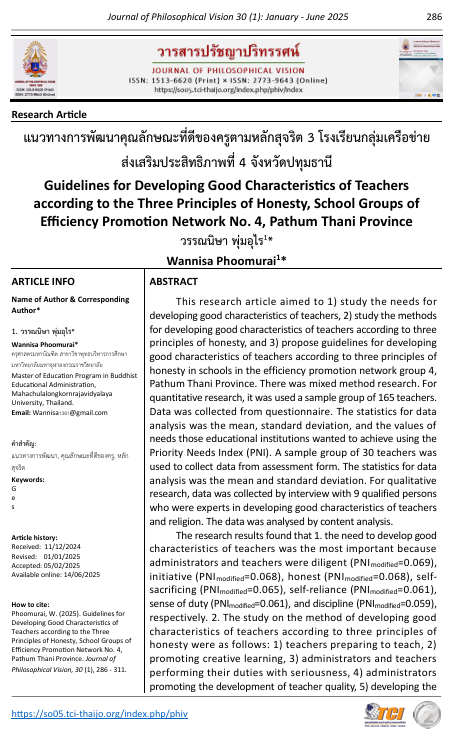
Guidelines for Developing Good Characteristics of Teachers according to the Three Principles of Honesty, School Groups of Efficiency Promotion Network No. 4, Pathum Thani Province
Keywords:
Development Guidelines, Good Characteristics of Teacher, Principles of HonestAbstract
This research article aimed to 1) study the needs for developing good characteristics of teachers, 2) study the methods for developing good characteristics of teachers according to three principles of honesty, and 3) propose guidelines for developing good characteristics of teachers according to three principles of honesty in schools in the efficiency promotion network group 4, Pathum Thani Province. There was mixed method research. For quantitative research, it was used a sample group of 165 teachers. Data was collected from questionnaire. The statistics for data analysis was the mean, standard deviation, and the values of needs those educational institutions wanted to achieve using the Priority Needs Index (PNI). A sample group of 30 teachers was used to collect data from assessment form. The statistics for data analysis was the mean and standard deviation. For qualitative research, data was collected by interview with 9 qualified persons who were experts in developing good characteristics of teachers and religion. The data was analysed by content analysis.
The research results found that 1. the need to develop good characteristics of teachers was the most important because administrators and teachers were diligent (PNImodified=0.069), initiative (PNImodified=0.068), honest (PNImodified=0.068), self-sacrificing (PNImodified=0.065), self-reliance (PNImodified=0.061), sense of duty (PNImodified=0.061), and discipline (PNImodified=0.059), respectively. 2. The study on the method of developing good characteristics of teachers according to three principles of honesty were as follows: 1) teachers preparing to teach, 2) promoting creative learning, 3) administrators and teachers performing their duties with seriousness, 4) administrators promoting the development of teacher quality, 5) developing the quality of education, 6) promoting participatory learning. 3. Propose guidelines for developing good characteristics of teachers according to three principles of honesty were as follows: 1) in terms of teaching preparation, 2) in terms of creative teaching preparation. 3) In terms of honesty towards the organization, 4) in terms of promoting participatory learning, 5) in terms of quality development, and 6) in terms of educational quality development.
Downloads
References
เกรียงศักดิ์ เจริญวงศ์ศักดิ์. (2546). การคิดและการตัดสินใจ. กรุงเทพฯ: มหาวิทยาลัยราชภัฏดุสิต.
ณัฐมน พันธุ์ชาตรี. (2559). การสร้างคุณลักษณะความเป็นครูของนักศึกษาคณะครุศาสตร์ มหาวิทยาลัยราชภัฏ. ดุษฎีนิพนธ์ปริญญาศึกษาศาสตรดุษฎีบัณฑิต มหาวิทยาลัยศิลปากร.
ดวงเดือน พันธุมนาวิน. (2538). ทฤษฎีต้นไม้จริยธรรม: การวิจัยและการพัฒนาบุคคล. กรุงเทพฯ: สถาบัณฑิตพัฒนบริหารศาสตร์.
ธานินทร์ ศิลป์จารุ. (2560). การวิจัยและการวิเคราะห์ข้อมูลทางสถิติด้วย SPSS และ AMOS, พิมพ์ครั้งที่ 17. กรุงเทพฯ: เอส.อาร์.พริ้นติ้ง แมสโปรดักส์.
นฤมล ทุมมี. (2566). แนวทางการบริหารความโปร่งใสตามหลักสุจริต 3 ของโรงเรียนขยายโอกาสสังกัดสำนักงานเขตพื้นที่การศึกษาประถมศึกษาปทุมธานีเขต 1. วิทยานิพนธ์ปริญญาครุศาสตรมหาบัณฑิต มหาวิทยาลัยมหาจุฬาลงกรณราชวิทยาลัย.
นวลศิริ เปาโรหิตย์. (2553). สอนลูกให้มีวินัยฝึกเด็กและวัยรุ่นอย่างไรให้ยอมรับและไม่ต่อต้านคุณ, พิมพ์ครั้งที่ 11. กรุงเทพฯ: บี มีเดีย.
พระพรหมคุณาภรณ์ (ป.อ. ปยุตฺโต). (2546). พจนานุกรมฉบับพุทธศาสตร์ ประมวลธรรม, พิมพ์ครั้งที่ 12. กรุงเทพฯ: โรงพิมพ์มหาวิทยาลัยมหาจุฬาลงกรณราชวิทยาลัย.
พระภาวนาวิริยคุณ (เผด็จ ทตฺตชีโว). (2547). คัมภีร์ปฏิรูปมนุษย์, พิมพ์ครั้งที่ 5. กรุงเทพฯ: ศิลป์การพิมพ์.
พีระศักดิ์ จันทร์สำราญ. (2542). ความต้องการพัฒนาคุณลักษณะของครูช่างอุตสาหกรรมเพื่อส่งเสริมการประกอบอาชีพอิสระในโรงเรียนมัธยมศึกษา สังกัดกรมสามัญศึกษาเขตการศึกษา 5. ปริญญานิพนธ์ปริญญาการศึกษามหาบัณฑิต มหาวิทยาลัยศรีนครินทรวิโรฒ.
มหาวิทยาลัยมหาจุฬาลงกรณราชวิทยาลัย. (2539). พระไตรปิฎกฉบับภาษาไทย ฉบับมหาจุฬาลงกรณราชวิทยาลัย. กรุงเทพฯ: โรงพิมพ์มหาจุฬาลงกรณราชวิทยาลัย.
สุพรรณี ไชยอำพร. (2542). การวิเคราะห์ทางสังคมเพื่อการพัฒนา: แนวความคิดและวิธีการ. กรุงเทพฯ: สถาบันบัณฑิตพัฒนบริหารศาสตร์.
สุวัฒน์ งามยิ่ง. (2547). คุณลักษณะที่ดีของครูอาจารย์ วิทยาลัยสารพัดช่างสังกัดสถาบันอาชีวศึกษาภาคกลาง 1 และภาคกลาง 5. สารนิพนธ์ปริญญาการศึกษาศาสตรมหาบัณฑิต มหาวิทยาลัยศรีนครินทรวิโรฒ.
เสาวนุช ศิริมาลัยรักษ์. (2560). ศึกษาความสำคัญของสุจริต 3 ต่อการปฏิบัติวิปัสสนาภาวนา. วิทยานิพนธ์ปริญญาพุทธศาสตรมหาบัณฑิต มหาวิทยาลัยมหาจุฬาลงกรณราชวิทยาลัย.
อรพิน นเรนร์สุทธิ์. (2535). คุณลักษณะครูคหกรรมที่พึงประสงค์สำหรับโรงเรียนมัธยมศึกษาในเขตกรุงเทพมหานคร. วิทยานิพนธ์ปริญญาศึกษาศาสตรมหาบัณฑิต มหาวิทยาลัยเกษตรศาสตร์.
Cornell, R. (1999). Paradigms for the New Millennium: How Professors Will Certainly Change! Educational Media International. 36 (2), 89-96.
Peine, J. (2007). The Educator's Professional Growth Plan: A Process for Developing Staff and Improving Instruction, 2nd ed. Thousand Oaks, CA: Corwin Press.
Downloads
Published
How to Cite
Issue
Section
License
Copyright (c) 2025 Journal of Philosophical Vision

This work is licensed under a Creative Commons Attribution-NonCommercial-NoDerivatives 4.0 International License.
บทความวิชาการและบทความวิจัย ในวารสารฉบับนี้ ถือเป็นความรับผิดชอบของผู้เขียนเท่านั้น
สงวนลิขสิทธิ์ตามพระราชบัญญัติลิขสิทธิ์



