Integrating the Principles of Meritorious Action in Human Development in the Current Social Context
Keywords:
Principles of meritorious action, ็human developmentAbstract
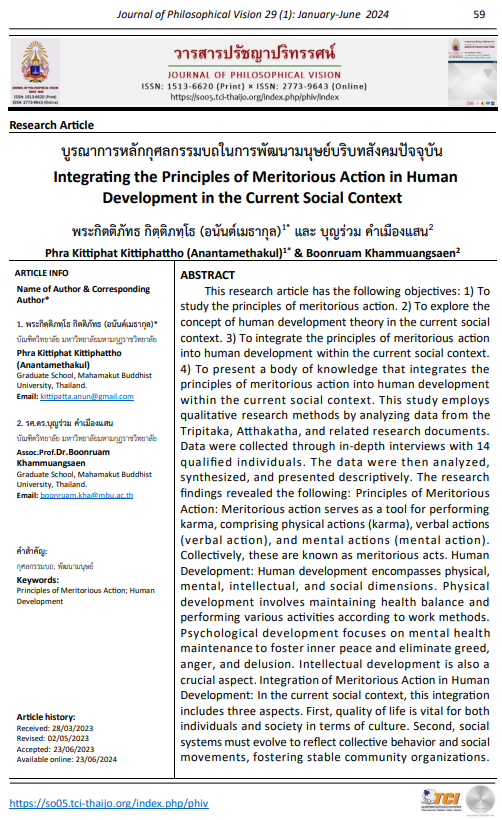
This research article has the following objectives: 1) To study the principles of meritorious action. 2) To explore the concept of human development theory in the current social context. 3) To integrate the principles of meritorious action into human development within the current social context. 4) To present a body of knowledge that integrates the principles of meritorious action into human development within the current social context. This study employs qualitative research methods by analyzing data from the Tripitaka, Atthakatha, and related research documents. Data were collected through in-depth interviews with 14 qualified individuals. The data were then analyzed, synthesized, and presented descriptively. The research findings revealed the following: Principles of Meritorious Action: Meritorious action serves as a tool for performing karma, comprising physical actions (karma), verbal actions (verbal action), and mental actions (mental action). Collectively, these are known as meritorious acts. Human Development: Human development encompasses physical, mental, intellectual, and social dimensions. Physical development involves maintaining health balance and performing various activities according to work methods. Psychological development focuses on mental health maintenance to foster inner peace and eliminate greed, anger, and delusion. Intellectual development is also a crucial aspect. Integration of Meritorious Action in Human Development: In the current social context, this integration includes three aspects. First, quality of life is vital for both individuals and society in terms of culture. Second, social systems must evolve to reflect collective behavior and social movements, fostering stable community organizations. Lastly, in terms of belief, Thai society is significantly influenced by materialism and consumerism, often leading to a misinterpretation of karma from Buddhist teachings, which suggests that good and evil inherent in karma are often misunderstood. Knowledge The body of knowledge gained from this research can be synthesized into what is called the "MAI MODEL.
Downloads
References
กรมการศาสนา. (2525). อังคุตตรนิกาย ปัญจก ฉักกนิบาต เล่ม 22. พระไตรปิฎกภาษาไทยฉบับหลวง. กรุงเทพฯ : โรงพิมพ์การศาสนา.
คณะกรรมการแผนกตำรามหาวิทยาลัยมหามกุฏราชวิทยาลัย. (2540). วิสุทฺธิมคฺคสฺส นาม ปกรณวิเสสสฺส ปโม ภาโค. พิมพ์ครั้งที่ 9. กรุงเทพฯ: โรงพิมพ์มหามกุฏราชวิทยาลัย.
จักรพันธ์ สุทธิธรรม. (2559). ศึกษาการรับผลกรรมในพุทธปรัชญาเถรวาทที่มีอิทธิพลต่อการดำเนินชีวิต. พุทธ มัคค์, 3(1), 19-25.
พรทิพย์ พฤทธ์กิตติวงศ์. (2563). การวิเคราะห์การกินเจด้วยหลักกรรมในพุทธปรัชญา. วิทยานิพนธ์หลักสูตรศาสนศาสตรมหาบัณฑิต สาขาวิชาพุทธศาสนาและปรัชญา บัณฑิตวิทยาลัย. มหาวิทยาลัยมหามกุฏราชวิทยาลัย.
พระธรรมปิฏก (ป.อ. ปยุตฺโต). (2536). พุทธศาสนากับการพัฒนามนุษย์. กรุงเทพฯ : บริษัท สหธรรมิ จำกัด.
พระธรรมปิฎก (ป.อ. ปยุตฺโต). (2540). ถึงเวลาพัฒนาคนกันใหม่. กรุงเทพ ฯ : โรงพิมพ์ธรรมสภา.
พระอธิการประมวล อธิปญฺโญ (จันทรประทักษ์) และคณะ. (2563). หลักกุศลกรรมบถ 10 กับการพัฒนาทรัพยากรมนุษย์. วารสารบัณฑิตศึกษามหาจุฬา, 7(3), 43.
วศิน อินทสระ. (2546). หลักกรรมและการเวียนว่ายตายเกิด. กรุงเทพมหานคร : เรือนธรรม
อรรถพล เปี่ยมปฐม. (2560). การศึกษาวิเคราะห์กุศลกรรมบถเพื่อพัฒนาชีวิต. วิทยานิพพนธ์มหาบัณฑิต. สาขาวิชาพระพุทธศาสนา. บัณฑิตวิทยาลัย. มหาวิทยาลัยมหาจุฬาลงกรณราชวิทยาลัย.
อำนาจ สงวนกลาง. (2558). การศึกษาวิเคราะห์ความเชื่อเรื่องกฎแห่งกรรมในพระพุทธศาสนาของนักศึกษาสาขาวิชาสังคมศึกษา. คณะมนุษยศาสตร์และสังคมศาสตร์ มหาวิทยาลัยราชภัฏลำปาง, คณะมนุษยศาสตร์และสังคมศาสตร์.
อัมพร หุตะสิทธิ์. (2546). ทรรศนะเรื่องกรรมในพระพุทธศาสนาเถรวาทและการให้ผลของกรรม. ศิลปศาสตรมหาบัญฑิต. มหาวิทยาลัยราชภัฏธนบุรี.
Downloads
Published
How to Cite
Issue
Section
License
Copyright (c) 2024 Journal of Philosophical Vision

This work is licensed under a Creative Commons Attribution-NonCommercial-NoDerivatives 4.0 International License.
บทความวิชาการและบทความวิจัย ในวารสารฉบับนี้ ถือเป็นความรับผิดชอบของผู้เขียนเท่านั้น
สงวนลิขสิทธิ์ตามพระราชบัญญัติลิขสิทธิ์



