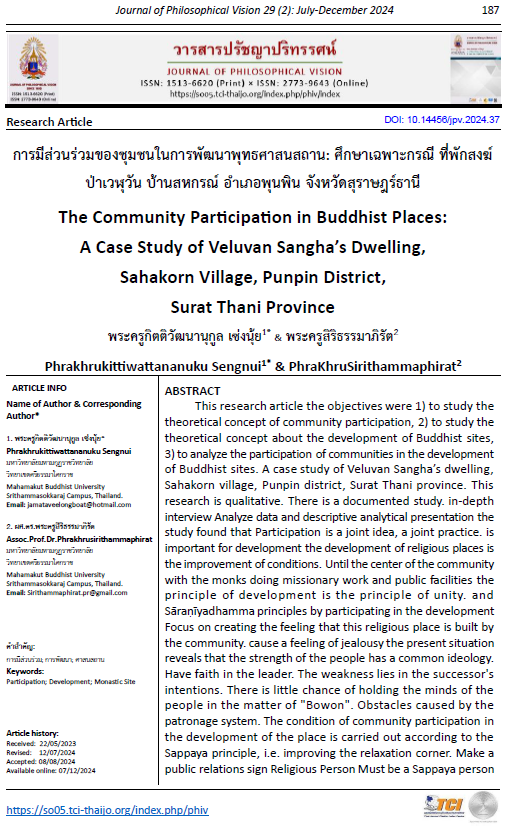
The Community Participation in Buddhist Places: A Case Study of Veluvan Sangha’s Dwelling, Sahakorn Village, Punpin District, Surat Thani Province
Keywords:
Participation; , Development; , Monastic SiteAbstract
This research article the objectives were 1) to study the theoretical concepts about community participation, 2) to study the theoretical concepts about the development of Buddhist sites, and 3) to analyze the community participation in the development of Buddhist sites at Weluwan Monastery Camp. Ban Sahakorn, Phun Phin District, Surat Thani Province This research is qualitative. There is a documented study. in-depth interview Analyze data and descriptive analytical presentation The study found that Participation is a joint idea, a joint practice. is important for development the development of religious places is the improvement of conditions. Until the center of the community with the monks doing missionary work and public facilities The principle of development is the principle of unity. and Sāraṇīyadhamma principles by participating in the development Focus on creating the feeling that This religious place is built by the community. cause a feeling of jealousy the present situation reveals that the strength of the people has a common ideology. Have faith in the leader. The weakness lies in the successor's intentions. There is little chance of holding the minds of the people in the matter of "Bowon". Obstacles caused by the patronage system. The condition of community participation in the development of the place is carried out according to the Sappaya principle, i.e. improving the relaxation corner. Make a public relations sign Religious Person Must be a Sappaya person interact with visitors Meepassa Sappaya is that there is a sweet talk showing that if developing a religious Place It should start from creating participation in the community, such as homes and schools, to help within religious places. When Bowon has already cooperated the development of religious places will be possible quickly.
Downloads
References
กองแผนงาน กรมศาสนา กระทรวงศึกษาธิการ. (2534). คู่มือประกอบคำบรรยายโครงการถวายความรู้แก่เจ้าอาวาส. กรุงเทพฯ: กรมการศาสนา กระทรวงศึกษาธิการ.
จิรกร กาญจนชัยรัตน์. (2548). นักเผยแผ่ศาสนาคริสต์นิกายโปรเตสแตนท์กับบทบาทในการขัดเกลาทางสังคม. ใน วิทยานิพนธ์ศิลปศาสตรมหาบัณฑิต, สาขาสังคมศาสตร์เพื่อการพัฒนา. มหาวิทยาลัยราชภัฏธนบุรี.
ประสาท สุขเกษม. (2542). บทบาทของพระภิกษุสงฆ์ในการขัดเกลาทางสังคมแก่เยาวชน: ศึกษากรณีค่ายคุณธรรมวัดอุโมงค์ จังหวัดเชียงใหม่. ใน วิทยานิพนธ์ศึกษาศาสตรมหาบัณฑิต, สาขาการศึกษานอกระบบ. มหาวิทยาลัยเชียงใหม่.
พระปลัดบุญมี คุณากโร. (2563). การศึกษาวิเคราะห์การใช้หลักสาราณียธรรมในการอยู่ร่วมกันอย่างสันติของชุมชนเทศบาลเมืองปาดังเบซาร์ จังหวัดสงขลา. วารสารมหาจุฬานาครทรรศน์, 7(4), 132-143.
ยุทธศาสตร์ชาติ พ.ศ. 2561–2580. (2561). ราชกิจจานุเบกษา, 31.
สำนักงานคณะกรรมการพัฒนาการเศรษฐกิจและสังคมแห่งชาติ. (2556). สัจธรรมแห่งแนวพระราชดำริ สู่การพัฒนาอย่างยั่งยืน. กรุงเทพฯ: อัมรินทร์พริ้นติ้งแอนด์พับลิชชิ่ง.
สุภางค์ จันทวานิช. (2540). วิธีวิจัยเชิงคุณภาพ. กรุงเทพฯ: สำนักพิมพ์แห่งจุฬาลงกรณ์มหาวิทยาลัย.
วิทย์ วิศทเวทย์. (2550). พระพุทธศาสนา ม.6. กรุงเทพฯ: อักษรเจริญทัศน์.
Downloads
Published
How to Cite
Issue
Section
License
Copyright (c) 2024 Journal of Philosophical Vision

This work is licensed under a Creative Commons Attribution-NonCommercial-NoDerivatives 4.0 International License.
บทความวิชาการและบทความวิจัย ในวารสารฉบับนี้ ถือเป็นความรับผิดชอบของผู้เขียนเท่านั้น
สงวนลิขสิทธิ์ตามพระราชบัญญัติลิขสิทธิ์



