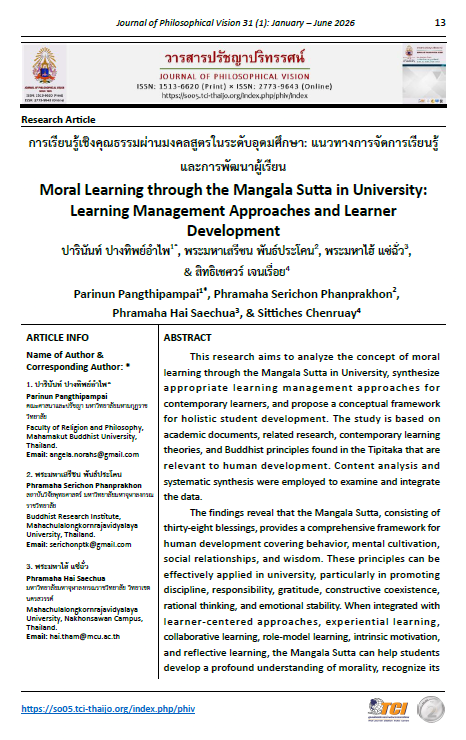
Moral Learning through the Mangala Sutta in University: Learning Management Approaches and Learner Development
Keywords:
Mangala Sutta, University, Tipitaka, Learner DevelopmentAbstract
This research aims to analyze the concept of moral learning through the Mangala Sutta in University, synthesize appropriate learning management approaches for contemporary learners, and propose a conceptual framework for holistic student development. The study is based on academic documents, related research, contemporary learning theories, and Buddhist principles found in the Tipitaka that are relevant to human development. Content analysis and systematic synthesis were employed to examine and integrate the data.
The findings reveal that the Mangala Sutta, consisting of thirty-eight blessings, provides a comprehensive framework for human development covering behavior, mental cultivation, social relationships, and wisdom. These principles can be effectively applied in university, particularly in promoting discipline, responsibility, gratitude, constructive coexistence, rational thinking, and emotional stability. When integrated with learner-centered approaches, experiential learning, collaborative learning, role-model learning, intrinsic motivation, and reflective learning, the Mangala Sutta can help students develop a profound understanding of morality, recognize its relevance to real life, and continuously improve themselves in academic, professional, and personal contexts. Furthermore, this article proposes the MANGALA MORAL LEARNING concept, which consists of Meaning, Action, Network, Guidance, Awareness, and Learning and Reflection, as a framework for designing moral learning activities in higher education. This supports the development of graduates who possess both academic competence and ethical integrity, demonstrate public responsibility, adapt effectively to rapid global changes, and maintain balanced and sustainable lives. Therefore, integrating Buddhist moral principles with modern educational practices can serve as an important pathway for producing quality graduates who are intellectually capable, socially responsible, and morally grounded in the twenty-first century.
Downloads
References
กรภัทร์ กัลยาบุตรและมานิตย์ อรรคชาติ. (2568). การคบบัณฑิตกับการพัฒนาตนเอง. วารสารพัฒนศึกษาศาสตร์, 1(1), 26-35.
กิตติศักดิ์ กิตฺติวฑฺฒโน. (2023). การพัฒนาคุณภาพชีวิตตามหลักมงคลสูตรเชิงพุทธบูรณาการ. วารสาร มจร บาฬีศึกษาพุทธโฆสปริทรรศน์, 9(2), 103–119..
พระไตรปิฎกภาษาไทย เล่ม 25. (2539). ขุททกนิกาย ขุททกปาฐะ. กรุงเทพฯ: มหาจุฬาลงกรณราชวิทยาลัย.
สุนทร สุขทรัพย์ทวีผลและคณะ. (2561). การศึกษาวิเคราะห์แนวคิดและการพัฒนาตนเองตามหลักมงคลสูตร
ที่ปรากฏในสุภาษิตพระร่วง. วารสารวิทยาลัยสงฆ์นครลำปาง, 7(1), 223–231.
อนุชา โสมาบุตร. (2013). ทฤษฎีคอนสตรัคติวิสต์ (Constructivist Theory). สืบค้นเมื่อ 8 พฤษภาคม,
, จาก https://teacherweekly.wordpress.com/2013/09/25/constructivist-theory/
Ignelzi, M. (2000). Meaning-making in the learning and teaching process. New Directions for Teaching and Learning, 2000(82), 5–14.
Kolb, A. Y., & Kolb, D. A. (2009). Experiential learning theory: A dynamic, holistic approach
to management learning, education and development. The SAGE handbook of management learning, education and development, 42, 68.
Piaget, J. (1972). The psychology of the child. Basic Books.
Vygotsky, L. S. (1978). Mind in society: The development of higher psychological processes. Harvard University Press.
Downloads
Published
How to Cite
Issue
Section
License
Copyright (c) 2026 Journal of Philosophical Vision

This work is licensed under a Creative Commons Attribution-NonCommercial-NoDerivatives 4.0 International License.
บทความวิชาการและบทความวิจัย ในวารสารฉบับนี้ ถือเป็นความรับผิดชอบของผู้เขียนเท่านั้น
สงวนลิขสิทธิ์ตามพระราชบัญญัติลิขสิทธิ์



