
Solving Life Problems according to Anussati in Buddhism
Keywords:
Life Problem Solution; , Anussati 10; , BuddhismAbstract
Abstract
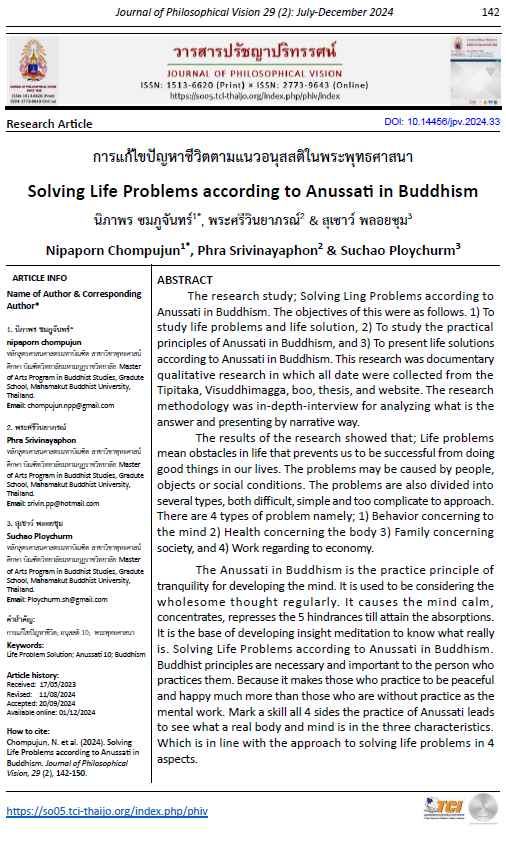
The research study; Solving Ling Problems according to Anussati in Buddhism. The objectives of this were as follows. 1) To study life problems and life solution, 2) To study the practical principles of Anussati in Buddhism, and 3) To present life solutions according to Anussati in Buddhism. This research was documentary qualitative research in which all date were collected from the Tipitaka, Visuddhimagga, boo, thesis, and website. The research methodology was in-depth-interview for analyzing what is the answer and presenting by narrative way.
The results of the research showed that; Life problems mean obstacles in life that prevents us to be successful from doing good things in our lives. The problems may be caused by people, objects or social conditions. The problems are also divided into several types, both difficult, simple and too complicate to approach. There are 4 types of problem namely; 1) Behavior concerning to the mind 2) Health concerning the body 3) Family concerning society, and 4) Work regarding to economy.
The Anussati in Buddhism is the practice principle of tranquility for developing the mind. It is used to be considering the wholesome thought regularly. It causes the mind calm, concentrates, represses the 5 hindrances till attain the absorptions. It is the base of developing insight meditation to know what really is.
Solving Life Problems according to Anussati in Buddhism. Buddhist principles are necessary and important to the person who practices them. Because it makes those who practice to be peaceful and happy much more than those who are without practice as the mental work. Mark a skill all 4 sides the practice of Anussati leads to see what a real body and mind is in the three characteristics. Which is in line with the approach to solving life problems in 4 aspects.
Keyword: 1. Life Problem Solution, 2. Anussati 10, 3. Buddhism
Downloads
References
จิตศริณย์พร ปัญจวัฒนคุณ. (2563). การดำเนินชีวิตในศตวรรษที่ 21 ด้วยหลักพุทธสุนทรีย์ศาสตร์. ดุษฎีนิพนธ์ปริญญาศาสนศาสตรดุษฎีบัณฑิต มหาวิทยาลัยมหามกุฏราชวิทยาลัย.
ชำนาญ วงศ์รัศมีเดือน. (2561). การจัดการพฤติกรรมมนุษย์ตามแนวจริตในพระพุทธศาสนา. ดุษฎีนิพนธ์ปริญญาศาสนศาสตรดุษฎีบัณฑิต มหาวิทยาลัยมหามกุฏราชวิทยาลัย.
ประกาศิต ประกอบผล. (2560). การพัฒนาคุณภาพจิตตามแนววิปัสสนากรรมฐาน. วารสารวไลยอลงกรณ์ปริทัศน์ (มนุษย์ศาสตร์และสังคมศาสตร์). 7 (3), กันยายน-ธันวาคม : 3
ปิยวรรณ สง่าจิต. (2562). กระบวนการเสริมสร้างทักษะชีวิตแนวพุทธ. วิทยานิพนธ์ปริญญาศาสนศาสตรมหาบัณฑิต มหาวิทยาลัยมหามกุฏราชวิทยาลัย.
พระนิวัฒน์ มหาโชติวฑฺฒโน (วันณา). (2564). โปรแกรมออนไลน์เพื่อเสริมพลังทักษะการแก้ปัญหาของนักเรียน โดยหลักการทางทฤษฎีและหลักคำสอนทางพระพุทธศาสนา ในสถานศึกษาเอกชน สังกัดสำนักงานคณะกรรมการส่งเสริมการศึกษาเอกชน. ดุษฎีนิพนธ์ปริญญาศึกษาศาสตรดุษฎีบัณฑิต มหาวิทยาลัยมหามกุฏราชวิทยาลัย.
พระมหาธีรพันธ์ ธีรกิตฺติ (ปัญญาเหล็ก). (2560). ศึกษาเปรียบเทียบคำสอนเรื่องอนุสสติกรรมฐานในคัมภีร์วิสุทธิมรรคกับคัมภีร์กัมมัฏฐานรอม. วิทยานิพนธ์ปริญญาพุทธศาสตรมหาบัณฑิต มหาวิทยาลัยมหาจุฬาลงกรณราชวิทยาลัย.
เรืออากาศเอกหญิง ณทมนรัศน์ ธนัทพรห์มภร. (2558). การศึกษาวิเคราะห์การพัฒนาจิตโดยการเจริญอนุสสติในมหานามสูตร. วิทยานิพนธ์ปริญญาพุทธศาสตรมหาบัณฑิต มหาวิทยาลัยมหาจุฬาลงกรณราชวิทยาลัย.
สมเด็จพระพุฒาจารย์ (อาจ อาสภมหาเถร). (2551). คัมภีร์วิสุทธิมรรค. กรุงเทพมหานคร: บริษัท ธนาเพรส จำกัด.
สุภเชษฐ์ จงธนากร. (2565). โอวาทปาติโมกข์ : การเสริมสร้างโครงข่ายดุลยภาพชีวิต. ดุษฎีนิพนธ์ปริญญาศาสนศาสตรดุษฎีบัณฑิต มหาวิทยาลัยมหามกุฏราชวิทยาลัย.
Downloads
Published
How to Cite
Issue
Section
License
Copyright (c) 2024 Journal of Philosophical Vision

This work is licensed under a Creative Commons Attribution-NonCommercial-NoDerivatives 4.0 International License.
บทความวิชาการและบทความวิจัย ในวารสารฉบับนี้ ถือเป็นความรับผิดชอบของผู้เขียนเท่านั้น
สงวนลิขสิทธิ์ตามพระราชบัญญัติลิขสิทธิ์



