
An Analytical study of Ethics in Karaṇīyametta Sutta
Keywords:
Ethics, Karaṇīyametta SuttaAbstract
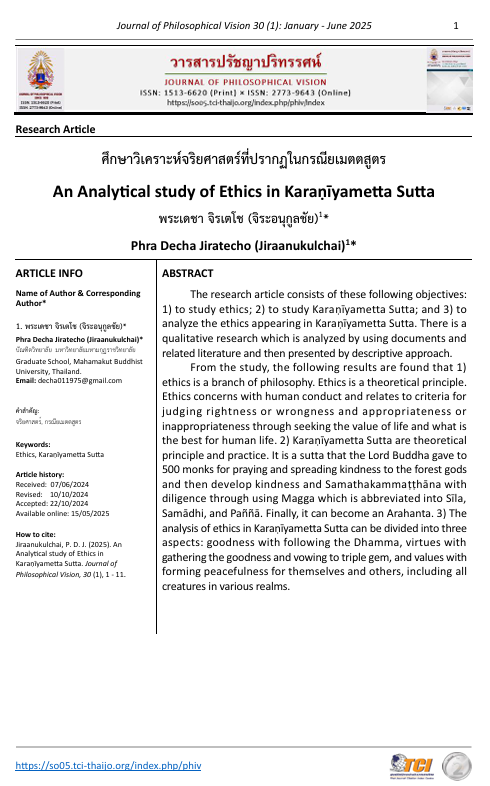
The research article consists of these following objectives: 1) to study ethics; 2) to study Karaṇīyametta Sutta; and 3) to analyze the ethics appearing in Karaṇīyametta Sutta. There is a qualitative research which is analyzed by using documents and related literature and then presented by descriptive approach.
From the study, the following results are found that 1) ethics is a branch of philosophy. Ethics is a theoretical principle. Ethics concerns with human conduct and relates to criteria for judging rightness or wrongness and appropriateness or inappropriateness through seeking the value of life and what is the best for human life. 2) Karaṇīyametta Sutta are theoretical principle and practice. It is a sutta that the Lord Buddha gave to 500 monks for praying and spreading kindness to the forest gods and then develop kindness and Samathakammaṭṭhāna with diligence through using Magga which is abbreviated into Sīla, Samādhi, and Paññā. Finally, it can become an Arahanta. 3) The analysis of ethics in Karaṇīyametta Sutta can be divided into three aspects: goodness with following the Dhamma, virtues with gathering the goodness and vowing to triple gem, and values with forming peacefulness for themselves and others, including all creatures in various realms.
Downloads
References
จำเริญรัตน์ เจือจันทร์. (2548). จริยศาสตร์: ทฤษฏีจริยธรรมสำหรับนักบริหารการศึกษา. กรุงเทพฯ: โอ.เอส. พริ้นติ้ง เฮ้าส์.
เชิดชัย เลิศจิตรเลขา. (2545). จริยศาสตร์เพื่อชีวิต. กรุงเทพฯ: วิทยาลัยเซนต์หลุยส์.
พระพรหมคุณาภรณ์ (ป.อ.ปยุตฺโต). (2550). สนทนาธรรม คติจตุคามรามเทพ. กรุงเทพฯ: สำนักงานพระพุทธศาสนาแห่งชาติ.
มหาวิทยาลัยมหาจุฬาลงกรณราชวิทยาลัย. (2539). พระไตรปิฎกภาษาไทย ฉบับมหาจุฬาลงกรณราชวิทยาลัย. กรุงเทพฯ: โรงพิมพ์มหาจุฬาลงกรณราชวิทยาลัย.
Aristotle. (2004). Nicomachean Ethics (R. Crisp, Trans.). Cambridge: Cambridge University Press.
Barua, A. (2022). Buddhist Ethics in Contemporary Society: Applications and Implications. Milton Park: Routledge.
Chakrabarti, A. (2020). Ethics of Compassion in the Buddhist Tradition. London: Springer.
Collins, S. (1982). Selfless Persons: Imagery and Thought in Theravada Buddhism. Cambridge: Cambridge University Press.
Gethin, R. (1998). The Foundations of Buddhism. Oxford: Oxford University Press.
Harvey, P. (2000). An Introduction to Buddhist Ethics: Foundations, Values, and Issues. Cambridge: Cambridge University Press.
Keown, D. (1992). The Nature of Buddhist Ethics. London: Palgrave Macmillan.
Ladwig, P. and Schlieter, J. (2019). Buddhist Practice and Ethics: Religious and Moral Reflections. Oxford: Oxford University Press.
MacIntyre, A. (2007). After Virtue, 3rd ed. Notre Dame: University of Notre Dame Press.
Scherer, B. (2018). Buddhism in Action: Engaged Practice and Modern Society. London: Palgrave Macmillan.
Schroeder, J. (2019). Buddhist Ethics in the Modern World: A Guide to Practice and Reflection. New York: SUNY Press.
Downloads
Published
How to Cite
Issue
Section
License
Copyright (c) 2025 Journal of Philosophical Vision

This work is licensed under a Creative Commons Attribution-NonCommercial-NoDerivatives 4.0 International License.
บทความวิชาการและบทความวิจัย ในวารสารฉบับนี้ ถือเป็นความรับผิดชอบของผู้เขียนเท่านั้น
สงวนลิขสิทธิ์ตามพระราชบัญญัติลิขสิทธิ์



